Indonesia’s chip ambitions: A slow burn as it lags regional champs
Unlike Malaysia and Singapore, which boast well-established semiconductor industries, Indonesia has faced difficulties due to regulatory hurdles and a less favourable business environment

[JAKARTA] While Indonesia is strongly positioned in the automotive value chain, it has been much less successful in the semiconductor sector.
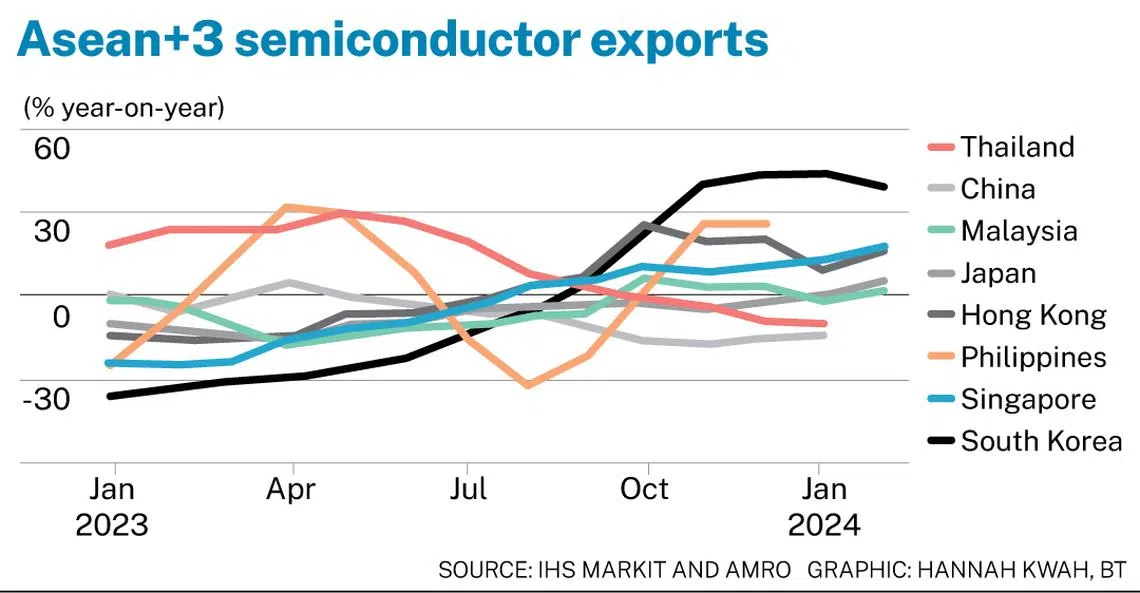
Despite possessing abundant essential semiconductor resources such as silica, nickel, tin, copper and gallium, South-east Asia’s largest economy is struggling to compete with regional powerhouses Malaysia and Singapore in carving out a niche in the booming chip sector.
The reasons behind Indonesia’s lag in this space are varied, including the lack of a comprehensive strategy, limited investor-friendly laws, a shortage of skilled workers, and insufficient infrastructure.
One could even say Indonesia has been running on the same spot for decades in pursuit of its semiconductor goals.
Professor Mudrajad Kuncoro, from economics and business Gadjah Mada University, said Indonesia has the potential to become a key semiconductor hub in the region due to its abundant silica sand resources.
“But without supporting policies and concrete investments, the industry will struggle to catch up with its more advanced neighbours,” he told The Business Times.
For the past two years, some ambitious plans have been laid out, one of which includes transforming Indonesia’s Rempang Island, near Batam, into a semiconductor hub as part of a Beijing-backed economic zone.
This project received a significant boost last year when Indonesian President Joko Widodo secured a US$11.5 billion investment from China’s Xinyi Glass Holdings. This investment aims to establish a silica sand processing plant on the island, paving the way for a sprawling 17,000-hectare Eco-City development.
However, the project is under scrutiny following protests last year about its anticipated impact on the island’s marine ecosystems, fisheries, and indigenous communities.
This marks another setback for Indonesia, whose semiconductor ambitions began in the early 1970s, when it hosted two major US multinational corporations, Fairchild Semiconductor and National Semiconductor. Both these pioneer investors later exited due to a lack of skilled labour, and relocated their operations to Malaysia.
Banking on diplomatic push
Coordinating Minister for Economic Affairs Airlangga Hartarto said Indonesia could move closer to realising its semiconductor ambitions by joining the Organisation for Economic Cooperation and Development (OECD), which has pledged to support the industry.
Indonesia is also leveraging stable diplomatic relations to garner support from both China and the United States.
Translating this support into substantial investments is crucial to elevate the country’s game in the chip sector, analysts have said.
President Widodo, during his visit to the White House last November, expressed Indonesia’s intention to invite the US to help develop its chip industry.
In March this year, Indonesia’s government established a task force in collaboration with the OECD and the US Department of State to accelerate the development of its chip industry, and conduct a comprehensive study of Indonesia’s semiconductor ecosystem.
During his visit to Jakarta in July, US Under Secretary of State for Economic Growth, Energy, and the Environment, Jose Fernandez, announced that Indonesia is among seven countries the US plans to support in becoming a semiconductor hub.
While the US is still at the joint-study stage, China has already shown interest in producing chip components in Indonesia, including through the setting up of the silica sand processing plant on Rempang island.
The silica sand is a primary raw material used to produce purified silicon, a key component in semiconductor chips. Indonesia boasts abundant silica reserves, totalling 332 million tonnes, dispersed throughout the archipelago.
Indonesia’s nascent chipmaking facilities are not yet a big contributor to the country’s gross domestic product.
“We are still in the very early stages of developing a semiconductor ecosystem,” said Priyadi Arie Nugroho, director of electronics and telematics at the Ministry of Industry. “Therefore, it cannot yet be compared to Malaysia and Singapore, which have a much longer history in this field.”
The Indonesian government has been actively courting investments and forming partnerships with global tech giants by offering tax incentives to position semiconductors as a key growth driver.
However, substantial investments and progress have yet to materialise.

Indonesia also aims to leverage its stable political relations with Taiwan and South Korea, the two largest chip-producing markets, to foster an environment conducive to attracting investors in the chip industry.
Indonesia has a rapidly developing electric vehicle (EV) industry, which could drive demand for semiconductors used in EVs and their components.
However, analysts note that Indonesia faces fierce regional competition to attract investment due to its underdeveloped chip manufacturing ecosystem.
Shortfalls from talent crunch to lack of R&D
Prof Kuncoro noted that semiconductor chip products have been classified as national strategic products since former president Susilo Bambang Yudhoyono’s administration.
For the past few years, Indonesia has outperformed many Asean peers in foreign direct investment attraction, but this has not translated into enhancing its human capital, crucial for sustainable development especially in the tech industry.
Indonesia ranks lowest among G20 countries in terms of research and development (R&D) and tertiary education spending, according to the World Bank.
Currently, Indonesia has only one chip company, Infineon Technologies Batam, which is majority owned by Germany-based chipmaker Infineon Technologies.
The company, established in 1996, is involved in backend semiconductor production processes such as chip testing, wafer sawing, and packaging in Batam. All products are then exported to overseas markets, including Singapore.
“From the development experience carried out by Infineon, Indonesia hopes to develop a broader semiconductor ecosystem from upstream to downstream,” said the Ministry of Industry’s Nugroho.
He said Indonesia is currently working to strengthen its semiconductor education and training programmes through both government and private initiatives.
In 2020, the government launched a semiconductor training centre at the country’s leading university, Bandung Institute of Technology, aiming to train more than 1,000 students per year in semiconductor design and manufacturing.
Polytron, an electronics manufacturer owned by brothers Michael and Robert Hartono, is partnering with IMEC, a Belgian technology company, to develop a chip-design training centre in Kudus, Central Java.
This initiative aims to support Polytron’s electric motorbike business.
“We are currently heavily dependent on imported chips, but we will eventually need to start manufacturing them ourselves one day,” said Joegianto, Polytron’s business development manager.
Imaduddin Abdullah, a researcher at the Institute for Development of Economic and Finance (Indef), emphasised that Indonesia must prioritise investment in R&D while also developing a skilled workforce capable of supporting advanced manufacturing activities.
“Semiconductors are a high-tech industry that demands a robust research and innovation ecosystem. It is essential to increase research funding so we can develop this industry,” said Abdullah.
Road map strategy
Indonesia has initiated the development of a road map to establish its silica industry, laying the groundwork for building a domestic chip industry.
Spearheaded by the Ministry of Industry, this roadmap is expected to be completed by the end of this year.
It will guide industrial development from 2025 to 2035, focusing on developing the capacity to produce silicon wafers domestically within this timeframe.
But Indef’s Abdullah said having plenty of silica resources alone does not translate into a strong competitive advantage, given that Indonesia is not the sole producing country.
Thus, the government cannot rely solely on this to attract investment.
“Without a strong research and innovation ecosystem, providing fiscal and non-fiscal incentives may not be effective in attracting investors to invest in semiconductors,” he said.