



Malaysia’s chip sector booms amid US-China tech clash
Recent US tariffs on Chinese imports have strengthened Malaysia’s longstanding role in the semiconductor industry, as multinationals shift production away from China

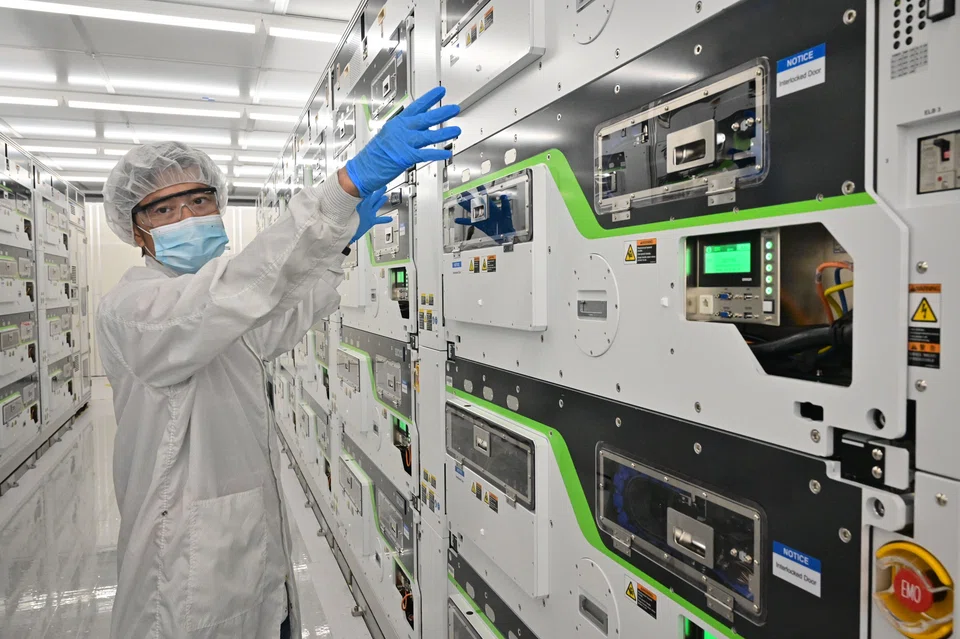
[KUALA LUMPUR] Malaysia, already a key player in the chip sector, supplies 13 per cent of the global demand for assembly, testing and packaging (ATP) services. It is quite possibly also the region’s biggest beneficiary of the supply chain shifts prompted by US-China tensions.
This South-east Asian nation is one of the world’s leading semiconductor hubs, standing alongside giants such as Taiwan, South Korea, Japan, the United States and China.
The recent US tariff hikes on Chinese imports, which have significantly disrupted global supply chains, have further solidified Malaysia’s long-established position in the sector.
Collins Chong, a foreign affairs, security and strategy analyst at Universiti Malaya, said Malaysia has become an attractive alternative as firms seek to hedge risks amid US sanctions on China’s chip industry. These sanctions restrict China’s access to high-end chips and critical components, including chips for artificial intelligence (AI).
“US and European firms are keen to diversify out of China, and Chinese firms are also relocating facilities to other countries to avoid the aftermath of US sanctions, adopting the ‘China-plus-one’ strategy,” he told The Business Times.
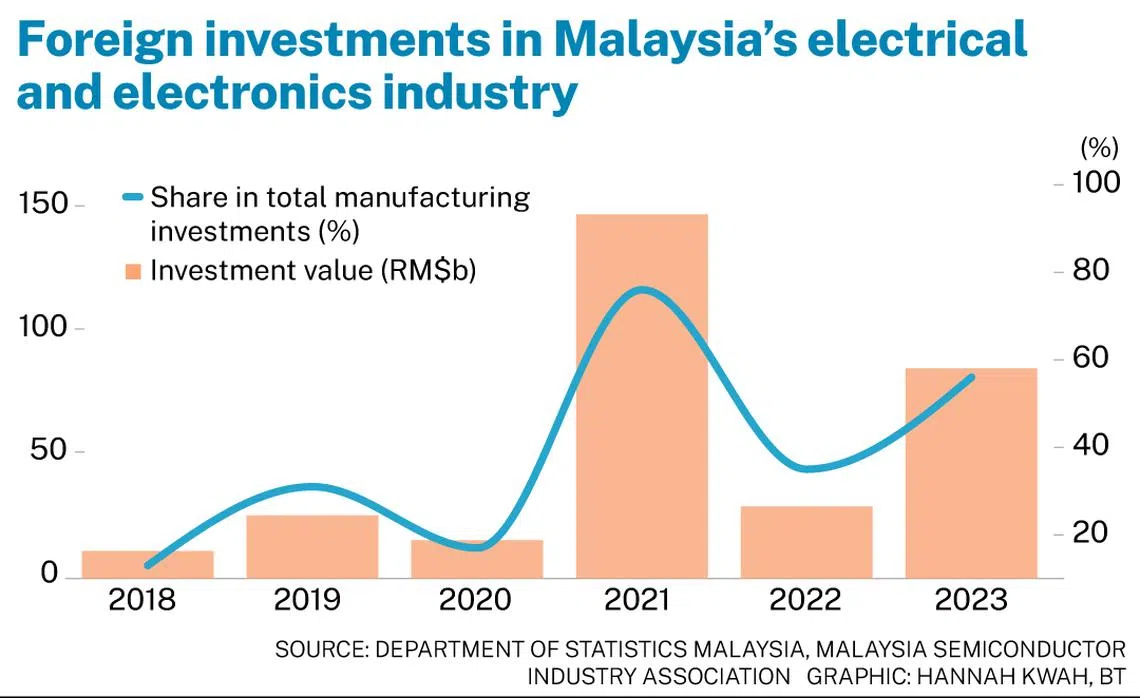
This shift has resulted in a significant surge in foreign direct investments (FDIs) into Malaysia, the world’s sixth-largest exporter of semiconductors. According to the Malaysian Investment Development Authority, approved FDIs into the country nearly quadrupled to RM188 billion (S$54 billion) between 2017 and 2023.
Penang, a thriving semiconductor hub in the country often referred to as the “Silicon Valley of the East”, attracted record-breaking FDIs of US$12.8 billion in 2023 – nearly a third of the country’s inbound FDIs that year.
In the past two years, Malaysia has attracted tech giants, raking in over US$15 billion in investments.
Geopolitical tensions over Taiwan’s semiconductor dominance have increased the focus on Malaysia, which packages 23 per cent of American chips, reinforcing its appeal as an alternative manufacturing hub, added Chong.
Lee Meng Horng, head of small-cap research at RHB Investment Bank, observed that some products or materials can get around the tariffs imposed on China by the US by switching operations to a neutral country such as Malaysia.
“This situation also opens doors for Malaysia-based companies, particularly in the automated test equipment sub-segment, as Chinese companies move away from US-based suppliers,” he said in a report.
There are plenty of factors working in favour of this South-east Asian open economy.
Wong Siew Hai, president of Malaysia Semiconductor Industry Association, cited Malaysia’s strong semiconductor ecosystem, supportive infrastructure and skilled workforce as key factors attracting companies in strategic sectors such as electric vehicles, batteries, solar cells and semiconductors.
“Additionally, the National Semiconductor Strategy (NSS) announced by the Malaysian government with an allocation of RM25 billion, will boost the interest of domestic direct investment and foreign direct investment,” he told BT.
Sweet prospects
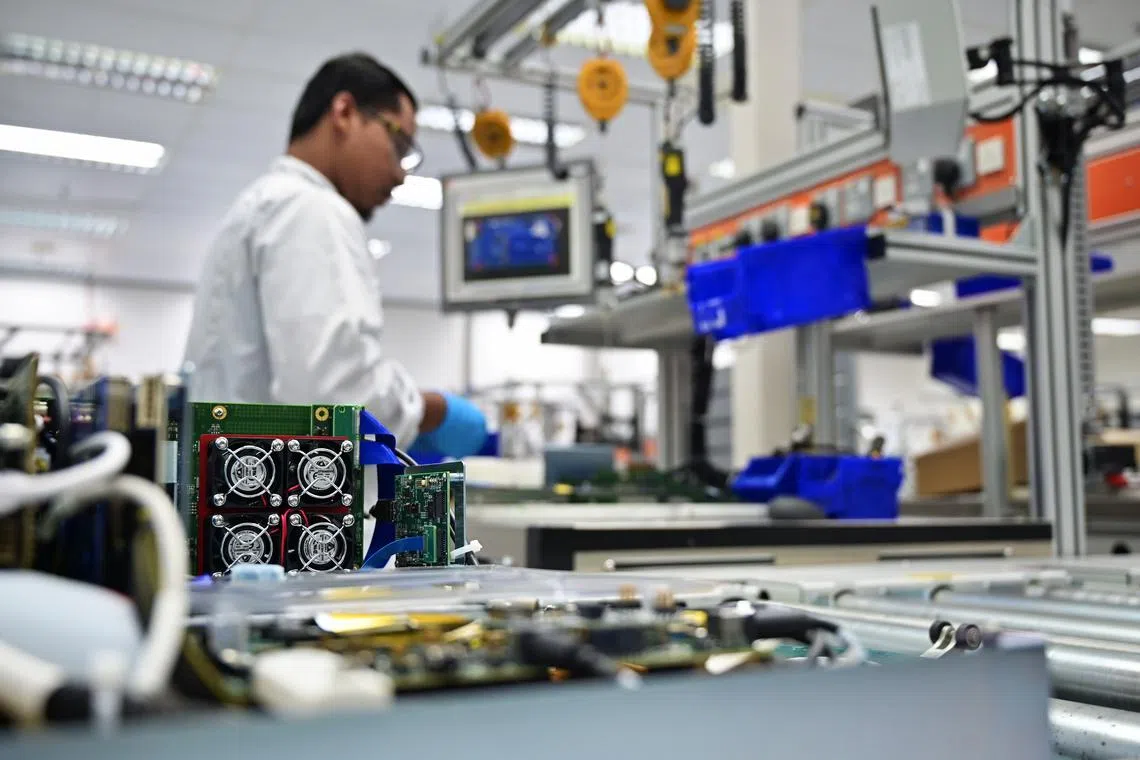
In late May, Malaysian Prime Minister Anwar Ibrahim unveiled the NSS, which aims to attract RM500 billion in investments, train 60,000 high-skilled Malaysian engineers, and establish at least 10 Malaysian companies in design and advanced packaging. The prize: revenues of at least RM1 billion.
Anwar’s announcement underscores Malaysia’s push to capture a larger share of the trillion-dollar semiconductor market and advance from back-end to more complex front-end activities, such as integrated circuit design, wafer fabrication and advanced packaging.
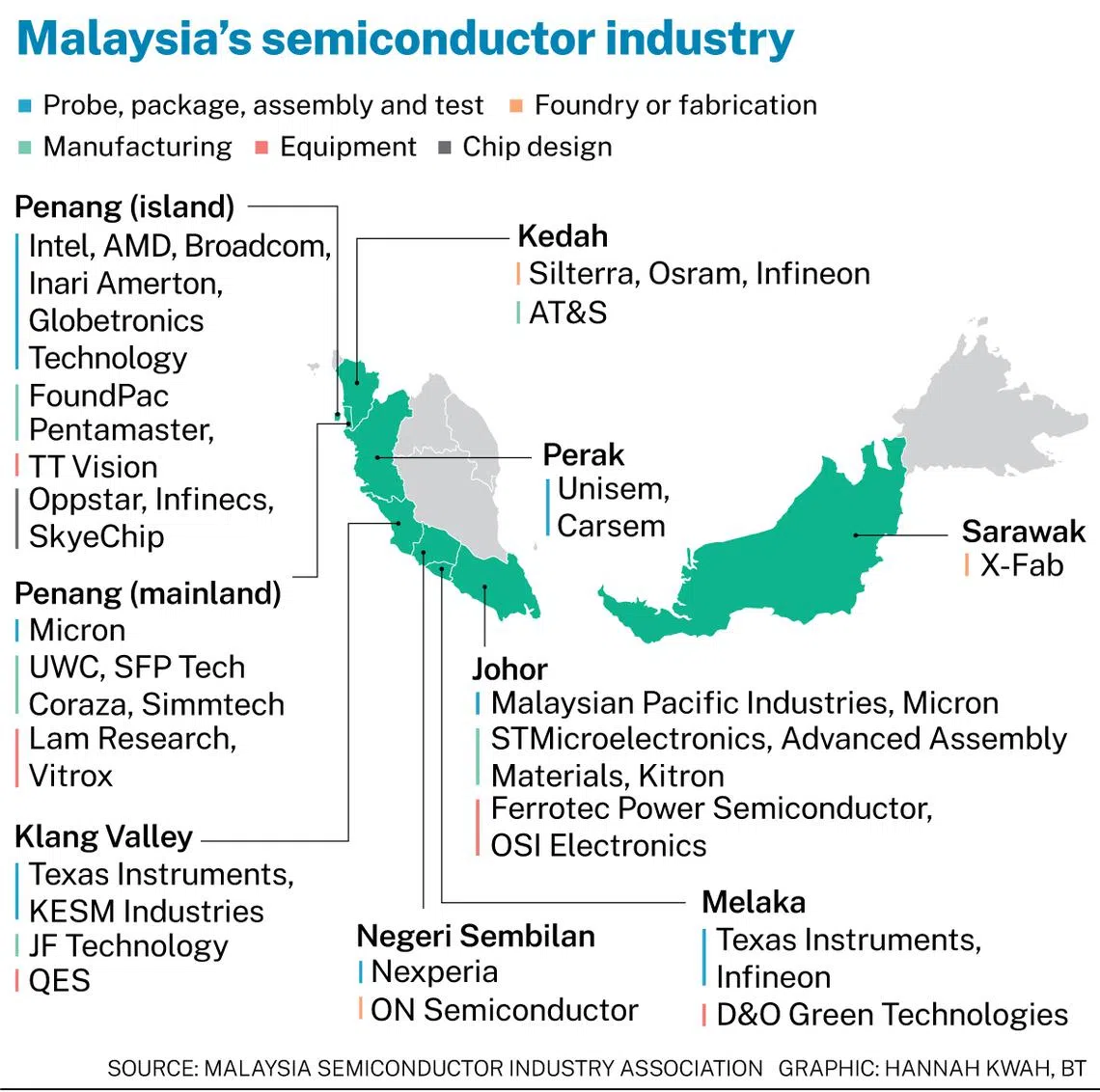
Major semiconductor firms and long-time investors in the country, namely Intel, Infineon and Texas Instruments, have ploughed billions of dollars into the country in recent years.
AK Chong, managing director of Intel Malaysia, cited Malaysia’s diverse talent pool, well-established infrastructure and robust supply chain as major drawing points.
The US-based tech giant picked Malaysia for its first international facility in 1972, making it one of the first major multinational tech companies to invest in and expand operations there.
Intel’s initial facility in Penang began as a five-acre (2 hectares) assembly plant with 100 workers; today, it employs more than 13,000 staff and sits on a 160-acre site.
Its operation, which started out merely assembling memory chips, is now engaged in ATP as well as product design, manufacturing, sales and marketing. Intel is now building a facility for advanced 3D chip packaging.
“Malaysia’s over-50-year investment in building the electrical and electronic sector is not easily duplicated,” said Chong, who is also Intel’s vice-president of foundry manufacturing and supply chain.
During the parliament session on Jun 17, Malaysia’s Investment, Trade and Industry Minister Tengku Zafrul Abdul Aziz emphasised Malaysia’s strong position in attracting high-value FDIs, particularly in AI. He also noted Malaysia’s 23rd place in a global ranking on Oxford Insights’ Government AI Readiness Index 2023, ahead of regional peers such as Thailand, Indonesia and Vietnam. Singapore is ranked second on that index.
According to research by Kearney, AI could contribute nearly US$1 trillion to South-east Asia’s gross domestic product by 2030, and that Malaysia could capture US$115 billion of that amount.
Much more work to do
With rising demand for consumer electronics such as personal computers and smartphones, coupled with the growing appetite for computing power led by AI and machine-learning developments, market observers expect to see more robust investment activities in Malaysia.
In a recent interview with radio station BFM, Semiconductor Industry Association CEO and president John Neuffer stated that the US Chips Act, expected to boost the development of the semiconductor industry in the US, will further catalyse global growth, benefiting South-east Asian countries in the process.
“Even if the manufacturing is shifting back to the US, the country may not be able to cope. Malaysia stands to benefit from the robust manufacturing activities, especially in the ATP segment, which is Malaysia’s forte,” he added.
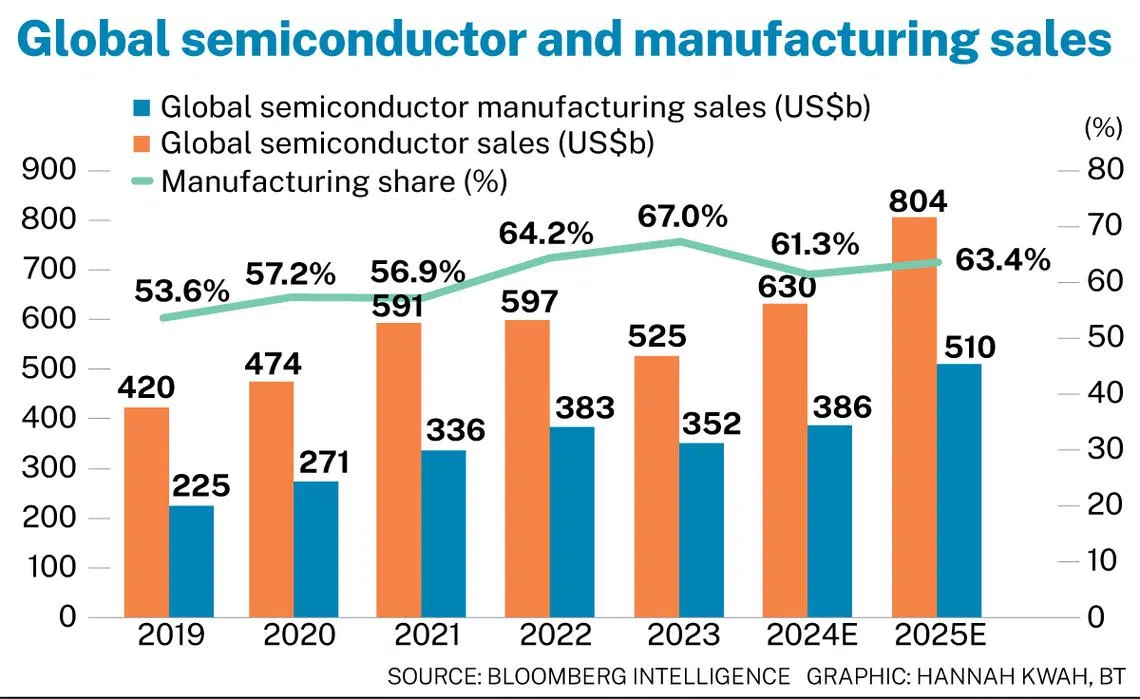
Bloomberg Intelligence forecasts global semiconductor manufacturing sales to grow 32 per cent from US$386 billion in 2024, to US$510 billion in 2027.
Wong concurred with Neuffer, but noted that the lack of talent owing to a brain drain may hinder Malaysia’s progress. “We are in a war for talent amid fierce competition. We are losing 15 to 20 per cent of talent to other countries. There’s an urgent need for the government to attract foreign talent or retain local high-skilled engineers for future developments.”
According to a survey released in 2023 by Malaysia Semiconductor Industry Association, the electrical and electronic sector in Malaysia employed around 590,000 individuals, representing about 4 per cent of the country’s workforce.
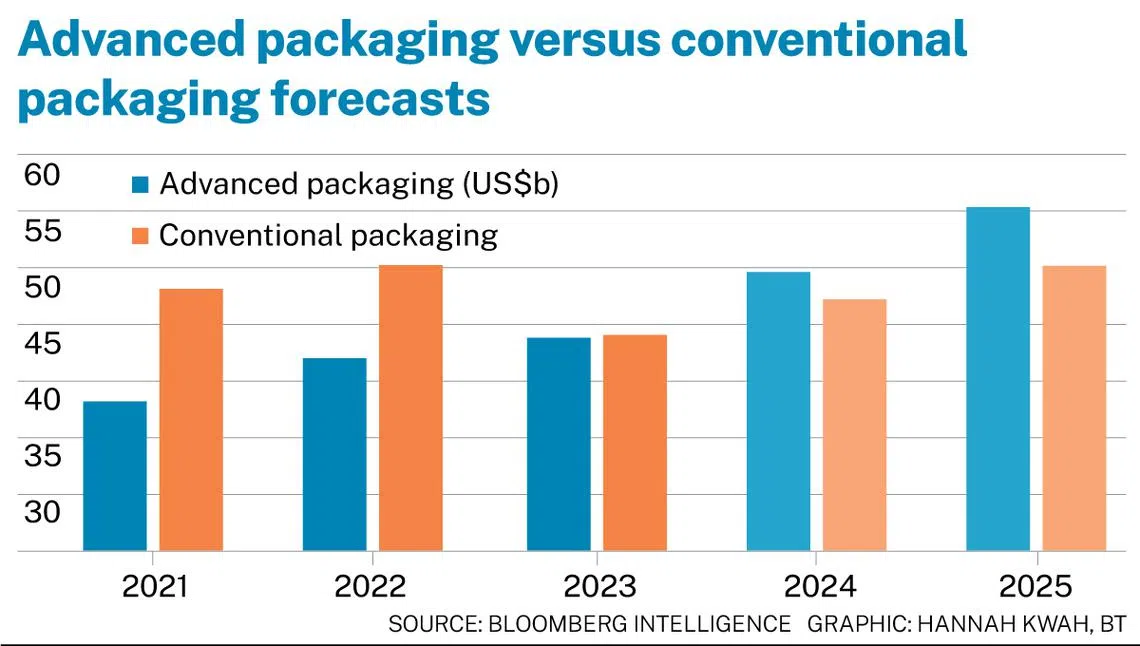
To be sure, Malaysia is well-positioned to capture a larger market share in the advanced-packaging segment, which is becoming increasingly crucial with the rise of AI.
However, Maybank Investment Bank analysts Jeremie Yap and Arvind Jayaratnam warn that companies in the outsourced semiconductor assembly and test (OSAT) sector that are slow to innovate may struggle to keep up with the rapid pace of technological advancements.
“Malaysian OSAT PLCs (public limited companies) may face structural headwinds if they do not quickly adapt to advanced packaging trends,” the pair said in a report.
TRENDING NOW

Britain’s mansion tax shows the difficulty of targeting wealth

Once staunchly pro-China, Malaysian Chinese businesses are now distancing themselves from Beijing

The only common thing in S-E Asia is that we all eat rice: Cisco’s Asean president

Singapore data centre operator DayOne opts for US IPO at likely US$20 billion valuation

