Thailand plays catch-up after a slow start in region’s chip race
Competition is tough as regional rivals jockey for top spot on the chipmaking racecourse – a key battlefield in the US-China trade war

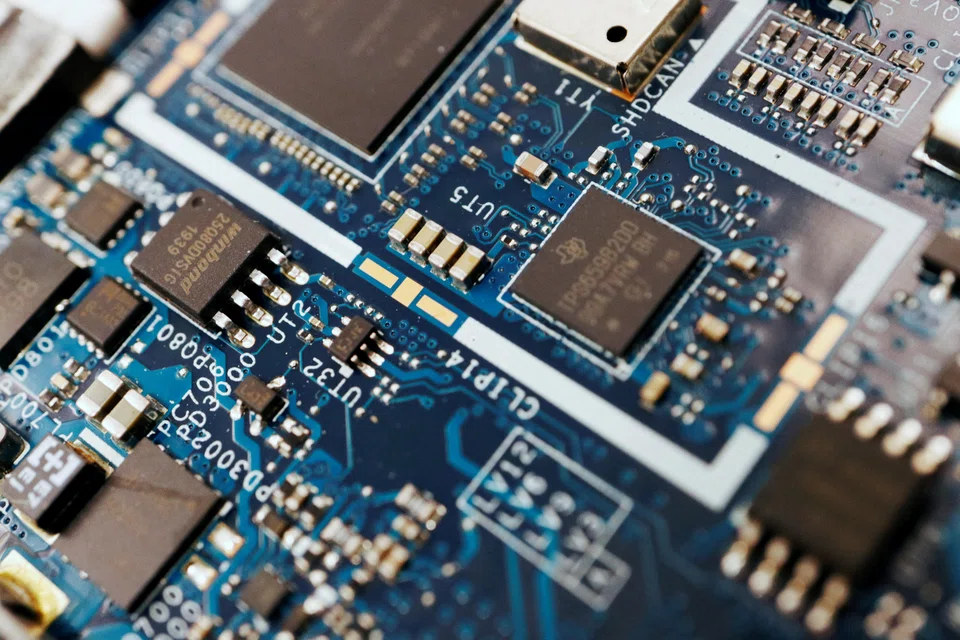
SEMICONDUCTORS are the shiniest toys in the playpen of the ongoing United States-China tech stand-off. But while the likes of Malaysia, Singapore, Vietnam and – to some extent – the Philippines are already pulling ahead, Thailand is well off the pace.
Historically, the kingdom’s role in the semiconductor industry has been limited to assembling and testing.
These are among the final steps in the semiconductor manufacturing process that are typically outsourced to low-cost locations such as Asean countries, said Oxford Economics’ lead economist Sunny Liu in a recent research note.
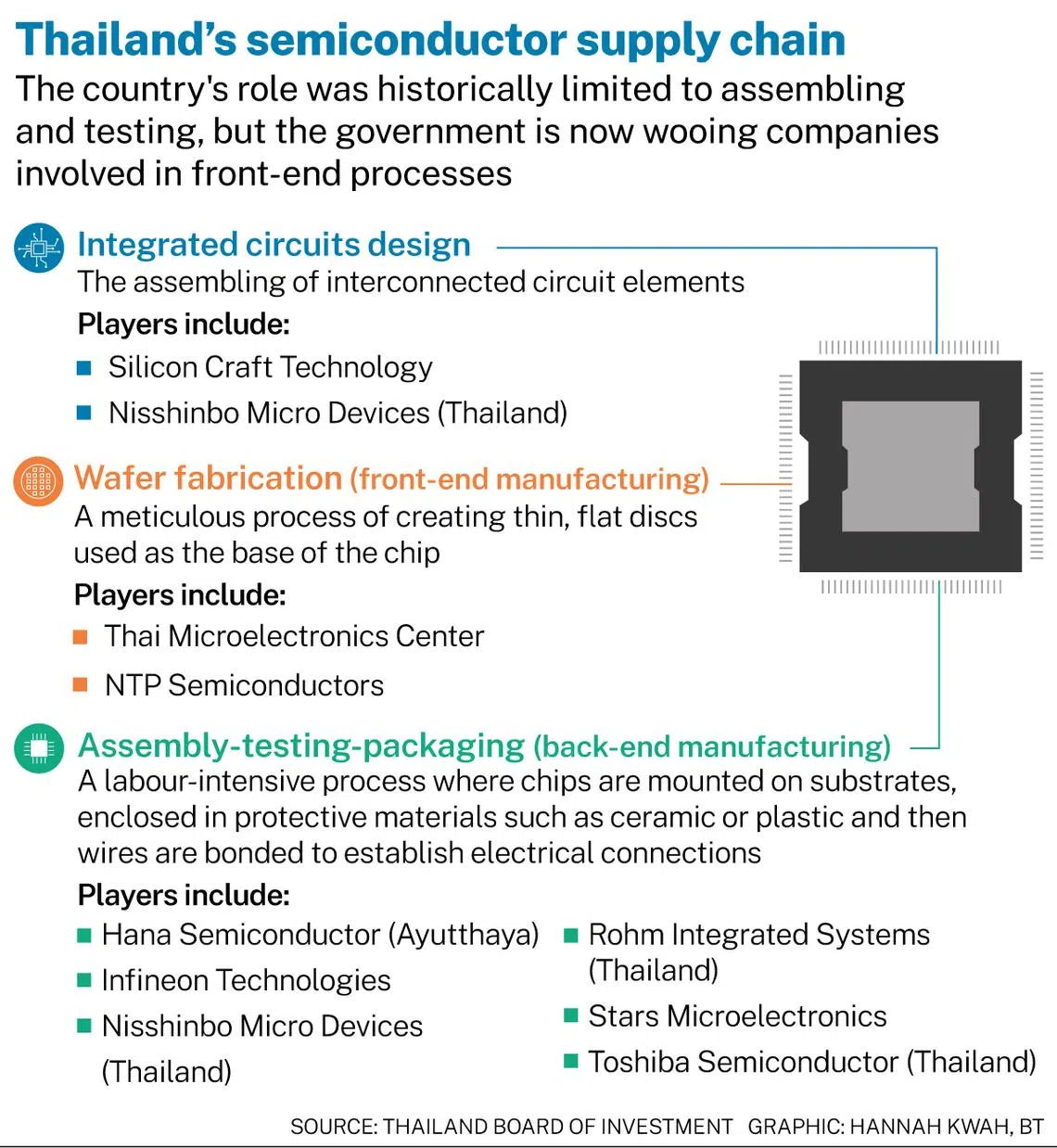
Companies in Thailand that have a presence across the entire semiconductor supply chain tend to be operated by global semiconductor players, such as those from the US or Japan, said senior economist Marthe Hinojales from the Asean+3 Macroeconomic Research Office (Amro).
“Local manufacturers, on the other hand, tend to operate in downstream activities such as packaging and assembly; and many are small and medium-sized enterprises that act as subcontractors,” she added.
When viewed as a collective entity, Asean stands as the world’s largest exporter of integrated circuits or chips – complex assemblies of electronic components built on semiconductor materials.
The region holds immense potential as a packaging and manufacturing centre that is largely shielded from geopolitical and overcapacity risks yet also able to take advantage of artificial intelligence-related chip demand, noted a Jun 25 report by HSBC Global Research on Asia semiconductors.
“In the long term, we expect certain Asean economies to draw greater investment from Chinese firms looking to go outward and avoid US restrictions, as well as non-Chinese firms seeking to diversify their supply chains away from China,” wrote Asia economist Justin Feng and chief Asia economist Frederic Neumann.
But Thailand – the second-largest economy in South-east Asia – trails behind its regional peers, accounting for only 1.5 per cent of the market share of global integrated circuit exports, indicated data from the Observatory of Economic Complexity.
Competition in the region is cut-throat.
Veteran players such as Singapore, Malaysia and the Philippines had their toes in the water since as early as the 1970s, and Vietnam in the early 2000s. While their initial forays started in the assembly-testing-packaging (ATP) phase, they have since been making moves upstream.
Noted Liu in her report titled How to Climb the Semiconductor Value Chain: “Among these countries, only Singapore has successfully transformed itself from being a location for ATP businesses to a tech and innovation hub for design and R&D enterprises, as well as fabrication.”
Malaysia – though not as successful globally – is also charting new frontiers in integrated circuit design and local wafer fabrication.
“Besides local leaders Singapore and Malaysia, Asean also has an established chip packaging economy in the Philippines and an industry emerger in Vietnam,” said the HSBC report.
Thailand, meanwhile, missed its chance to be integrated into the global semiconductor network despite igniting around the early 1990s, said visiting senior fellow Archanun Kohpaiboon of the Iseas-Yusof Ishak Institute.
“Given the nature of lumpy investment in front-end semiconductors, investment diversion away from China will likely be in locations where the industry has long developed – and Thailand is not one of them,” he explained.
Amro’s Hinojales agrees that Thailand belongs in a different league – at least for now.
Although Thai players are also engaged in downstream activities like Malaysia, many rely on the import of materials, design and technology, said the senior economist.
“Large skill gaps and high informality in Thailand also mean that the current workforce may not be able to meet the talent demands of global semiconductor manufacturers,” she pointed out. “Some investors may also find Vietnam more attractive, given its cheaper labour costs compared to Thailand.”
Plenty of sunshine
But it is not too late for Thailand to get a leg up, said observers.
For months now, the Thai government has been making strides in the semiconductor space and pushing for greater investment to catch up with regional peers.
Its efforts have been welcomed by the US, whose commerce secretary said in March that American businesses stand ready to “supercharge” investments into Thailand as the US looks to diversify semiconductor production.
Notably, a joint venture company was established in February by electronic manufacturing services company Hana Microelectronics and NewVersal, a subsidiary of state-controlled energy giant PTT, to study potential investments in the smart electronics industry.
Said Iseas’ Archanun: “Local firms regard the investment as the return of opportunities to join the global semiconductor industry in Thailand.” He added: “All efforts undertaken so far are to create a conducive investment climate for further investment in the future.”
Nurturing a conducive investment landscape relies heavily on fostering human capital, especially on the electrical engineering front, and many leading engineering faculties in Thailand have launched cooperative education schemes with private companies, he also noted.
Thailand’s burgeoning electric vehicle (EV) market also holds great promise for its semiconductor ambitions, said Archanun and Amro’s senior economist Hinojales.
Commented Hinojales: “Thai players must be able to find new areas of growth, while leveraging on existing areas of strength. A multi-stakeholder approach – including the government and the academe – would be crucial to identifying promising segments.”
Harnessing the potential synergy between the kingdom’s semiconductor capabilities and its growing reputation as an EV manufacturing hub could be a good example of this, she added.
Associate economist Eugene Tan of Moody’s Analytics maintained that although Thailand’s semiconductor production has been struggling, the sector’s long-term outlook remains bright.
He pointed out that the kingdom’s share of the global electronics circuit market is anticipated to increase to 10 per cent from 4 per cent currently, on the back of increased investments from the national Board of Investment.
Tan said that American companies are also eyeing Thailand for semiconductor production as they look to diversify their supply chain.
A cautionary note from the economist: Such a rosy outlook hinges on the kingdom’s ability to cultivate a sufficient talent pool for the industry and sustain its appeal to foreign investors over the long term.