Bursa Malaysia, HKEX unveil joint large-cap index as they seek to deepen market links
The index tracks 30 Malaysian blue chips and 30 Hong Kong-listed large-cap stocks

[KUALA LUMPUR] Bursa Malaysia and Hong Kong Exchanges and Clearing (HKEX) have launched a co-branded index – the HKEX Bursa Malaysia Large Cap Index, marking a fresh push to deepen capital market links and pave the way for cross-border products such as exchange-traded funds (ETFs).
The HKEX Bursa Malaysia Large Cap Index, unveiled on Friday (Mar 27), tracks 60 companies – 30 from each market – providing a single investable benchmark.
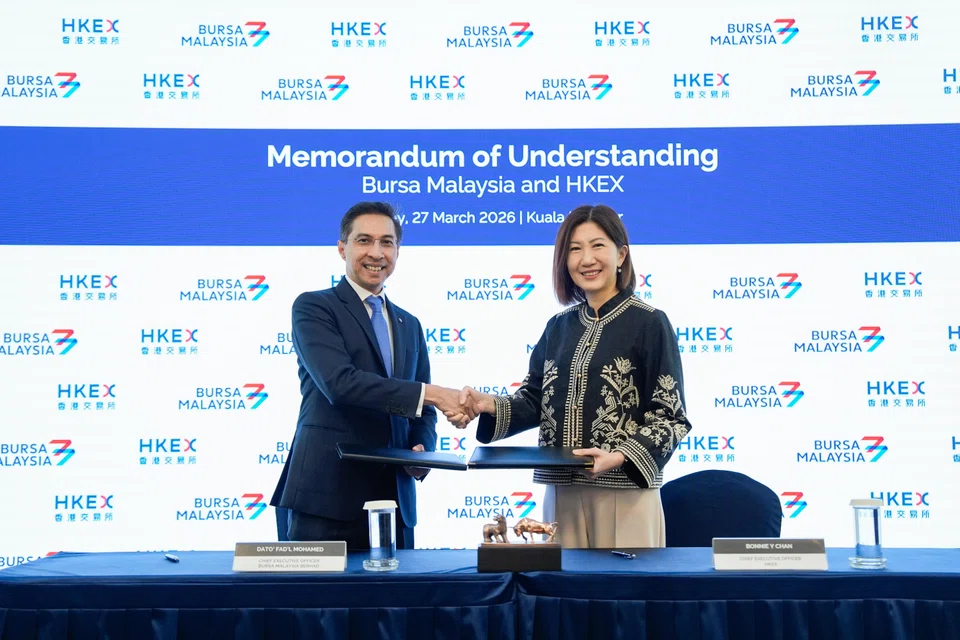
The launch coincided with the signing of a memorandum of understanding (MOU) between the two bourses to collaborate across five areas: facilitating dual listings, co-developing indices, expanding access to ETFs, enabling syariah-compliant securities, and exploring opportunities in carbon markets.
The MOU was signed by Bursa Malaysia CEO Fad’l Mohamed and HKEX CEO Bonnie Chan, as both exchanges step up efforts to deepen regional connectivity and attract global liquidity.
Fad’l said the partnership reflects the growing importance of internationalisation as capital flows rotate more dynamically across regions amid heightened volatility.
“This collaboration with HKEX aligns with our efforts to boost market vibrancy, expand opportunities for listed companies and investors, and enhance Malaysia’s connectivity and visibility within the global investment landscape,” he said.
He added that Malaysia’s strong domestic institutional base and leadership in Islamic capital markets position Bursa as a gateway for corporates and syariah-compliant investments seeking regional and global capital.
Chan said the tie-up forms part of HKEX’s strategy to deepen regional engagement and build a multi-asset ecosystem capable of attracting global liquidity.
“Malaysia sits at the heart of South-east Asia – one of the world’s fastest-growing regions – while HKEX offers unique access to opportunities on the Chinese mainland,” she said, adding that expanding engagement with the region remains a key priority.




Balanced exposure
The index comprises 30 Malaysian blue chips and 30 Hong Kong-listed large-cap stocks eligible for southbound trading, allowing investors from mainland China to participate.
Constituents are selected based on market capitalisation, liquidity and listing history, and the index adopts a free-float market capitalisation-weighted methodology.
It maintains a fixed geographic split of 62 per cent to Hong Kong stocks and 38 per cent to Malaysian stocks, with semi-annual reviews and quarterly rebalancing.
The initiative builds on Bursa Malaysia’s earlier cross-border index collaboration with the Shenzhen Stock Exchange in 2020, which was primarily aimed at raising the profile of listed companies.
Limited progress on SGX, HKEX, Bursa collaborations
HKEX and Bursa Malaysia have separately explored collaborations with the Singapore Exchange (SGX), but these discussions yielded no significant results.
SGX and HKEX signed an MOU in 2013 to promote renminbi internationalisation through joint products, data connectivity, technology collaboration and regulatory alignment.
More than a decade on, however, progress remains limited. It was reported that both exchanges operate as front-line regulators, creating potential conflicts of interest in cross-border supervision, listings and enforcement.
Their dual role as commercial operators and regulatory authorities complicates the sharing of oversight responsibilities across jurisdictions. Differences in legal frameworks, enforcement powers and approaches to investor protection further add to the challenge, particularly in handling disciplinary actions.
In February 2018, SGX and Bursa Malaysia announced a bilateral stock-market trading link for cross-border trading, clearing and settlement by the year-end, backed by the Monetary Authority of Singapore and Securities Commission Malaysia. The US$1.2 trillion initiative aimed to deepen Asean integration beyond the existing Asean Trading Link.
It stalled by June 2018 when Malaysia’s Pakatan Harapan government – after the 1MDB scandal – imposed fiscal austerity, shelving the project alongside the Kuala Lumpur-Singapore high-speed rail project. No progress followed as both exchanges pursued separate priorities.
SGX, meanwhile, has pursued partnerships with other exchanges, including the National Stock Exchange of India, Japan Exchange Group and the Stock Exchange of Thailand, as well as Nasdaq on technology and listings.
More recently, it has focused on derivatives-linked collaborations, such as MSCI index futures, to attract international investors.
However, these efforts have largely centred on specific products or trading links rather than deeper market integration or joint capital-raising platforms.
Decoding Asia newsletter: your guide to navigating Asia in a new global order. Sign up here to get Decoding Asia newsletter. Delivered to your inbox. Free.
Copyright SPH Media. All rights reserved.