



Catalonia president eyes Asean investors for infrastructure, healthcare, green tech
Salvador Illa describes the autonomous region in Spain as a safe bet for investing, working and living


[SINGAPORE] Catalonia – an autonomous community in north-eastern Spain hailed as one of the “four motors for Europe” – will be the right bet for investors in South-east Asia, said President Salvador Illa, who was on a week-long trip to the region in a first for a Catalan leader.
Illa, who took office in August 2024, made Vietnam and Singapore his first ports of call, and was in Singapore from Jul 29 to 31.
This is his third official trip to Asia in a year, following earlier visits to China, Japan and South Korea.
“There are big opportunities in infrastructure, the housing market, logistics and the chemicals industries,” he told The Business Times in an interview on Jul 30. “All that has relation with the health system is especially attractive for us… be it the pharmaceutical industry, education (or) technology,” he added.
The housing market is another space where investments are welcome, especially as the government looks to industrialise home construction and improve infrastructure – an area in which it intends to invest heavily, Illa noted. Other areas with potential for synergy include the green and digital economies, as well as tourism.
“Let me stress that we are interested in lasting relationships and lasting investment. We do not refuse any kind of investor, but we are not seeking short-term investments or quick gains,” Illa told BT. “If you want to invest and find a lasting relationship with fair benefit and a fair profit, Catalonia is the right place.”
Asia strategy in full swing
The Catalan president’s three-day stay in Singapore included a meeting with Prime Minister Lawrence Wong, during which both parties discussed mutual interests in strengthening cooperation in the digital and green economies.
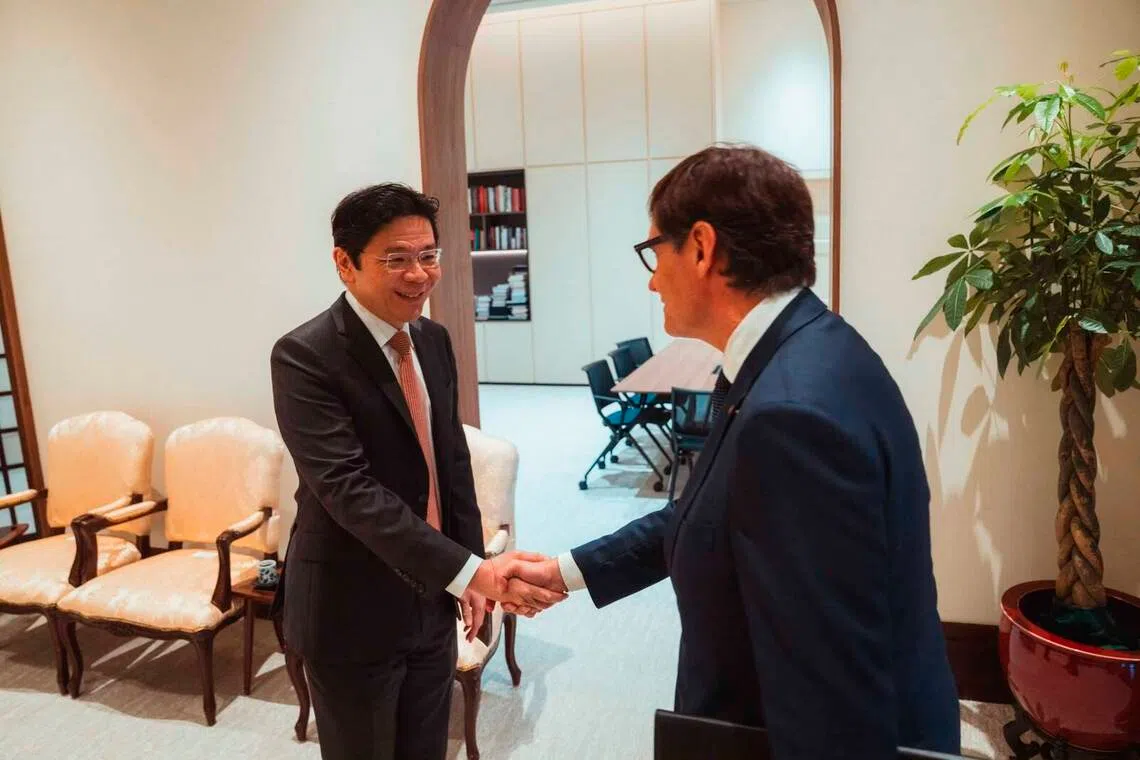
Illa also met European Union Ambassador to Singapore Artis Bertulis, Singapore Airlines chief executive Goh Choon Phong and the Catalan business community here.
There are some 48 Catalan companies established in Singapore, including global healthcare firm Grifols, bathroom and sanitary-ware designer and manufacturer Roca, pool and wellness solutions provider Fluidra, global seating manufacturer Figueras and electric cable manufacturer Top Cable.


Around 53 Singapore companies are active in Catalonia, such as Temasek-owned medical technology firm Advanced MedTech, global agribusiness group Wilmar International and cargo consolidation and sea freight forwarding service provider Globelink Group.
The Catalan president also delivered the keynote address at a dialogue organised by the Singapore Business Federation on Jul 30, before engaging in a question-and-answer session moderated by the business chamber council’s vice-chairman Yong Hsin Yue.

In his speech, Illa said: “We want to bring in companies from Singapore in the sectors that will define the next decade: artificial intelligence, semiconductors, health, the pharmaceutical industry, sustainable mobility and green hydrogen.”
He added that the trip allowed Catalonia to strengthen bonds, open up new opportunities and confirm a reality – that the future is being written in Asia.
Last November, the president announced Catalonia’s Asia Strategy – a road map for strengthening, diversifying and expanding its engagement in the region. The strategy will be rolled out as two action plans for the periods 2026 to 2028, and 2028 to 2030.
Singapore and Vietnam are two priority countries in South-east Asia that Catalonia identified, alongside Indonesia and the Philippines. The priority countries in East Asia are China, Japan and South Korea; the two in South Asia are India and Pakistan.
What’s in it for South-east Asia?
In 2025, Catalonia’s exports to Singapore amounted to some 343.1 million euros (US$395.4 million), or 37.1 per cent of Spain’s total exports to the Republic, indicated data provided by the Catalan government.
Around 480 Catalan companies export regularly to Singapore. Catalonia’s imports from Singapore amounted to 145.2 million euros, or 32.1 per cent of Spain’s total imports from the Republic.
Catalonia notched a fresh high in foreign investment inflows last year at more than 1.1 billion euros, and intends to grow the figure six times by 2030. Of the 101 foreign-investment projects secured in 2025, almost a third were greenfield investments that came from companies setting up there for the first time.
Illa described Catalonia as a safe bet for investing, working and living. He pointed out that its economic health is sound – Catalonia’s economy grew 2.7 per cent last year, well above the EU’s expansion of 1.5 per cent. It logged five consecutive years of productivity growth; and its labour market is charting historic employment figures, especially in skilled positions across high-value-added sectors.
Catalonia also lies in a strategic position that allows it to serve as a gateway to the rest of Europe and the Mediterranean, where its Port of Barcelona is one of the main logistics hubs, said the president.
He noted that a technological modernisation of its government is well underway, noting that building homes, setting up a business or promoting a new economic activity will be “quick and straightforward”.
Asked what success looks like to him when it comes to Catalonia’s ties with South-east Asia, Illa replied: “Trade and economic relations between countries take time to materialise. We are not in a hurry to have any specific result (by a certain time). What we want is to keep moving.”
He emphasised that sustainability is key, stressing: “People must be convinced when they decide to invest. What we want is to do things step by step, and in a sound and lasting way.”
Decoding Asia newsletter: your guide to navigating Asia in a new global order. Sign up here to get Decoding Asia newsletter. Delivered to your inbox. Free.
Copyright SPH Media. All rights reserved.
TRENDING NOW
Easy to rent out, hard to sell: Are buyers losing interest in Singapore’s one-bedroom condos?

GovTech retrenches another 38 staff in second round of layoffs

Stocks to watch: Seatrium, CapitaLand Investment, Keppel DC Reit, Suntec Reit, CLCT, TSH Resources

World’s largest offshore wind platform by Seatrium consortium on track to be completed by 2028

