



Challenges remain even as Thailand moves to open border amid pandemic: report
 Add BT as a preferred source
DeeperDive is a beta AI feature. Refer to full articles for the facts.
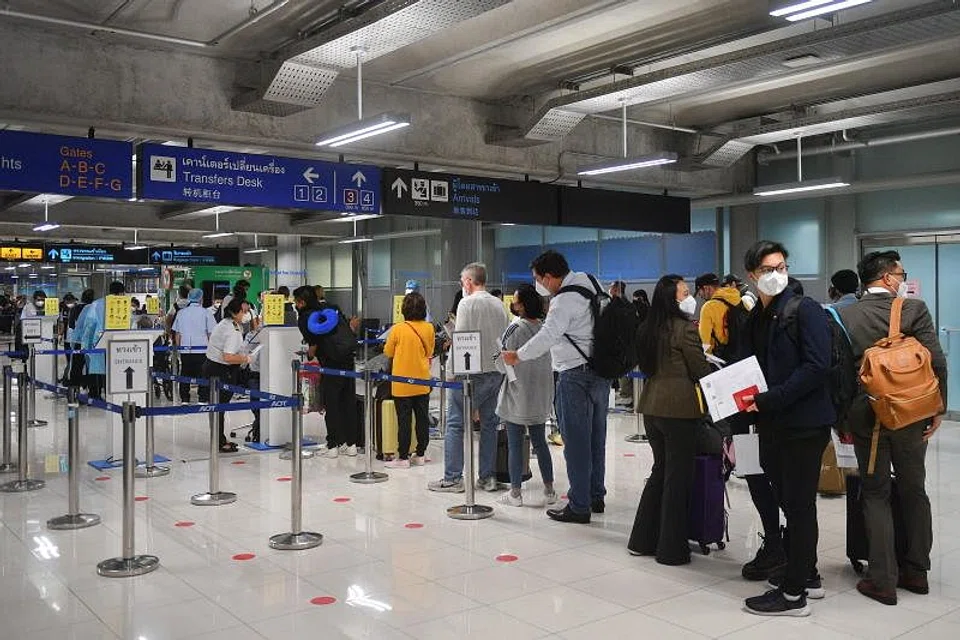
EVEN as Thailand gears up to welcome more international arrivals in November, challenges remain. The Phuket Sandbox programme, for instance, has seen limited success in attracting tourists to the kingdom, with the resort island seeing just 1 per cent of pre-pandemic arrival levels.
Meanwhile, the country has detected its first case of the infectious Delta-plus Covid variant in the northern province of Kamphaeng Phet early last week, which could place more strain on tourist arrivals should the locally transmitted cases accelerate again, noted UOB economist Barnabas Gan in a note.
"We believe that the economy in 2021 and 2022 will be dependent on further take-up of Covid-19 vaccinations, which in turn will support domestic spending, foreign tourist figures and consumer confidence," he said.
" We are comforted over the government's decision to open Thailand's borders to 46 countries starting Nov 1, although tangible positive economic spill over effects may only be seen in 2022, given Thailand's Covid-19 situation and low vaccination rates."
The nationwide vaccination rate stands at 42 per cent of the population as at end-October, up from 19 per cent in September.
Elsewhere, data on exports growth surprised on the upside while manufacturing production disappointed.
Navigate Asia in
a new global order
Get the insights delivered to your inbox.
Custom exports surged 17.1 per cent year on year in September 2021, beating market expectations of 11.8 per cent year-on-year growth and bringing trade balance to a surplus of US$610 million. Separately, manufacturing production contracted 1.3 per cent year on year in September. Thai authorities are keeping their manufacturing growth target at between 4 and 5 per cent for 2021 with year-to-date growth at 6.1 per cent.
On the inflation front, Thailand's consumer prices rose 1.7 per cent year on year in September, bucking the 0.2 per cent year-on-year deflation seen in August. The rise in consumer prices was due to higher oil prices as well as the absence of subsidies for water and electricity charges previously present.
Thailand's Trade Policy and Strategy Office pointed out that inflation may stay elevated if global oil prices continue to increase, and if no additional government subsidies are introduced to alleviate living costs.
"Coupled with the relatively positive economic outlook, benign inflation rates, and Covid-19-related risks, we think that the BOT is likely to keep its accommodative monetary policy stance for the rest of the year," said Gan.
"This means that the policy rate is expected to stay at 0.5 per cent for 2021, although an unexpected worsening of macroeconomic fundamentals could prompt a 25 basis point rate cut in Q4.
"Barring the exacerbation of Covid-19 risks, the improvement in economic outlook and higher inflation into 2022 could also support the start of rate normalisation by Q4 2022 with a 25 basis point hike then."
Decoding Asia newsletter: your guide to navigating Asia in a new global order. Sign up here to get Decoding Asia newsletter. Delivered to your inbox. Free.
Copyright SPH Media. All rights reserved.
TRENDING NOW

Air India asks Tata, Singapore Airlines for funds after US$2.4 billion loss

Beijing’s calculated silence on the Iran war

China pips the US if Asean is forced to choose, but analysts warn against reading it like a sports result

Richard Eu on how core values, customers keep Singapore’s TCM chain Eu Yan Sang relevant

