China to deepen economic ties with Asean, focusing on high-growth sectors
Amid escalating US-China trade tension, China boosts FDI into the bloc, targeting EVs, semiconductors and renewable energy


FOREIGN direct investment (FDI) flows from China to Asean have surged, particularly in high-growth sectors such as electric vehicles (EV), semiconductors and renewable energy.
This marks a sharp shift from the pre-2018 era – before US-China trade tensions – when investments were primarily concentrated in real estate and financial services.
This strategic pivot aligns with a broader trend of Chinese companies pushing to expand overseas, said Mark Greeven, professor of management innovation and dean of Asia at the Institute for Management Development (IMD).
Singapore, for instance, has witnessed a growing presence of Chinese food and beverage brands, a trend driven by the city-state’s cultural similarities and its large ethnic Chinese population, he noted.
China’s strategic reorientation has not only diversified the investment portfolio of the world’s second-largest economy in the region, but also solidified Asean’s position as China’s largest trading partner.
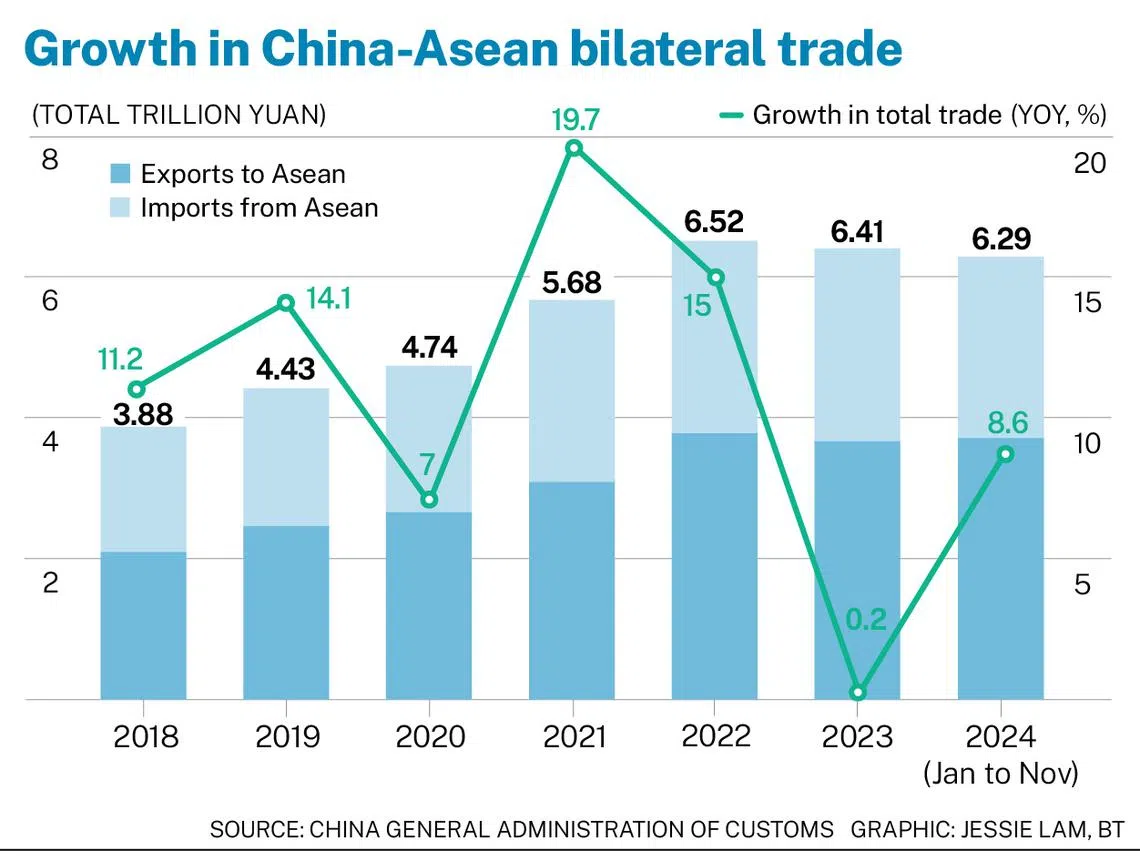
Bilateral trade reached a staggering 6.3 trillion yuan (S$1.2 trillion) in the first 11 months of 2024 – up nearly 9 per cent from a year ago, indicated data released by China’s General Administration of Customs.
Of this total, China’s exports to Asean accounted for 3.7 trillion yuan, up 12.7 per cent year on year, while imports from Asean amounted to 2.6 trillion yuan, reflecting a 3 per cent year-on-year increase.
Much of that jump in FDI is due to China intensifying economic ties with Asean. This comes amid a strategic pivot in recent years as Chinese companies seek to de-risk against a trade war with the US.
Experts predict that this trend is likely to continue, with sectors such as EVs, semiconductors and renewable energy within the Asean-6 markets of Indonesia, Malaysia, the Philippines, Singapore, Thailand and Vietnam seeing keen interest from Chinese investors.
In terms of trade, China has been Asean’s largest trading partner since 2009, while Asean has risen to become China’s largest trade partner since it overtook the European Union in 2020.
Before the onset of US-China trade tensions in 2018, Chinese investments in Asean were predominantly focused on real estate and financial services.
However, this trend has shifted significantly, with FDI in the manufacturing sector growing at an impressive 33 per cent annually from 2020 to 2023, to reach US$6 billion in 2023, noted Nithin Chandra, managing partner for South-east Asia at management consultant firm Kearney, in an interview with The Business Times.
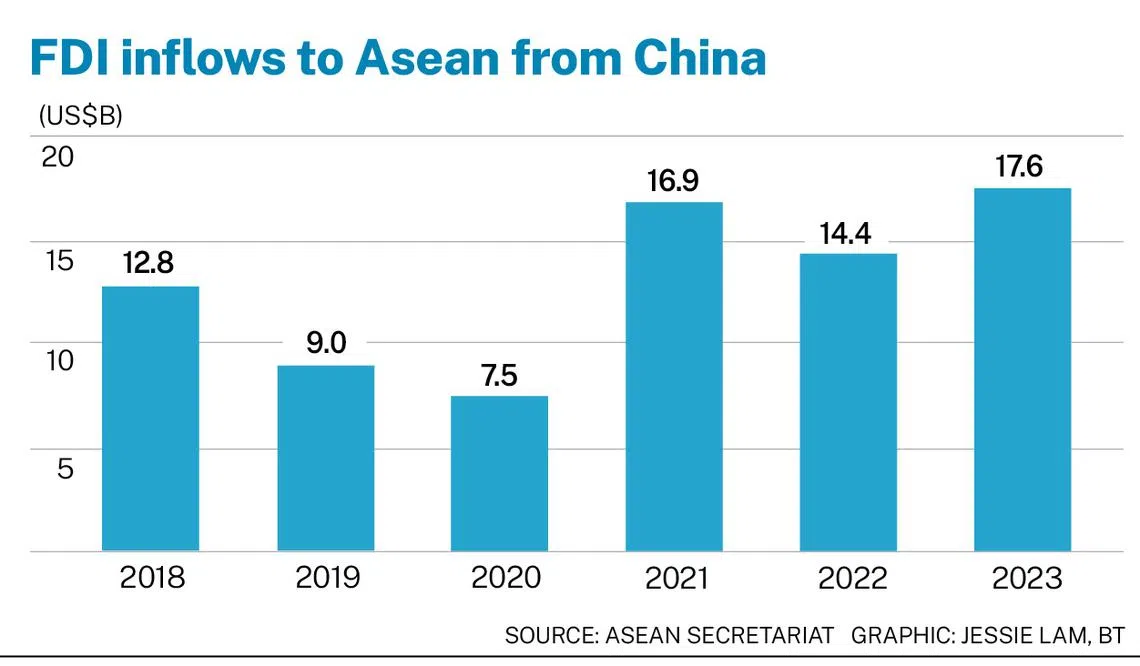
Total FDI from China into Asean has been steadily increasing, reaching a total of US$17.6 billion in 2023, indicated data from the Jakarta-based Asean Secretariat.
Key motivating factors
Experts pointed to several factors driving the growth of Chinese FDI into Asean, including the region’s fast-growing and increasingly affluent middle class; its rising demand for digital consumerism; and a large, progressively skilled labour force.
These strengths position Asean as “well-placed to attract FDIs”, said Johnny Lim, partner and co-chair of global corporate (Asia) at law firm Reed Smith.
The region is also an attractive manufacturing hub supported by strong fundamentals, such as access to raw materials and conducive trade policies, added Kearney’s Chandra.
Furthermore, the Asean-China free trade area is to be upgraded in 2025, enhancing cooperation in new areas such as the digital economy and green economy.
Lim highlighted renewable and clean energy, as well as EVs and energy storage among sectors seeing keen interest in the region.
A prominent example of Chinese greenfield investment in Asean is in the EV manufacturing and supply chain. For example, Chinese EV giant BYD has invested US$490 million to set up its first EV factory in South-east Asia, located in Thailand.
More importantly, amid intensifying tensions and a trade war between the US and China, Asean is seen as “the alternative destination” in supply chain shifts under the “China plus one” strategy as companies search for solutions to improve resiliency, said Chandra.
Asean investment shifts
FDI inflows into Asean are expected to gain momentum in the coming year, driven by the potential for renewed tariffs and escalating tensions in the US-China trade war under the new US administration. This is likely to accelerate diversification efforts, prompting more investments to shift from China to Asean.
The Trump administration is expected to enact an “America First” agenda, which could involve a blanket tariff of up to 20 per cent on imports from all countries and a higher tariff of up to 60 per cent on Chinese imports.
If the tariff on Chinese imports materialises, manufacturers with production facilities in China might accelerate the relocation of their facilities to Asean countries, as part of the “China plus one” strategy, said Reed Smith’s Lim.
However, he cautioned that this could lead to increased scrutiny from the US, resulting in trade uncertainties and tensions.
IMD’s Greeven anticipates a change in the structure of investments coming out of China, where depending on the sector, there may be slightly less allocation to the US or Europe. Instead, countries in close proximity to China within Asia are likely to see “a lot of initiative and interest” from Chinese investors.
Given that we know how Trump thinks about China and trade, Greeven believes that many Chinese companies and investors should at least be prepared for the policies that are coming.
Within Asean, Chandra highlighted Vietnam’s vulnerability to tariffs due to its significant contribution – 10 per cent – to the overall US trade deficit, ranking it third globally behind China and Mexico.
As a result, he anticipates a gradual shift in FDI inflows within Asean, with Malaysia, Thailand and Indonesia likely to capture a larger share at Vietnam’s expense.
Target sectors
In the coming year, key sectors across the Asean-6 markets are expected to capture strong interest from Chinese investors, driven by each country’s unique strengths and strategic positioning.
In Singapore, high-end research and development (R&D), design and precision engineering industries are set to draw Chinese investment, according to Chandra. The city-state’s robust R&D infrastructure, strong intellectual property protection policies and skilled engineering workforce make it an attractive destination for these sectors.
Malaysia is likely to see increased investment in semiconductors and mid to high value-added electronics, areas aligned with the country’s established electronics manufacturing ecosystem.
Thailand, aiming to position itself as a regional hub for EV manufacturing, is another focal point. Reed Smith’s Lim highlights that Chinese EV makers BYD and Great Wall Motor have already made substantial inroads in the country, reflecting strong interest in its automotive sector.
In Indonesia, clean energy, natural resources, infrastructure, transportation, and packaged food production are anticipated to attract Chinese investors. Lim notes that critical minerals such as nickel and cobalt, crucial for the EV industry, along with aluminium, will remain key targets under China’s Belt and Road Initiative.
Vietnam continues to strengthen its position as a hub for high-tech investments, with Chinese interest expected in electronics, semiconductors and other high-tech manufacturing sectors.
Meanwhile, the Philippines may see growing Chinese investment in renewable energy projects, leveraging the country’s abundant natural resources and supportive policies.
Lim said: “These investments are driven by Asean’s growing consumer markets, strategic location, their respective skilled workforces and respective government support for these sectors.”