



China-owned British car brand MG aims to double South-east Asia sales to 100,000 in next three years
It will add two more factories in the region, and offer electric vehicles, hybrids and conventional cars

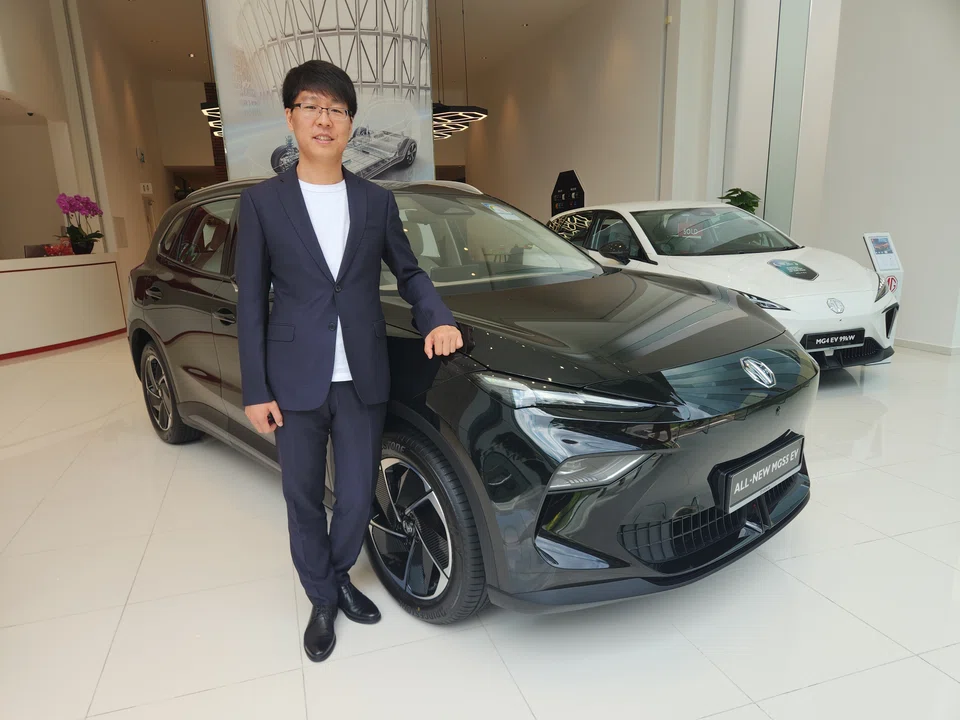
[SINGAPORE] Car brand MG Motor hopes to double its South-east Asia sales to 100,000 cars over the next three years, up from its 2024 total of around 50,000.
This is part of its push to raise its total sales to 870,000 in 2025 from around 770,000 in 2024.
MG originated in Britain, but has been owned by state-owned China carmaker SAIC Motor since 2007.
“There is a lot of potential for SAIC and MG in South-east Asia,” said Li Sheng, MG’s overseas brand and marketing director, in an interview with Singapore media on Wednesday (Apr 9).
In 2024, its sales to markets outside China reached around 550,000, up from 420,000 the year before. Its China market sales rose slightly to around 200,000, from 190,000 before.
To support its sales drive in South-east Asia, SAIC will add two factories in Malaysia and Vietnam, in addition to existing sites in Thailand and Indonesia.
The new plants will produce MG cars, but could also produce vehicles from some of SAIC’s China brands, such as Maxus and Wuling.
The factories are expected to begin with so-called “complete knock-down” production – in which cars are assembled only from imported parts. Locally produced parts will be incorporated down the road.
Li did not give details on the intended production capacity, cost or timeline, noting that negotiations with the respective countries’ governments were still ongoing.
Exports have long been an important focus for SAIC and MG, he noted.
SAIC established factories in Thailand in 2013, and in Indonesia in 2017. MG cars were introduced to Singapore in 2020, Vietnam in 2021, Indonesia in 2022 and Malaysia in 2023. Elsewhere, the brand entered the Middle East and South America in 2015, and Australia in 2016.
Other Chinese carmakers, including BYD, Changan and XPeng, started to focus on boosting export sales to the region in the past two years.
Indonesia and Malaysia will be the largest markets for MG, due to the former’s large population of around 282 million, and the latter’s vehicle market being the region’s largest, said Li. In 2024, a record 820,000 new cars were sold in Malaysia.
New models
MG will bolster its regional sales with three models. All in the mainstream, high-volume segments of the market, they are the MG S5 mid-sized electric sport utility vehicle (SUV), the MG ZS Hybrid+ mid-sized SUV and the MG3 compact hatchback.
The MG S5 will be the brand’s “most important” model in sales terms, said Li. The car was launched in Singapore on Wednesday, and will be rolled out to other markets in South-east Asia this year.
It joins the popular but highly competitive electric vehicle (EV), mid-sized SUV segment – dominated by the Tesla Model Y and BYD Atto 3. The Model Y is the world’s best-selling EV, and the Atto 3 is a key contributor to BYD’s total sales, with more than 300,000 units produced in 2024.
MG’s other models are not EVs, but could offer a competitive advantage in the region.
The ZS Hybrid+ and MG3, which debuted globally late last year and will launch in the region in 2025, are petrol-electric hybrids, which use an internal combustion engine and run on petrol.
In contrast to some EV-only brands, MG will continue to offer models with internal combustion engines, including purely petrol-driven cars, petrol-electric hybrids and plug-in hybrid electric vehicles (PHEVs). For example, the MG3 is also available as a conventional, petrol-only car.
Li said that having this range allows the company to tailor its offerings to each market, even within regions. For example, EVs and hybrids are the obvious choice for Singapore because of its national green push, he said. On the other hand, Indonesia may not be ready for a large proportion of EVs, but could see more hybrids and PHEVs instead.
Some 80 per cent of the brand’s exports are cars with internal combustion engines, with the remainder made up largely of EVs.
Since the brand introduced its first hybrids only in 2024, sales have been small but growing, said Li.






