China’s Great Wall Motor muscles in on Thailand’s electric vehicle scene
ON THE third floor of Iconsiam, an upmarket mall in Bangkok on the banks of the Chao Phraya River, there is a newcomer to the Motor Vehicle Kingdom – a series of showrooms for imported luxury automobiles and motorcycle brands catering to the super-rich.
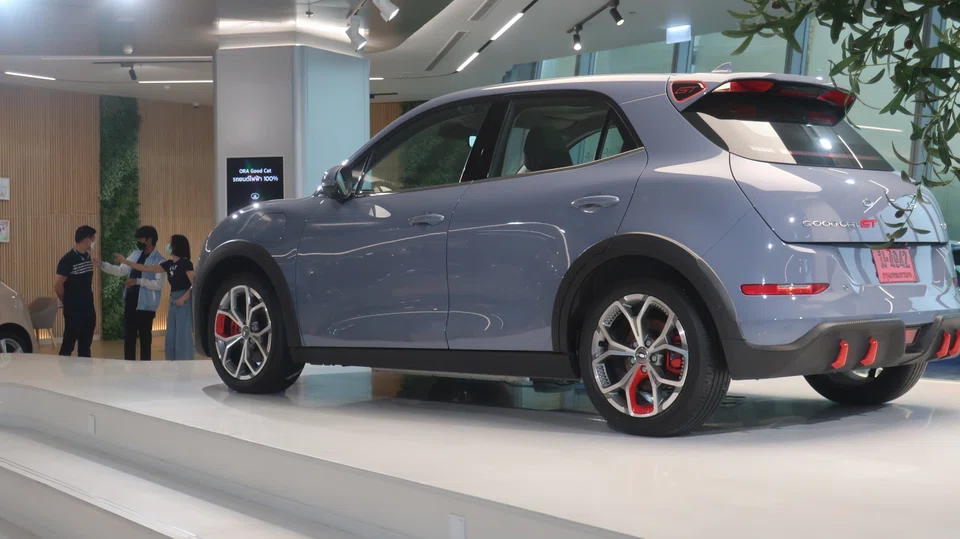
Neighbouring the fancy Rolls-Royce, Maserati, BMW and Mini Cooper displays is that of Great Wall Motor (GWM), showing off their ORA Good Cat – a battery-powered electric vehicle (EV) imported from China – and HAVAL models. The latter are hybrid EVs currently assembled at GWM’s plant in Rayong province, which was acquired from General Motors in 2020 after the US automotive giant closed its Thailand operations.
All the GWM models on display sell for about 1 million baht (S$38,950), below the price of most imported BMW motorcycles and 30 per cent below that of Nissan’s all-electric Leaf model, also on sale in Thailand.
Despite its newcomer status in an automobile market traditionally dominated by Japanese brands, GWM is making headway in Thailand’s booming EV space this year.
“Since its launch in October 2021 until the end of July 2022, GWM has delivered a total of 2,560 ORA Good Cats to Thai customers,” said Elliott Zhang, president (Asean) of Great Wall Motor, in a written reply to The Business Times.
In April, GWM in Thailand suspended new orders of the original ORA Good Cat models after receiving more than 3,000 requests, due to production constraints in China. On Jun 29, it officially launched the new ORA Good Cat GT, with 500 units available for booking.
“The latest variant of ORA Good Cat received tremendous consumer interest – 500 vehicles were reserved with deposit payments of 10,000 baht within less than an hour,” Zhang said.
Much of ORA Good Cat’s growing popularity in Thailand has to do with its low price, which dropped further on Jul 15 thanks to direct subsidies under the Thai government’s latest policy to promote local EV production.
Under the scheme, announced in June, automotive companies that commit to local production of EVs in Thailand by 2024 can benefit from government subsidies of between 75,000 baht and 150,000 baht on imported models, depending on the battery size. Participating companies must commit to locally manufacturing the same number or even more vehicles that they import under the scheme.
So far, GWM, SAIC – the Shanghai-based producer of MG brand cars – and Japan’s Toyota Motor have signed on to the scheme.
Mercedes-Benz (Thailand) has also committed to locally producing its EQS EV model, to be launched late this year, but has not been permitted to join the subsidy scheme as its models are priced above 2 million baht, the cut-off price for EV benefits.
Mercedes was enticed to move into local EV production chiefly because of the success that its plug-in hybrid models have enjoyed in the Thai market over the past 4 years.
“We were very interested in Thailand to see how plug-in sales basically exploded,” said Roland Folger, chief executive officer of Mercedes-Benz (Thailand). “Thailand is among the top 5 markets in the world, as far as penetration of plug-in cars is concerned.”
Plug-in hybrid EVs have benefitted from a host of Thai government tax incentives and other benefits announced in 2017, which basically allowed Mercedes, BMW, Toyota and others in the programme to sell their plug-ins at prices below that of their ICE (internal combustion engine) counterparts.
Registrations of hybrid vehicles in Thailand grew from 24,440 units in 2018, or a total market share of 4.3 per cent, to 46,995 units in 2021, or 12.2 per cent of the market. They are expected to exceed 94,000 units by the end of 2022, for a market share of 21 per cent.
But it does not seem to be climate concerns that are driving plug-in sales. In fact, industry surveys have shown that many owners of hybrids in Thailand never charge their EV batteries – at least not before fuel prices shot up this year.
“Because of the government support of plug-in hybrids, we can sell them cheaper and that’s why people are buying them,” said Folger. He hopes the government will enhance benefits for Mercedes’ local EQS model production, especially given that Mercedes has invested heavily in the assembly of EV batteries in Thailand, at 1 of 4 such locations worldwide.
Industry experts wonder if Thai demand for plug-ins and EVs will plummet once the subsidies end.
But there are other advantages to the local production of EVs in Thailand, which remains the largest market for vehicles in the region.
GWM cites Thailand’s “geographical location and perfect industrial supply chain” as part of the draw, and has pledged to invest further in local parts manufacturing as well as research and development. “To this end, GWM plans to invest 22.6 billion baht in stages, and finally make Thailand the global production and export base of GWM’s new energy vehicles,” Zhang said.