



China’s price weakness adds to economy’s drag on Asean trade
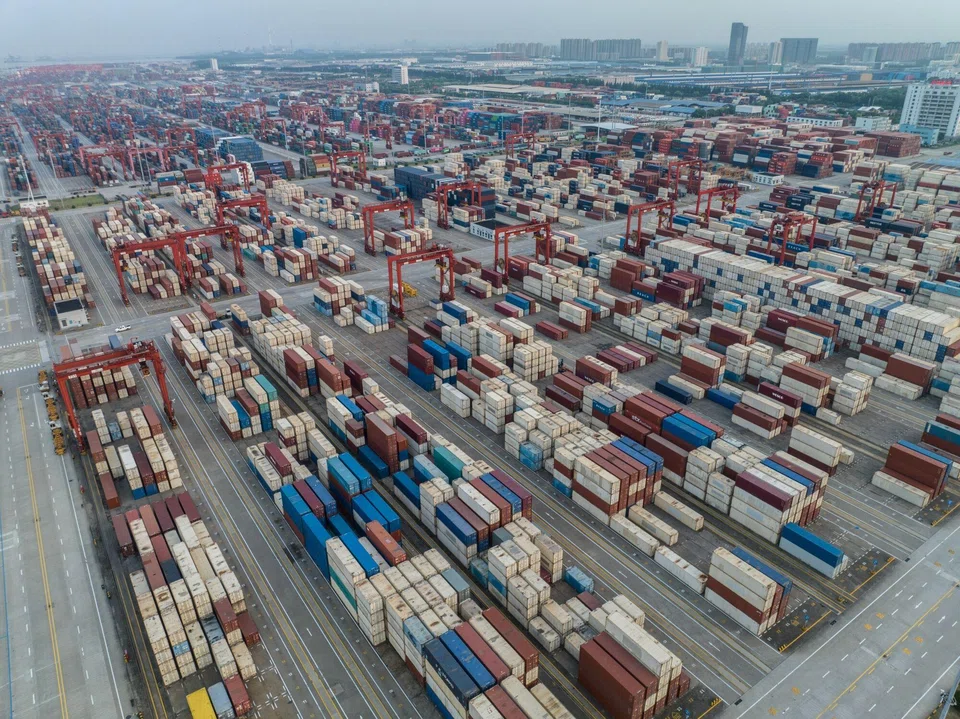
CHINA’S recent deflation print could pose fresh headwinds for its trading partners in South-east Asia, already exposed to potential economic fallout from a slowdown in the world’s second-largest economy.
“Falling domestic prices, as well as a weak yuan, mean that Chinese households are therefore likely to prioritise domestic goods and services over imports in general, including those from Asean,” Moody’s Analytics economist Denise Cheok told The Business Times.
“Exports of most goods from Asean to China have generally been down across the board,” she added, naming electronics as a key South-east Asian export that has been hit hard.
“In recent months, there has been an uptick in imports to China for items such as aircraft parts as tourism starts to pick up. However, these are exported mainly from the EU and the US.”
In the latest sign of post-pandemic economic malaise, China saw consumer prices fall by 0.3 per cent year on year in July – the first such decline since early 2021. The producer price index has also reported year-on-year drops for 10 straight months.
The People’s Bank of China has already made cautious interventions to support the economy, even as the central bank’s deputy governor Liu Guoqiang said in July that China would avoid deflation in the second half of the year.
Surprising the market, the central bank lowered a key one-year medium-term lending facility rate on Aug 14. But a week later, it trimmed the one-year loan prime rate by less than expected, and stood pat on the five-year rate, to which mortgages are pegged.
Even though deflation could theoretically make cheaper Chinese goods more attractive in global markets or bring down prices in other economies, analysts do not see that happening as yet.
“The factors driving prices lower in China are idiosyncratic of the economy and will have limited spillover effects onto the Asean region,” said Lavanya Venkateswaran, senior Asean economist at OCBC.



Meanwhile, China’s exports have been on a downtrend, falling 14.5 per cent year on year in July.
“Because the current export downturn stems from the weaker global and Chinese demand, the Asean export recovery may take a bit longer,” said Sam Cheong, head of group foreign direct investment advisory and network partnerships at UOB.
“We need to first see an improvement in global demand and particularly some stabilisation in China’s economic outlook as well as consumer confidence.”
In a report released on Aug 29, Cheok and other Moody’s analysts noted that “the greatest impact upon the rest of Asia from the economic malaise in China is via trade”, given the decline in both imports and exports.
“With both construction and manufacturing moribund, the loss of demand for imported intermediate goods – whether they be iron ore, copper, cement, auto parts, electronic components or others – is felt across the entire region.
“Fortunately, the direct financial impact from China’s economy, especially from the property market, is minimal, since funding has largely come from domestic sources in China,” wrote the Moody’s team.
However, they warned that “a new period of robust growth won’t likely commence until mid-2024” for the Asian region.
Siddharth Mathur, head of Asia-Pacific macro strategy and emerging markets research at BNP Paribas, named Indonesia and Singapore as two of the region’s economies that could take a more sizeable hit to their exports from deflation conditions in China.
With Thailand having the highest exposure to China in value-added terms, “the looming slowdown in advanced economies and weaker growth in China will likely taper demand for Thailand’s exports, although the steady normalisation of tourist traffic is providing an offset for now”, he said.
He also highlighted the risks from indirect trade exposure to China, such as through regional trade connectivity and trade with markets such as Japan, South Korea and Taiwan.
“Reflecting Singapore’s role as an entrepot hub in the region, the spillover impact of China’s softer growth outlook on these economies will naturally be a headwind for Singapore,” Mathur said.
Asean economies have seen their own trade shipments on a losing streak for months. Singapore posted a 20.2 per cent drop in non-oil domestic exports in July. Malaysia’s exports shrank by 13.1 per cent, Thailand’s by 6.2 per cent, and Vietnam’s by 3.5 per cent.
OCBC’s Lavanya said that “near-term growth headwinds will weigh on growth in the second half of 2023”, with the pace of economic expansion tipped to slow to 4.1 per cent year on year, compared with 4.4 per cent in the first six months.
Weaker momentum in the region could come on factors such as “weaker near-term growth in China”, recession risks in the US, and a fading boost from commodity prices, she added.
UOB’s Cheong noted the recent tepidness in Asian economic data, adding that “data so far has not been encouraging, particularly on the exports and manufacturing fronts” for the second half of the year.
“We anticipate a more moderate growth recovery in the second half of 2023 in Asean, largely supported by domestic demand and consumer spending,” he added.
Tommy Xie, OCBC’s head of Greater China research, said the “disinflation” in China stems from weakness in both domestic and external demand, as well as destocking in the inventory cycle.
Still, “given that the typical destocking phase lasts less than 20 months, the current phase could be nearing its conclusion”, he added.
He warned that “insufficient demand may decelerate the pace of recovery”, but believes historical patterns point to possible support for prices by year-end.
Cheong added that “the long-term outlook is strong” for regional trade and investment, with UOB reporting a pick-up in foreign direct investment flows after China reopened its borders.
He highlighted moves by Chinese businesses in areas such as the electric vehicle value chain in Thailand and Vietnam, and expanding operations by mineral companies in Indonesia.
Weaker growth and property prices will offset some of the costs of doing business in China in the short term, but “businesses would have longer-term considerations, including the need to diversify their production chains”, which will burnish Asean’s attractiveness, Cheong said.
Decoding Asia newsletter: your guide to navigating Asia in a new global order. Sign up here to get Decoding Asia newsletter. Delivered to your inbox. Free.
Share with us your feedback on BT's products and services
TRENDING NOW

ComfortDelGro appoints two new independent directors

Once staunchly pro-China, Malaysian Chinese businesses are now distancing themselves from Beijing

NoonTalk needs continued financial support from CEO Dasmond Koh, auditors warn

DP Architects sets the benchmark for sustainability disclosure and design

