Chinese automakers drive Thailand’s aggressive EV push
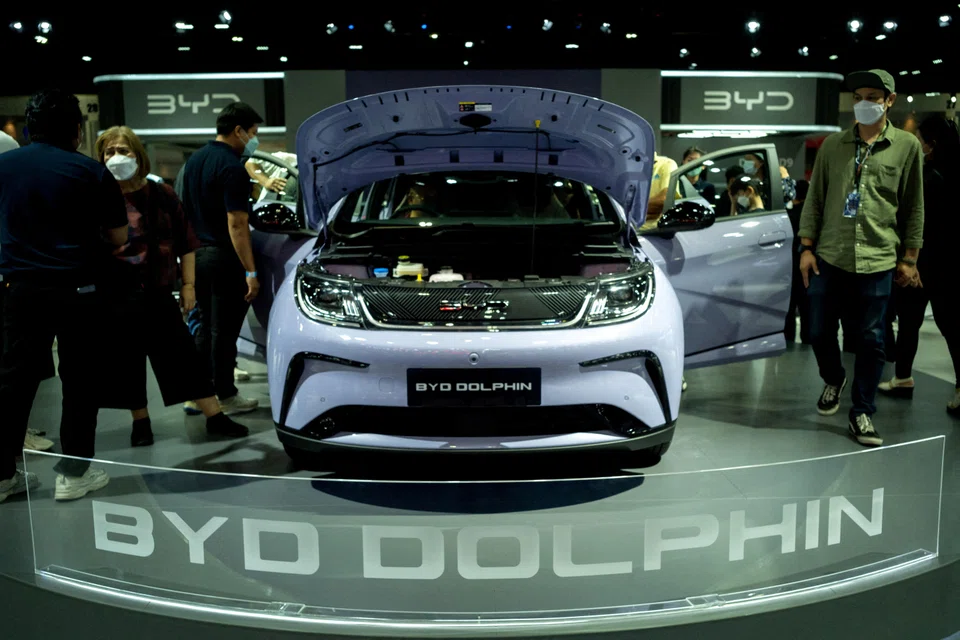
[BANGKOK] By the end of this year, Thailand expects to have attracted six of China’s top manufacturers of battery electric vehicles (BEVs), along with several well-known Japanese and German brands, a boon to the country’s credentials as South-east Asia’s leading automotive manufacturing hub.
Since the launch of an aggressive BEV investment promotion scheme in 2022, Thailand has secured commitments from China’s BYD Auto (the top-selling brand in China), Great Wall Motor, SAIC-MG, Neta, GAC-AION and Changan Automobile to manufacture BEV models locally, along with Japan’s Toyota, Germany’s Mercedes-Benz and Taiwan’s Foxconn in a joint venture with Thailand’s PTT.
The success was hardly accidental.
“Thailand was the first country in the region to announce comprehensive measures to promote the EV industry, both on the supply and demand side. We had to move quickly to make Thailand the regional leader in this industry,” said Narit Therdsteerasukdi, secretary-general of the Thailand Board of Investment (BOI), in an exclusive interview with The Business Times in Bangkok.
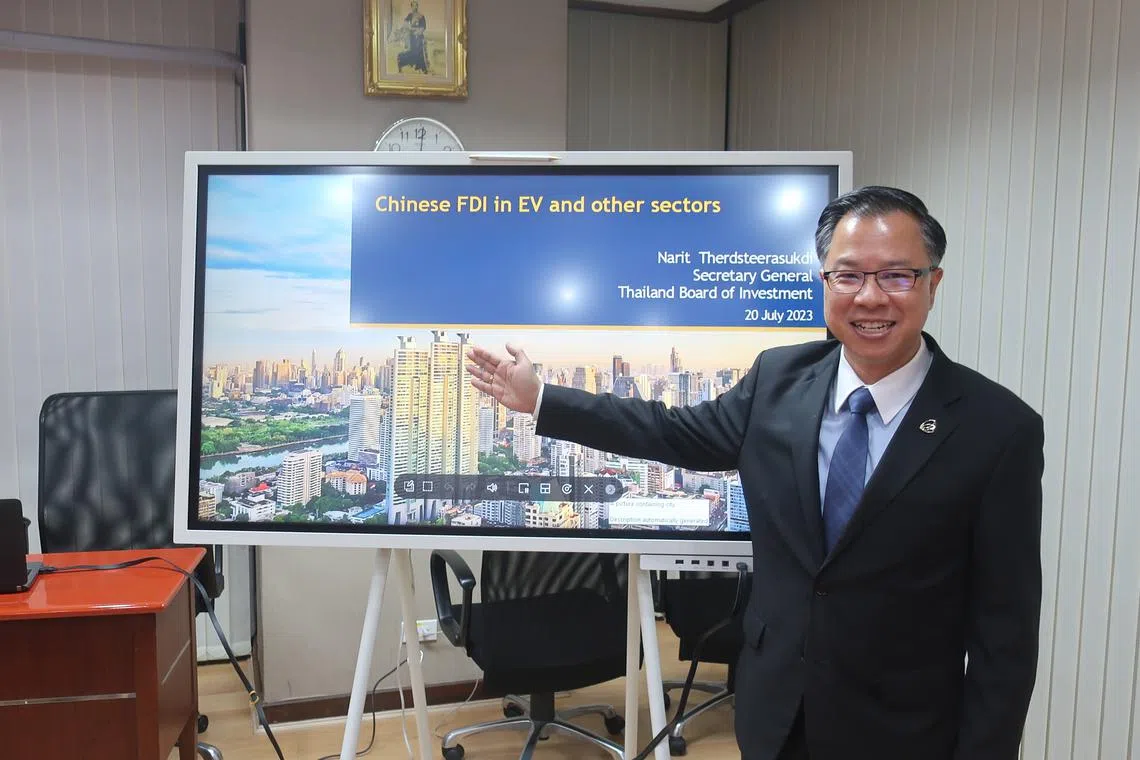
The BOI is a government agency under the Prime Minister’s Office and its mandate is to promote direct investment in Thailand by coming up with investment policies.
In August 2022, the Thai Cabinet approved a special Budget worth three billion baht (S$116.1 million) to subsidise purchases of imported EV passenger cars, pickups and motorcycles.
This was on the condition that suppliers signed an agreement with the government that they would establish a local manufacturing base in Thailand, and manufacture BEVs on a 1:1 ratio of imported units that received the subsidy by 2024, with this ratio improving to 1.5:1 by 2025.
The subsidies range from 150,000 baht for BEVs valued under two million baht, to 18,000 baht for BEV motorcycles that cost less than 150,000 baht. The subsidies, which went into effect in January this year, sparked a surge in BEV projects in South-east Asia’s second-largest economy, with Chinese firms leading the pack.
The government has also slashed the excise tax and waived import duties on the imports of CBU – or completely built up – cars.
“Why we are giving this subsidy is very simple. We want to make the prices of EVs comparable to those of internal combustion engine (ICE) vehicles,” said Narit.
The scheme has worked in terms of boosting BEV sales on the Thai market. Between January and May, some 33,367 imported BEV models were sold in Thailand, compared with 20,816 units in all of 2022, and 5,781 units in 2021.
In keeping with its carbon-free goals, the Thai government has set a target of having 30 per cent of local automobile production (both for the domestic and export markets) being BEVs by 2030, and 50 per cent of newly-registered cars.
Thailand is currently the world’s 10th-largest automobile manufacturer and the biggest in South-east Asia, producing about 1.8 million passenger cars and commercial vehicles per year.
The automotive industry employs about 700,000 people, includes 1,700 local suppliers and accounts for 7 per cent to 8 per cent of gross domestic product.
With the world’s auto manufacturing moving towards EVs, Thailand has been actively promoting local EV production since 2017. While initial efforts encouraged Japanese and German auto makers to introduce hybrid EV (HEV) and plug-in hybrid EV models, the Chinese brands were the first to jump into pure BEV manufacturing.
Observers say it is not coincidental that Thailand has been targeting Chinese investment in the sector. Through some oversight by trade negotiators of a free trade agreement (FTA) with China, Thailand failed to protect its local market from Chinese CBU EVs, which were allowed zero import tax.
As such, the Thai market was in danger of being flooded by cheap Chinese EV imports.
“That’s why the government decided to give this tax subsidy. Because although Chinese EVs can be imported with zero per cent import tax, now they also get the subsidy if they produce locally,” said Titikorn Lertsirirungsun, an automotive industry expert at GlobalData.
The subsidy allows Chinese brands to be price-competitive with Japanese ICE cars on the Thai market, and also gives them an opportunity to use Thailand as an export base, especially to the Asean market, which has an FTA among members that reduces import taxes on imported CBU cars to zero.
Great Wall Motor, for instance, is already exporting its made-in-Thailand Haval HEV model abroad, Narit said.
“When they start their business in Thailand, it’s easy for them because we have everything ready – the supply chain, the skilled workforce, high-quality industrial estates and supportive policies from the government,” said Narit of the EV investments flowing in from China.
In 2020, Prime Minister Prayut Chan-o-cha set up a National Electric Vehicle Policy Committee to coordinate the promotion of local EV manufacturing, which led to the country having a comprehensive and successful EV policy agenda.
It remains to be seen, however, if Thailand’s next government – when it is eventually formed – will be similarly gung-ho on EV production.
Narit said: “I believe the new government will continue to support, and even speed up the measures, to stimulate investment in the EV industry, because it is the key industry driving the Thai economy and it involves all the suppliers in related industries.”