



Chinese EVs drive record high sales in Indonesia, set for explosive growth in 2025
But though electric vehicles are gaining traction among Indonesians, adoption rates are low relative to those in neighbouring Singapore and Thailand

[JAKARTA] Chinese carmakers drove a huge surge in Indonesia’s electric vehicle (EV) sales last year, more than doubling to a record 43,000 units. Growth is expected to continue in 2025 with solid sales tax incentives for local production, further shaking up the country’s traditional automotive industry.
Latest data from the Association of Indonesia Automotive Industries (Gaikindo) pointed to a surge of more than 150 per cent in battery electric car sales to 43,188 units in 2024. China’s BYD led the charge, selling over 15,000 units, solidifying its position as a powerhouse in South-east Asia’s EV market.
This surge contrasts sharply with conventional car sales, which fell 14 per cent in wholesale to 866,000 units, and nearly 11 per cent in retail to some 890,000 units. This reflected changing consumer preferences and the growing influence of government-backed incentives for greener transportation options. Analysts anticipate that this growth trend will gain pace in 2025, bolstered by extended sales tax incentives for carmakers committed to establishing manufacturing facilities in Indonesia.
Major foreign players are expected to continue dominating Indonesia’s EV market in the absence of home-grown four-wheel manufacturers. However, for Indonesia to succeed in making the EV industry a cornerstone of its economic ambition, it must first boost the adoption rate, which remains low relative to that in the neighbouring countries.
Indonesia, with its growing middle class, rapid urbanisation and abundant nickel resources, is emerging as South-east Asia’s top market and a key player in the EV battery sector, attracting significant investment, said Hendra Lie, PwC Indonesia’s automotive leader. He noted: “By implementing strategic policies and offering attractive incentives, Indonesia is strengthening its nickel processing capabilities while fostering the growth of local EV and battery manufacturing.”
To attract more investment to the country’s nascent EV industry, the Ministry of Industry has announced several incentives for 2026, including the extension of exemptions from import duties and luxury goods tax on fully built or completely knocked down imported electric cars. The government will also reduce the value-added tax (VAT) on EVs, exempting them from the 12 per cent tariff hike and keeping the rate at a more favourable 10 per cent.
Reshaping the competition
Chinese EV leader BYD is among the biggest beneficiaries from the moves. The others include rising stars Citroen and Aion, all of which are poised to strengthen their presence in South-east Asia’s largest economy.
South Korea’s Hyundai has had years of dominance. In 2024, the Chinese brands surged ahead, overtaking the Korean giant and reshaping the competition in Indonesia’s EV market.
BYD, a newcomer to Indonesia’s market, debuted in 2024 and quickly made its mark, breaking into the top five best-selling EV brands.
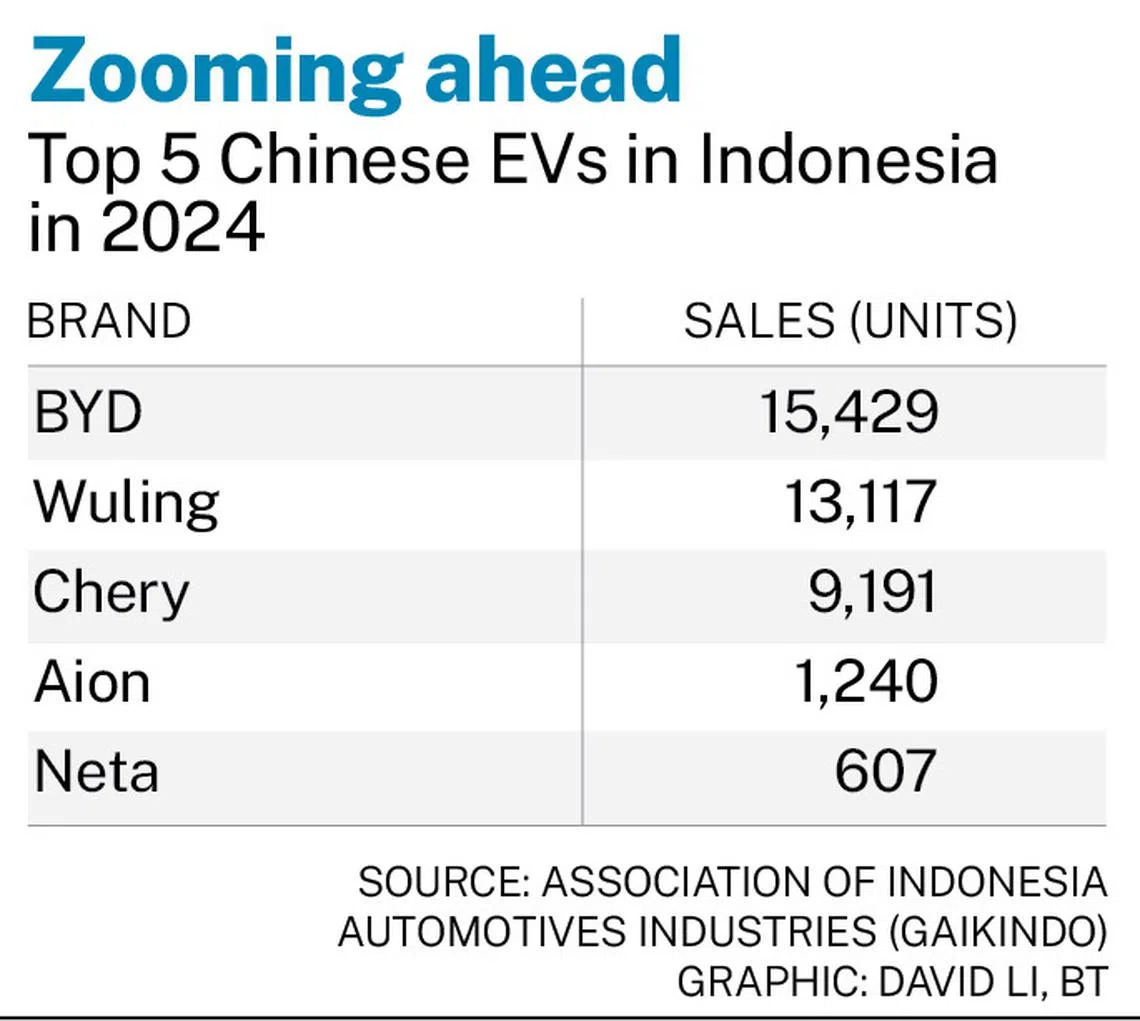
BYD is nearing completion of its US$1.3 billion assembly plant in Subang, West Java, where operations begin in early 2026. The plant will be able to churn out 100,000 units a year, boosting BYD’s presence in the region. The brand’s success was propelled by the launch of the groundbreaking BYD M6, the first seven-seater electric MPV, priced at between 340 million rupiah (S$28,220) and 400 million rupiah. It led its segment with 6,100 units sold last year.
Close behind BYD is Wuling, which made notable progress with its five-seater Binguo, which sold 5,156 units last year. Priced at between 348 million rupiah and 400 million rupiah, this hatchback has resonated with Indonesian consumers looking for an affordable, yet modern EV option.
Kukuh Kumara, Gaikindo’s general secretary, said that nearly two-thirds of Indonesian consumers have a positive view of Chinese cars, driven by affordability, innovative features and a focus on comfort – factors that resonate with the country’s diverse market.
Advanced charging infrastructure
But even as EVs gain traction among Indonesian consumers, their adoption remains low relative to that in neighbouring countries such as Singapore and Thailand. In a market where over a million cars are sold annually, EV owners in Indonesia make up just 7 per cent of the consumer base. It is a small but growing segment that marks the early stages of a nascent market, PwC Indonesia’s November report said. This group of consumers, predominantly women, mostly live in urban areas where charging infrastructure is more advanced and accessible.
Unlike in more established markets where used EVs have gained popularity, only 20 per cent of current EV owners in Indonesia show interest in buying a pre-owned EV. This reluctance is largely driven by concerns over battery degradation, the risk of undisclosed damages and the lack of warranties.
Roshan Raj, a partner at Redseer Strategy Consultants, said that the VAT reduction and other tax incentives decrease the overall cost structure for carmakers. With the current low penetration of EVs, he expects carmakers to largely pass the savings from the tax incentives on to consumers to stimulate demand, and to retain only a small portion to plump up profit margins. He pointed out: “This financial relief could enable manufacturers to price EVs more competitively against internal-combustion engine vehicles, potentially increasing EV market share.”
While Indonesia aims to establish itself as a regional EV hub, it has yet to produce a locally made EV on a large scale for the commercial market. Raj explained that the absence of a dominant domestic automotive manufacturer makes it unlikely that home-grown companies will lead the EV sector in the near future. This also means that foreign manufacturers or established global brands are likely to continue to hold sway.
Raj emphasised that robust regulatory support and significant investments will be key to driving EV production and adoption in Indonesia. “Otherwise, Indonesia may become an EV manufacturer and exporter, while local adoption remains stagnant,” he added.






