Crude palm oil prices to stay robust on inventory crunch, but may not lift all SGX agri counters
Higher CPO prices are set to persist; analysts expect Bumitama Agri, First Resources to get a boost

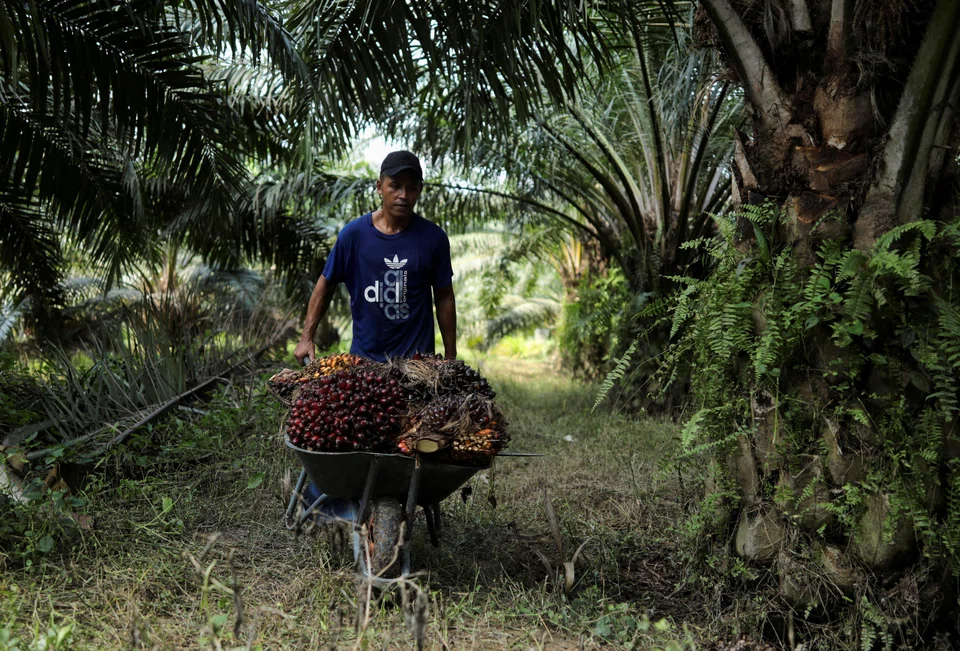
[SINGAPORE] Crude palm oil (CPO) prices are expected to stay high in 2025 as inventories shrink and output weakens, deepening a supply crunch that could fuel earnings growth for Singapore-listed plantation stocks.
The Malaysian Palm Oil Board’s data released last week showed stockpiles at a low of 1.5 million tonnes as at end-February, due to weak production levels. This marks Malaysia’s fifth consecutive month of declining inventories, underscoring tight supply conditions in the world’s second-largest palm oil producer and exporter.
This reinforced RHB Research’s “overweight” stance on the sector, citing strong pricing power and a projected 12.4 per cent earnings growth for plantation players in 2025, driven by firm selling prices amid tight supply and strong demand.
“We expect palm oil inventory to remain tight and below the two-million tonne mark, as it is the low output season,” said RHB’s analyst Hoe Lee Leng, adding that the team maintained its forecasts for CPO prices at RM4,300 (S$1,289) per tonne in 2025 and RM4,100 next year.
Pointing to recent declines in regional plantation stocks, Hoe noted that “regional valuations have shrunk and are now averaging 11 times earnings (compared to the historical average of 14 times), while earnings growth remains robust”.
She recommended Bumitama Agri as one of her top picks with a “buy” rating and target price of S$1. The counter closed at S$0.85 on Tuesday (Mar 18), at 1.313 times the book value and 8.16 times the earnings.
Bumitama Agri’s full-year earnings for FY2024 declined 6.6 per cent despite a 13.5 per cent gain in net profit for the second half of the year, while higher selling prices offset lower sales volumes.
Meanwhile, the strength in CPO prices could boost rubber prices as commodities tend to be led by overlapping market dynamics in the agricultural space – providing a fillip for natural rubber and related players.
Singapore Exchange-listed rubber player Sri Trang Agro-Industry experienced a year of turnaround. It registered a full-year net profit of 1.7 billion baht (S$67.4 million) in 2024, from a net loss of 434.4 million baht in the previous financial year. The growth was led by higher contributions from natural rubber and gloves businesses, on the back of higher selling prices and sales volumes.
This is after plantation players listed on the Singapore bourse largely registered significant profit growth in 2024, given higher average selling prices on the back of a CPO price surge.
Malaysia-listed CPO futures surged in the fourth quarter of 2024, pushing year-on-year gains to nearly 33 per cent.
Among the CPO players on the local bourse, Golden Agri-Resources recorded the biggest profit jump for the full year at 84.5 per cent, as increased sales volume, together with higher CPO prices, more than offset weaker palm production.
However, OCBC Investment Research highlighted that the company’s full-year yield remained below 2023 levels due to land preparation for replanting and the lingering impact of El Nino weather conditions.
The team kept its fair value estimate of S$0.27 with a “hold” call. The counter closed at S$0.265 on Tuesday, at a 0.494 multiple of its booking value, and 6.92 times of its full-year earnings.
The planter’s earnings progress was followed by Indofood Agri Resources and First Resources .
Both Maybank and RHB analysts upgraded First Resources to “buy” on its stronger-than-expected earnings, as well as positive operational performance.
Maybank raised its target price to S$1.69 from S$1.60, while RHB lifted its target price to S$1.85 from S$1.65. First Resources’ shares closed on Tuesday at S$1.66, at 1.414 times the book value and 7.96 times the earnings.
Other agri-commodity players
While higher CPO prices boosted the plantation sector’s performance, challenging price conditions of other agri-commodities dampened big players’ earnings.
Agri-business giant Wilmar International’s full-year earnings dove 23.3 per cent, as weak sugar prices hurt its sugar milling and merchandising activities. This is despite higher palm oil prices benefiting its plantation business and cushioning the overall impact.
RHB research team maintained its “neutral” call for Wilmar, with a lowered target price of S$3 from S$3.10, after paring down margin assumptions for the feed and industrial division.
“While operating conditions are improving in China, Wilmar’s sugar and palm-refining units continue to face challenges,” said the team.
However, UOB Kay Hian analysts Heidi Mo and Llelleythan Tan upgraded their call for Wilmar to “buy” with a higher target price to S$3.45 from S$3.18, on optimistic outlooks for food products on higher sales volumes and margin improvement.
They highlighted that the market has already priced in weakness from 2024.
“We anticipate Wilmar’s core net profit improving in 2025, driven by sales volume growth from increased market share and better soybean crush margins. The surprise is that contributions from China may be higher due to better-than-expected volume growth,” said UOB Kay Hian’s Mo and Tan.
Other agri-food players such as Olam and Delfi , however, suffered from rising prices and supply constraints of its raw materials such as cocoa, of which prices rose almost 180 per cent in 2024.
Delfi’s full-year profit was down 26.6 per cent, while Olam’s plummeted 69 per cent. Both companies said they have been managing working capital to ensure stable supplies of raw materials amid market turbulence.
As elevated cocoa prices continue to weigh on Delfi’s profitability, analysts lowered their target prices for Delfi.
UOB Kay Hian’s Mo and John Cheong maintained their “hold” call with a lowered target price of S$0.82 from S$0.86.
CGS International’s Tay Wee Kuang trimmed his target price to S$0.88 from S$0.96, after paring down earnings forecasts amid high raw material prices.
However, he maintained his “add” call on the belief that Delfi would better weather the challenging market than its peers, given its leading market share – which made up more than 40 per cent of the Indonesian chocolate confectionery segment by revenue.