Economic growth should not be sacrificed to achieve net-zero target: Malaysia PM Anwar
Tan Ai Leng
[KUALA LUMPUR] Asean countries are keen on shifting to cleaner energy, but affordability is a key concern for them in their move away from hydrocarbons. Malaysian Prime Minister Anwar Ibrahim said economic growth should not be sacrificed to achieve the target of net zero.
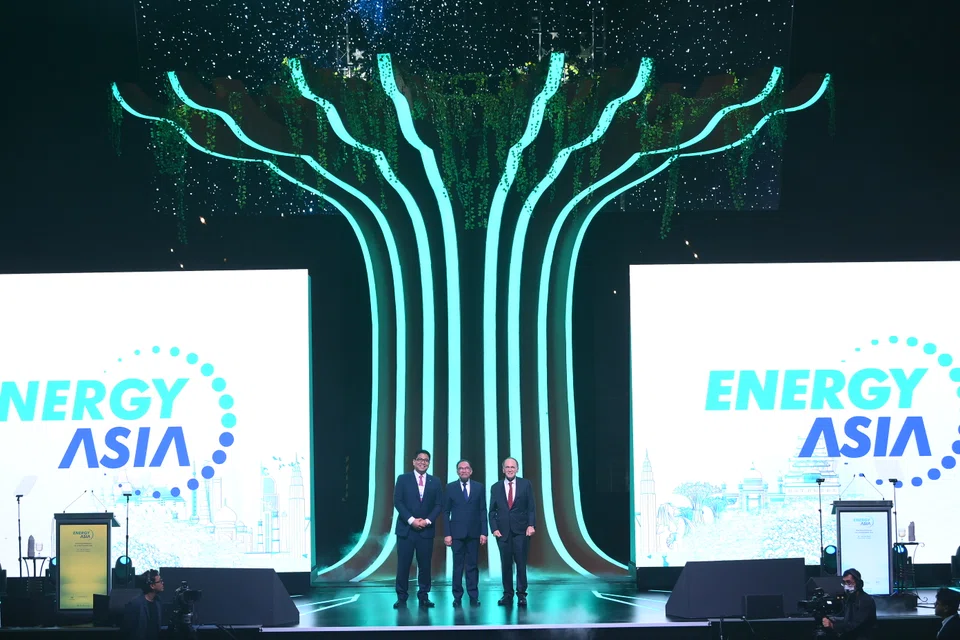
Speaking at the inaugural Energy Asia conference on Monday (Jun 26), he said that while some countries are preparing for the energy transition, there are some countries that are still struggling with access to complete electrification, clean cooking fuel and energy security.
“Affordability remains a key concern, particularly for parts of developing Asia where people are not looking too far to pay the bill or to put food on the table,” he said at the energy conference hosted by the country’s state oil firm Petroliam Nasional (Petronas).
He noted that over 75 per cent of the energy consumed in Asia comes from hydrocarbons and by 2030, Asia’s demand for energy is projected to double.
“Net zero need not be a zero-sum equation. It should not be one of lowering carbon emissions at the expense of economic growth or vice versa. Instead, Asia must take every opportunity to further dialogue and actions around how we can responsibly plan to enable every country its right to development and lower carbon aspirations,” he added.
In a separate session, the secretary-general of the Organization of the Petroleum Exporting Countries Haitham Al Ghais shared the same view, saying that “oil is irreplaceable for the foreseeable future”.
He said gas, hydrogen and biomass will continue to expand as a part of the energy mix, but oil will remain as an important energy source to support the growing global energy demand.
“Global oil demand will rise to 110 million barrels a day in two decades, bringing the world’s energy demand up 23 per cent,” he added.
Petronas president and group chief executive officer Muhammad Taufik Aziz noted that Asia is made up of countries with vastly different economic maturities where gross domestic product (GDP) per capita ranges from a modest US$2,000 to over US$90,000.
“The harsh reality is that 350 million (of the population) in Asia are still facing challenges in accessing affordable and reliable electricity,” he added.
However, he stressed that the governments in Asia are not climate deniers. “In fact, in Asean, all 10 countries have submitted their Nationally Determined Contributions (NDC) with most having pledged to a net-zero aspiration.”
Malaysia has committed to halt deforestation by 2030 and presented its updated NDC or climate ambition to reduce economy-wide carbon intensity (against GDP) by 45 per cent by 2030.
On top of this, the country has joined a global pledge to cut methane emissions by 30 per cent by 2030, compared with 2020 levels.
To achieve this, Anwar said that Malaysia is in the midst of finalising the National Energy Transition Roadmap, which will outline the overarching strategy and high-impact initiatives to expedite the energy transition efforts.
He added that the road map will be complemented by the Hydrogen Economy and Technology Roadmap, which will pave the way for Malaysia to achieve its objective of enhancing the country’s energy security and becoming an environmentally sustainable nation.
These two road maps are targeted to be launched by the second half of this year, said Anwar.
In addition, Malaysia is also taking the opportunity to develop the framework and harness the commercial potential of carbon capture and storage, particularly in depleted reservoirs offshore Sabah and Sarawak.
Meanwhile, ministers from Singapore and Indonesia also shared their respective countries’ energy transition efforts at a separate session, noting that natural gas, hydrogen and other renewable energy are potential sources that they are looking at.
Singapore’s Minister of State for Trade and Industry Low Yen Ling said the Republic has been seen as a first mover in shifting to low carbon energy sources, as 95 per cent of the country’s electricity is now generated from natural gas – the cleanest burning fossil fuel – from just 20 per cent 23 years ago.
Although Singapore is on track to achieve net zero by 2050, Low said the country continued to future-proof its power system to ensure there is sufficient gas to meet future needs, including the construction of a hydrogen power plant.
Indonesia is looking at reducing greenhouse-gas emissions from passenger vehicles by encouraging the use of electric motorbikes, said the country’s Minister of Energy and Mineral Resources Arifin Tasrif.
“We have around 120 million motorcycles; if each of them consumed one litre of fuel every day, this equals to around 600,000 barrels of oil. We are in talks with the private sector in developing a battery swapping programme to encourage more motorcyclists to switch to electric motorbikes,” he added.
Other than this, he said the country is also looking at other renewable energy sources including hydrogen, nuclear and geothermal energy that could help to enhance its long-term energy security.