



Election-related spending in Indonesia fuels country’s economic growth

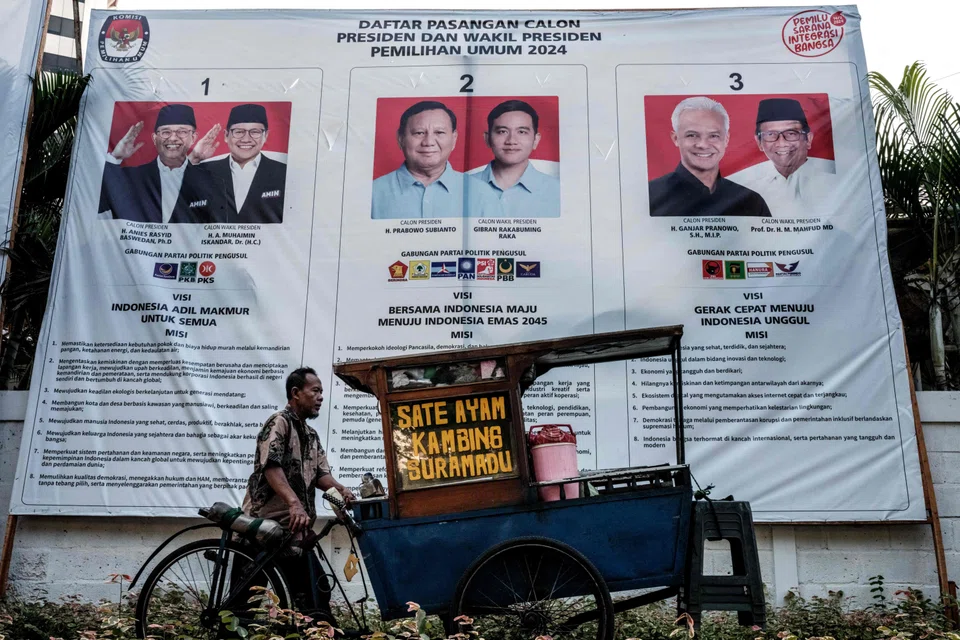
[JAKARTA] With campaigning for Indonesia’s upcoming presidential election now in its final weeks, spending by the government and political parties is also in overdrive.
Local media reports estimate that the government had spent 23.4 trillion rupiah (S$2 billion) as at December 2023, to cover expenses related to the presidential and legislative elections.
The finance ministry’s records showed that the 2023 Budget set aside 30.4 trillion rupiah for election-related spending, with more funds committed for the 2024 fiscal year.
The General Elections Commission (GEC) said the 18 political parties contesting in the election have so far spent around 165 billion rupiah to cover their candidates’ expenses. The money has gone towards items ranging from the printing of giant billboards on display along roads to meals, security and transport. In many regions, the parties and their candidates have organised music and entertainment to attract crowds to the campaign rallies.
Bank Indonesia estimated last November that as much as 100 trillion rupiah – in physical cash, electronic funds and withdrawable savings – were in circulation from election-related spending.
The sum was a projection from the amounts in circulation in the 2014 and 2019 elections, which fell in the range of 23 trillion to 52 trillion rupiah.
The 204 million eligible voters in Indonesia, the world’s third-largest democracy, will on Feb 14 head to voting booths to pick their next president and vice-president, as well as legislators and councillors at both the national and regional levels.
Arga Imawan, a political lecturer from Gadjah Mada University in Yogyakarta, said: “Spending money before the elections is a quick win for Indonesian politicians. It’s an effective way to attract voters.”
The GEC does not set a limit for campaign expenses, but each of the three presidential candidates is allowed to receive up to 25 billion rupiah from corporate donors and 2.5 billion rupiah from individual donors.
Prabowo Subianto, identified by numerous surveys as the front runner so far, has attracted the most campaign funding, at 31.4 billion rupiah. This is streets ahead of his two rivals, Ganjar Pranowo and Anies Baswedan, who have amassed 23.4 billion rupiah and 1 billion rupiah, respectively.
Observers said the actual amounts are likely to be much higher, as many parties do not fully report the amounts from individual donors.
Policymakers and analysts said that election-related spending will deliver a timely boost to Indonesia’s economic growth in the first few months of 2024, providing a much-needed cushion against the impact of weaker commodity prices and trade.
Finance Minister Sri Mulyani Indrawati said recently that election-related spending could account for as much as 0.6 per cent of gross domestic product (GDP). This could potentially result in private consumption growing by 5.3 per cent year on year in 2024. Household consumption accounts for 53 per cent of total GDP.
Andry Asmoro, the chief economist of state-owned lender Bank Mandiri, said that lower inflation and the possibility of interest rate cuts this year are helping to underpin consumer sentiment.
“This is likely to give a temporary boost to economic growth in 2024, which languished at around the 5-per-cent mark for most of last year,” he said.
Populist budget
President Joko Widodo, who is nearing the end of his two terms in office, launched several populist policies over the years to protect the purchasing power of South-east Asia’s largest economy. He has said he is aiming for a soft landing, with a target of 5.2 per cent GDP growth this year.
In recent months, the government has allocated 10 trillion rupiah for a cash-aid programme designed to help underprivileged families cope with the impact of the prolonged dry weather, which has disrupted food supplies.
The government has also committed 52 trillion rupiah in salary increases for civil servants and members of the police force and the military service this year.
Radhika Rao, the head economist of DBS Bank, said the government’s populist policies ahead of and throughout the 2024 election period could support most consumer-related sectors via higher consumption.
Some companies are already feeling the positive effects of this higher consumption.
Indofood CBP Sukses Makmur, which manufactures the Indomie instant noodles popular among the lower and middle-income groups, said the election-driven stimulus and lower raw material costs are expected to boost its revenue this year.
Analyst from BRI Danareksa Securities projected revenue of 73.25 trillion rupiah for 2024, 7.9 per cent higher than the predicted 67.88 trillion rupiah for last year.
Ricky Afrianto, the marketing director of food and beverage company Mayora Indah, which produces the famous Kopiko candy, said the company’s sweets, biscuits and drinks have been among the items included in food parcels handed out by candidates on the campaign trail.
He noted that the vast amounts of money spent during election campaigns in Indonesia often translates into higher purchasing power among consumers.
TRENDING NOW

First Resources blames El Nino, outside fires for Kalimantan hotspots amid haze scrutiny

High Court rules against Julius Baer’s Singapore trust arm in US$50 million family trust dispute
Singapore key exports jump by higher-than-expected 68.4% in September, led by non-electronics

MSCI proposes downgrading Indonesia to standalone market status

