



Foreign buyers cushion Thailand housing slump as market heads for 4th year of decline
As debt and tighter credit sap local demand, developers draw overseas buyers to resort markets

[BANGKOK] On a humid afternoon in mid-April on Phuket’s west coast, prospective buyers crowded into a glass-walled sales gallery overlooking Bang Tao beach along the Andaman Sea.
Inside, a real estate agent gestured towards scale models of beachfront condominiums and luxury pool villas, switching seamlessly between English and other languages as international clients leaned in with questions.
Many of the foreigners were hunting for second homes; others were exploring rental investments tied to Thailand’s tourism rebound. A few were considering longer-term relocation, drawn by lifestyle factors as much as financial ones.
Scenes like this are becoming increasingly common across Thailand’s resort property markets. They reflect a deeper shift underway in Thailand’s real estate sector, which is confronting sustained weakness, with the housing sector poised for a fourth straight year of contraction.
“Overall, Thailand’s property market is under pressure to perform,” Bill Barnett, C9 Hotelworks managing director and Phuket Hotels Association founder and adviser, told The Business Times.
Developers are grappling with an overhang of unsold inventory, particularly among the largest listed property groups, amid a sustained decline in domestic buyers. The slowdown has been compounded by a lack of qualified Thai purchasers able to secure bank financing, while a sharp drop in Chinese buyers – once the biggest foreign group – has added to the strain.
As a result, developers have begun to reposition. Many have moved away from mass-market condominium projects towards single-detached family homes, while others have sold non-core hospitality assets to shore up earnings.
Land acquisition has also slowed, with Barnett saying it has taken “a back seat to surviving the crunch period”.
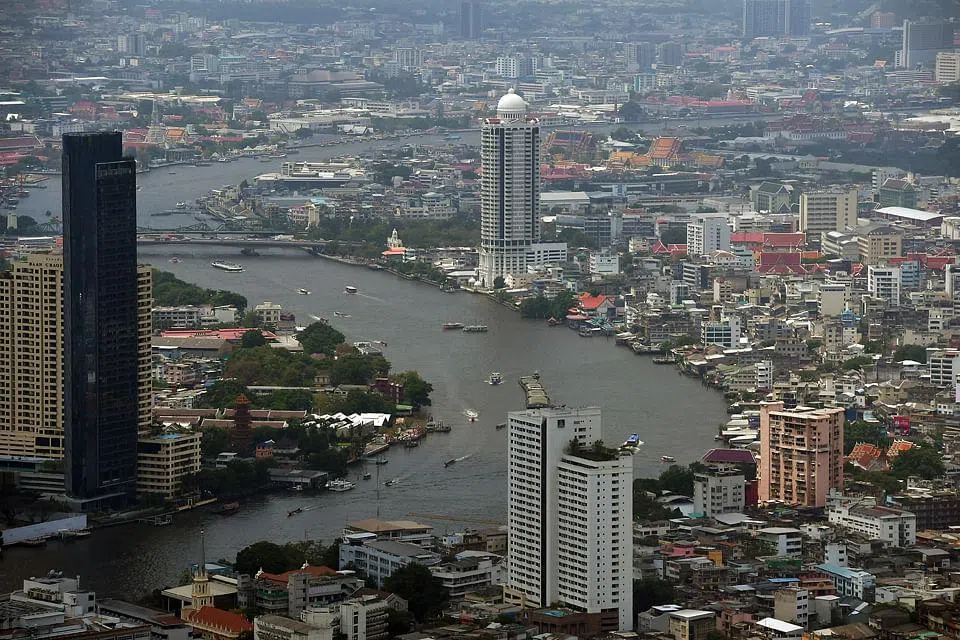
Siam Commercial Bank’s Economic Intelligence Center (SCB EIC) forecasts that nationwide residential property transfers are set to decline 5 per cent in 2026 from the previous year to 824 billion baht (S$33 billion).
The bank’s senior analyst Chetthawat Songprasert told BT that elevated household debt and living costs rising faster than income have eroded purchasing power, while stricter mortgage lending standards since 2025 have crimped access to financing.
More recently, external factors have cast another layer of uncertainty. “Ongoing tensions in the Middle East have pushed up global energy prices, feeding through into inflation and further weighing on consumer sentiment. In a prolonged scenario, the market contraction could deepen to 10 to 15 per cent year on year,” he added.
Foreign buyers gain ground
The country’s property sector appears to be entering a new phase – one in which foreign buyers are playing a more visible role as domestic demand weakens, heightened further by rising living costs. Overseas demand has provided a crucial source of liquidity for developers, particularly in resort areas where tourism and property investment are closely intertwined.
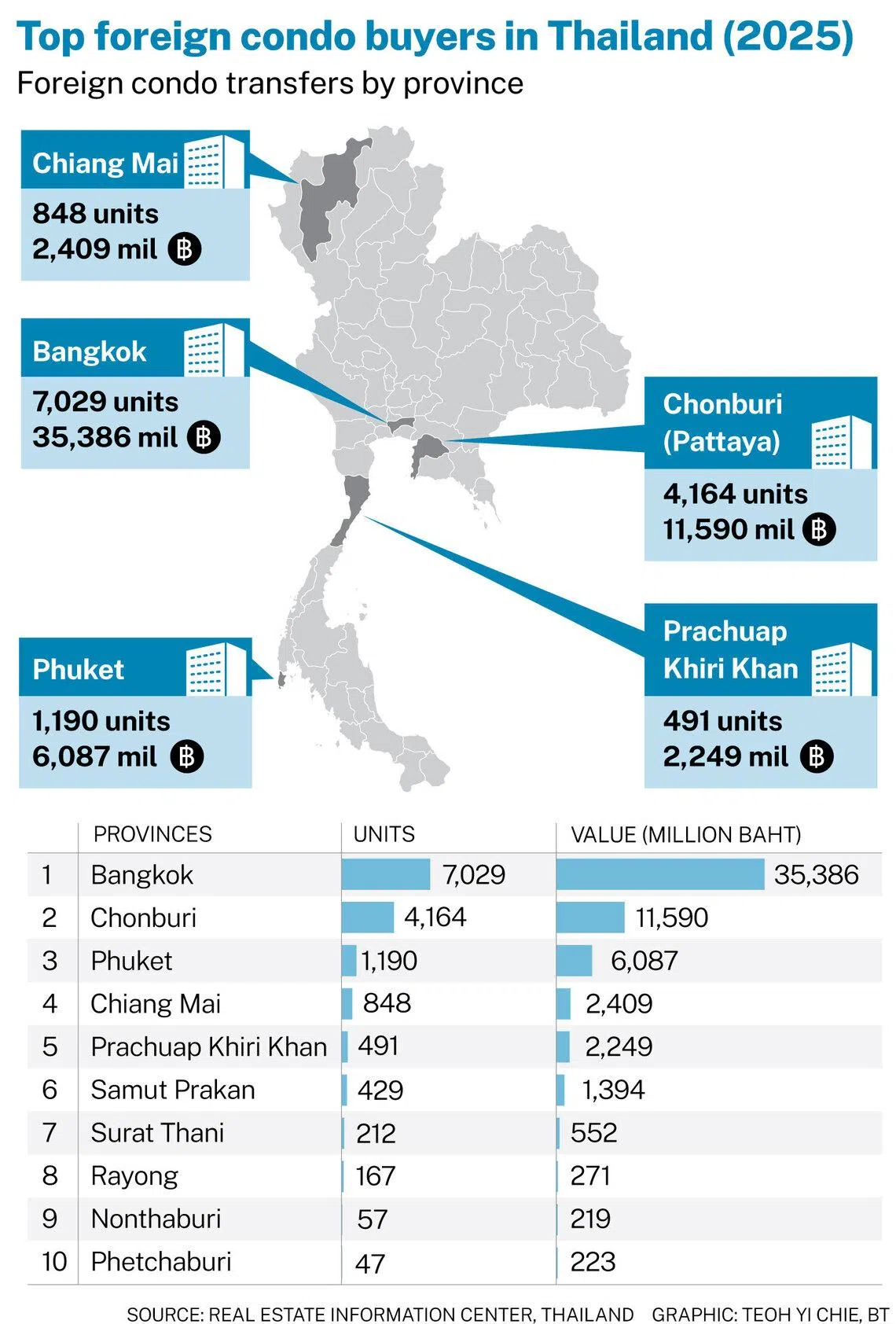
According to Thailand’s Real Estate Information Center, foreigners purchased 14,899 condominium units in 2025, up 2.2 per cent year on year. However, the total value of those transactions fell 10.7 per cent to 60.92 billion baht, pointing to a shift towards smaller or more affordable units.
Chinese buyers remained the largest group, followed by Myanmar and Russia.
The profile of foreign buyers has broadened. Russian buyers have expanded their presence in Phuket and Pattaya, driven partly by geopolitical shifts since 2022, while investors from Taiwan and Europe have gained market share.
Foreign demand remains highly concentrated in resort-driven markets such as Phuket and Chonburi (Pattaya), where overseas buyers can account for a significant share of transactions.
Foreign buyers typically enter Thailand’s property market through two main routes:
- They can purchase freehold condominium units within the legally designated foreign quota (foreigners can own up to 49 per cent of the total saleable area in a condominium building);
- They can secure long-term leasehold arrangements – typically 30 years – for landed properties such as villas.
Phuket emerges as a global residential hub
Among Thailand’s property markets, Phuket stands out as the most internationally oriented – and increasingly central to developers’ growth strategies.
Listed developers such as Sansiri, Ananda Development, Origin Property and AssetWise have all expanded into Phuket to tap into its large foreign buyer base, said Barnett.
Phuket currently has more than 40,000 residential units under development; the Bang Tao-Cherngtalay area on the island’s upscale west coast, known for its beach clubs, resorts and luxury villa, accounts for more than 18,000 units, making it the epicentre of activity, noted Barnett.
Several factors have driven the island’s popularity as a global residential destination. Phuket now hosts 13 international schools, with more in development, alongside five major marinas and an estimated US$8 billion in resort-grade residential supply.
Geography and seasonality also play a role. Barnett said the European “snowbird” buyers – who spend the winter months from October to March in warmer climates – have become a key segment of second-home purchasers, supported by improved international air connectivity.
Developers have responded by launching projects tailored to overseas buyers.
AssetWise is developing two luxury pool-villa projects – Casa de Monte and Villa del Luna – worth a combined 5.7 billion baht in Koh Kaew, a residential enclave in central Phuket favoured by expatriate families and long-stay residents for its relative seclusion and easy access to schools, marinas and retail hubs.
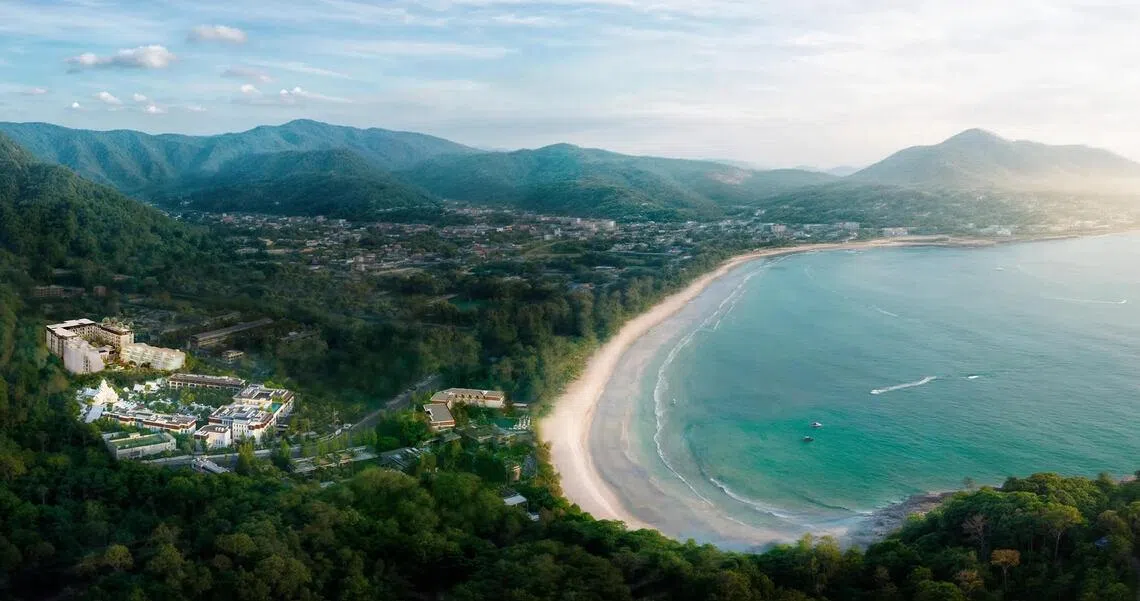
“We believe that international buyers are not only looking for real estate, but also seeking quality of life and long-term residential stability,” said Kromchet Vipanpong, chief executive officer of AssetWise, in a recent press statement.
Similarly, Sansiri has reported strong foreign demand for its Phuket developments, noting a shift from short-term speculation towards longer-term residential investment.
Branded residences
One of the fastest-growing segments of Thailand’s property market is branded residences – developments linked to international hotel and lifestyle brands.
These projects cater to a different type of buyer. Unlike traditional condominium investors, branded residence buyers often benchmark prices against global markets rather than local comparables, said Barnett.
One example is Etro Residences Phuket, an ultra-luxury development in the Gardens of Eden enclave near Bang Tao Beach. Set for completion in 2027, its units have reached prices of 830,000 baht per square metre – nearly four times the island’s branded residence average.
C9 Hotelworks noted that the average price stands at 197,745 baht per sq m, rising to 212,113 baht per sq m in prime areas such as Bang Tao-Kamala.
The trend is evident in projects such as The Residences at InterContinental Phuket Resort, where more than 20 per cent of units were sold within two weeks of launch. Developed by Proud Real Estate, the 2.5 billion baht project highlights growing demand among high-net-worth international buyers.
Thailand’s property market is being driven increasingly by overseas demand rather than domestic fundamentals. As developers recalibrate, resort markets are drawing more capital and a wider mix of buyers, from European retirees to remote workers.
Wooing foreign dollars
Developers are also moving beyond traditional sales models by linking property purchases with long-term residency solutions.
AssetWise and Rhom Bho Property have introduced an integrated long-stay service model aimed at overseas buyers, combining real estate investment with visa facilitation services, helping to streamline what has traditionally been a complex process.
“Thailand has strong potential to become a regional hub for international residents,” Kromchet said, citing infrastructure, cost of living and lifestyle appeal.
Yet the outlook remains mixed.
Thailand’s property market is becoming more segmented, with resort-driven locations supported by foreign demand showing relative resilience, while domestically driven segments remain more subdued.
While the country retains long-term appeal as a residential and investment destination, the pace of recovery will likely depend on both domestic economic conditions and resilience of international demand.
This divergence – increasingly driven by foreign capital flows – points to a more structurally uneven landscape, with growth concentrated in globally linked markets rather than a broad-based domestic recovery.
TRENDING NOW

Malaysian king buys stake in Singapore-listed mining firm expanding into rare earths

Grab CEO’s wife Chloe Tong on life with Anthony Tan and finding her purpose

Once staunchly pro-China, Malaysian Chinese businesses are now distancing themselves from Beijing
Longer wait times expected as S’pore healthcare institutions report system disruptions

