



Foreign investors eye Vietnamese startups despite funding slowdown

[HO CHI MINH CITY] In recent times, early-stage tech investor VinaCapital Ventures has not only had to field pitches from Vietnamese startups.
Funds from all over the world – including Korea, America, Russia and the Middle East – have been contacting the firm, wanting to understand the local landscape and how they can get in on investment opportunities.
“Vietnam has developed a lot in terms of complexity,” said Hoang Duc Trung, partner at local fund VinaCapital Ventures. Hoang said a combination of strong economic growth, an educated workforce and latent technological potential has spurred foreign investors to circle the market.
Some aren’t ready to commit to it yet, and are testing the waters by cutting cheques of US$500,000 to US$1 million in early-stage startup deals, he added.
Others have opened offices in Vietnam to get closer to the new generation of entrepreneurs, many of whom were educated overseas and are hungry to solve a myriad of issues back home.
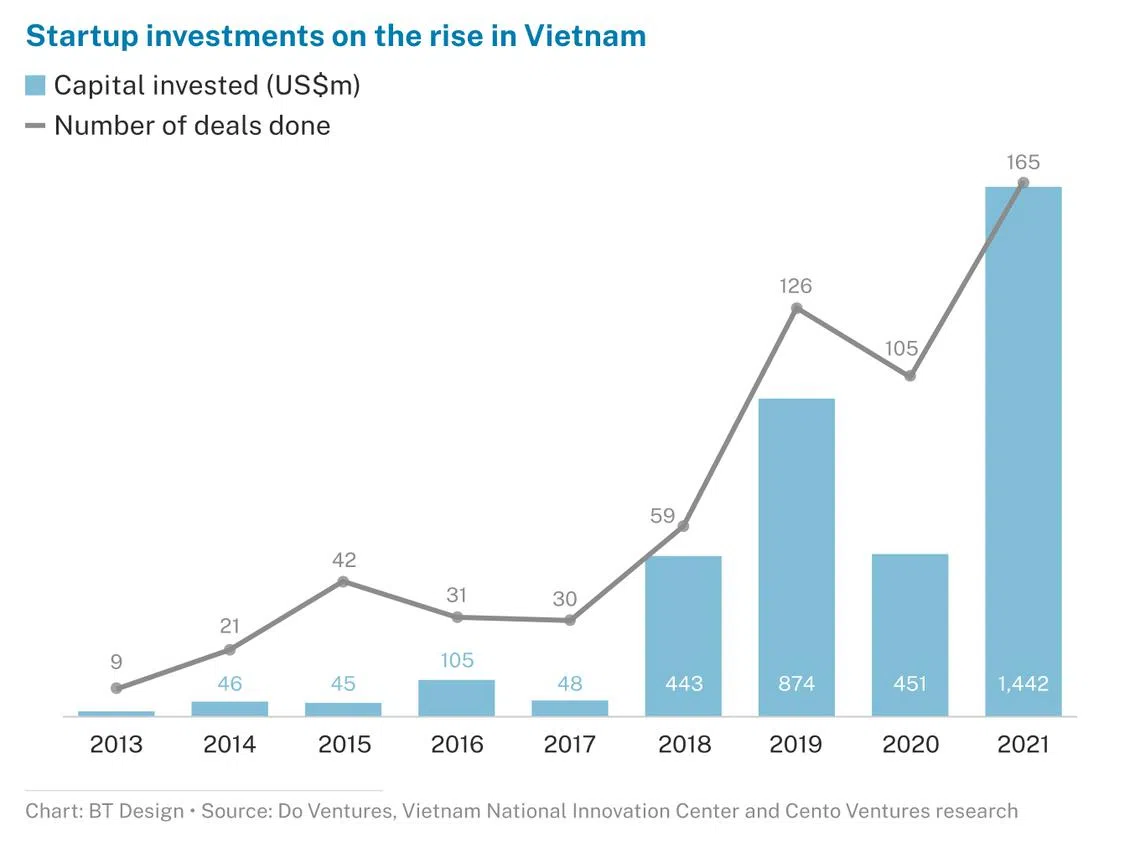
The step-up in activity has contributed to a surge in funding. Startups in Vietnam raised US$1.4 billion last year, about 1.6 times the previous peak in 2019, according to research from Do Ventures, the National Innovation Center and Cento Ventures.
When former investment banker and venture capitalist Michael Do set out to raise funds for a new investment app, he was surprised by the extent of interest from foreign investors.
“When the Covid lockdowns ended, we had a bunch of investors from Singapore, Japan and Korea coming into town, wanting to meet companies here,” he said.
Do’s startup Anfin ended up raising US$6 million across two rounds from firms including US-based Goodwater Capital and Global Founders Capital, and Belgium investor Kharis Capital.
Goodwater, which manages over US$4 billion in assets, has become one of the most active investors in Vietnam after backing companies such as e-wallet unicorn MoMo.
Owing to Korea and Japan’s history of foreign direct investment in the country, investors like Mirae Asset, Naver and Genesia Ventures have become important sources of capital for Vietnamese startups.
Singapore-based venture firms are bullish on the ecosystem as well, with Insignia Ventures, Openspace and Wavemaker actively deploying funds across fintech, healthcare, supply chain solutions and more. Golden Gate Ventures recently opened two offices in the country.
Bright spot in South-east Asia
A thousand miles south of Vietnam lies Indonesia, home to a population of over 270 million and one of the fastest growing digital economies. It has long captured the imagination of VCs, but a recent tightening in capital sources has caused investors to reconsider the valuation premiums they were willing to pay.
Many have turned to the Vietnamese market, where business models are young and valuations have yet to reach the feverish heights seen in Indonesia and Singapore.
The country has been holding up well despite macroeconomic pressures. It is expected to beat its Asia-Pacific peers this year to grow at a rate of 7.2 per cent, up from 5.3 per cent in the World Bank’s April forecast.
While Vietnam isn’t immune to the effects of a funding slowdown, the interest from foreign investors is helping to cushion the fall in some startup valuations, said Vy Le, co-founder of local VC firm Do Ventures.
“At the early stage, we’re still fortunate because we have a new inflow of foreign investors. Because of the new flow of money, some valuations don’t see much of an adjustment,” said Le.

Overseas investors tend to be more generous in the valuations they set, going by the fundraising experiences of founders The Business Times spoke to.
Le said young startups still need to be “extra careful”, as raising a seed round at a high valuation could be “a trap” that leads to fundraising challenges later on.
Investors are getting increasingly optimistic about the long-term prospects of Vietnam, partly due to rising consumption driven by a middle class population expected to expand by as many as 36 million people by 2030.
Local investors are getting more active as well. Touchstone Partners last April announced the first close of its inaugural US$50 million fund, which attracted investments from Singapore state-linked Pavilion Capital, and Vulcan Capital, the investment arm of Microsoft co-founder Paul Allen’s Vulcan Inc.
Touchstone has made 21 investments since then, said managing partner Khanh Tran, who used to lead technology investments at VinaCapital and was briefly the country head of business development at Grab.
Even as a flock of new investors descend upon Vietnam, the ecosystem still has bottlenecks. Capital flow controls are tight and the local jurisdiction lacks the transparency of other markets such as Singapore.
“A good number of the local founders do not speak fluent English,” added Huang Shao-Ning, partner at Singapore-headquartered angel investor network AngelCentral, whose Vietnam portfolio includes Vietnamese audiobook platform Fonos. “So communication is very tricky, especially for early investments where we really need to get to know the founders.”
Some startups in search of funds have resorted to using brokers, who bridge communication gaps and scout for investors. This, however, could present another challenge in due diligence.
“A few had approached us but we did not pursue it, as they did not allow us to interact with the founders directly,” said Huang. “This works against our model, as we invest based on founders and not being able to interact with founders means we cannot gauge and assess them.”
Still, AngelCentral does not intend to shy away from the market. Several of its members are attracted by its large consumer base with growing needs in sectors like healthcare and education.
“Good local startups that can produce quality businesses that meet local needs will be ripe for investment opportunities,” said Huang.
This story is part of an ongoing BT regional series on South-east Asian markets. In the coming months, BT journalists will head to different countries in the region to bring you the latest from the ground.
TRENDING NOW

Indonesia’s coal tycoon Low Tuck Kwong replaced as Bayan Resources president-director

OCBC names Ang Eng Siong as global corporate banking head in rejig of wholesale banking business

Consider lowering homeownership barriers for some non-resident foreigners

DBS opens flagship investment strategy to retail investors with new fund

