



Foreign money is lining up behind Luzon’s tech hubs. Can this push the Philippines up the value chain?
Investment momentum behind the Luzon Economic Corridor must overcome domestic hurdles, say experts

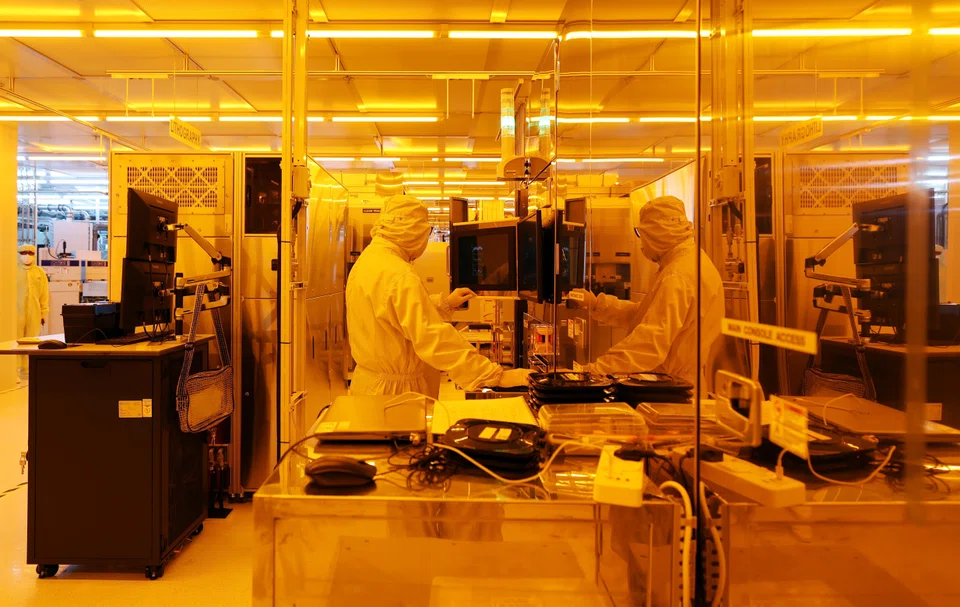
[SINGAPORE] International investment momentum is gathering around Luzon, the Philippines’ largest island, as the country taps a US-backed infrastructure “corridor” to create new hubs for advanced manufacturing amid a global artificial intelligence buildout.
But doubts exist over whether new investments can overcome long-standing political and structural constraints that have held the country back from its industrial potential.
Dr Michael Batu, associate professor of economics at the University of the Fraser Valley in Canada, said he was “cautiously optimistic” about the Luzon Economic Corridor (LEC) but stressed that the Philippines has historically been stronger at producing plans than implementing them.
“The country lacks the physical capital that’s needed to generate these kinds of projects,” said Dr Batu. “It needs an external push.”
That is why the flurry of international commitments to invest in the LEC has got observers sitting up.
Now linked to the US-led Pax Silica initiative, the corridor has drawn support from a widening group of partners – including Canada, France and South Korea – as the US seeks to secure supply chains for advanced technologies such as semiconductors, critical minerals and AI infrastructure.
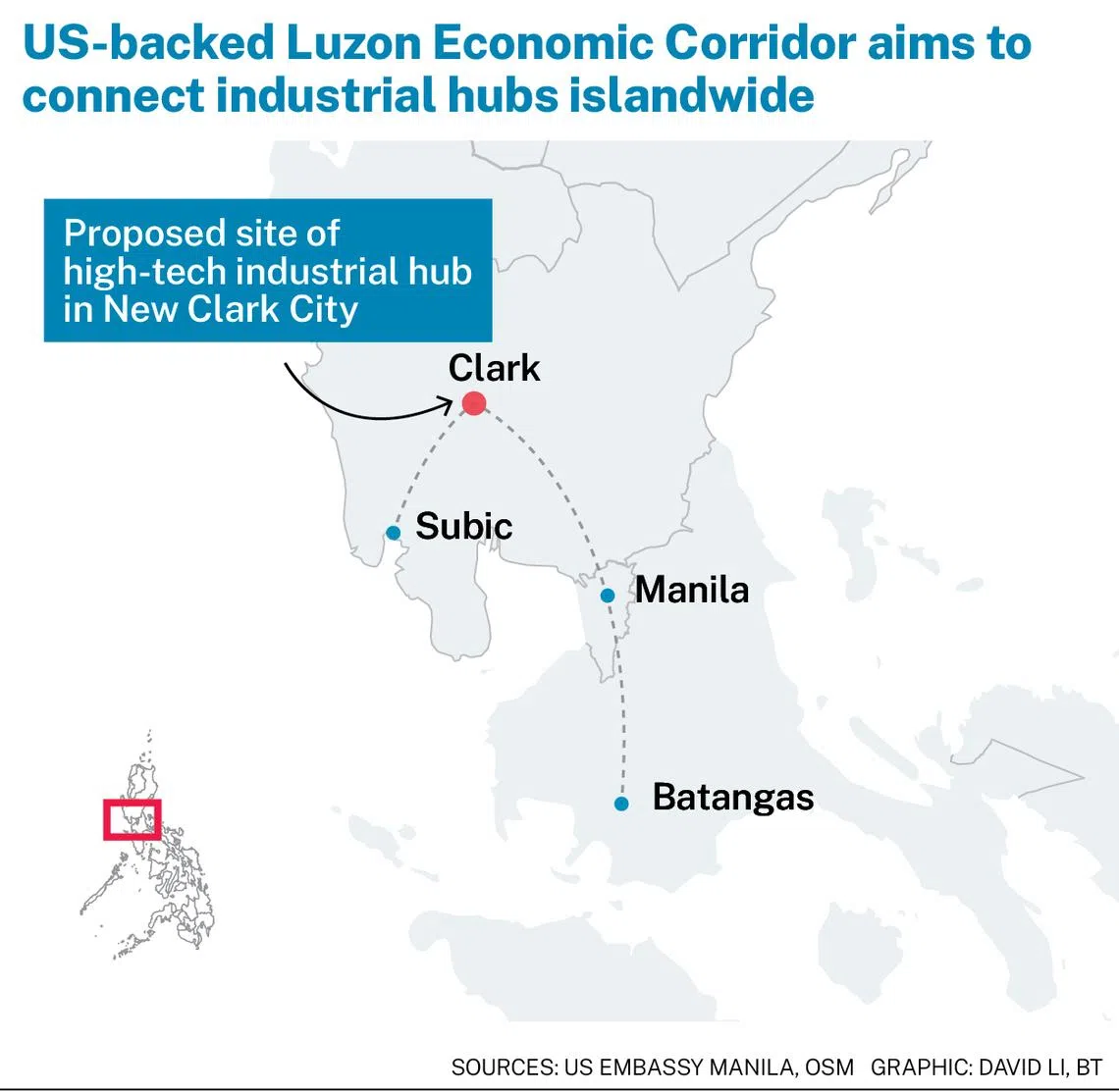
Planned initiatives include a fuel pipeline connecting industrial zones in Subic and Clark, a freight railway connecting key ports and upgrades to fibre optic and undersea cables across the island.
As a result, Luzon could receive the boost it needs to ride the global AI wave through higher-value manufacturing and building supply chains of critical infrastructure.
“By and large, the Philippines is still a laggard when it comes to participation in global supply chains,” said Dr Jayant Menon, visiting senior fellow at the Iseas-Yusof Ishak Institute. “They are involved in electronics, but at the very low end, and they want to change that.”
The LEC was first announced in April 2024 as part of a trilateral partnership between the Philippines, US and Japan, with the goal of improving transport networks, energy access and digital infrastructure along the “corridor”, connecting some of the country’s most important industrial and logistics hubs.
Anchoring the corridor is a planned 1,620-hectare high-tech industrial hub in New Clark City, north of Manila, which is expected to have special economic zone (SEZ) status.

Despite being the country’s largest export category at about US$44.2 billion in 2025, the electronics sector lags far behind its South-east Asian neighbours in trade value.
Malaysia’s semiconductor manufacturing industry is the region’s largest hotspot for back-end operations while attracting heavy investments from major industry players. Singapore’s exports of integrated circuits and status as a research and development hub make it a critical node in the global AI supply chain.
The Philippines’ electronics manufacturers, conversely, remain largely entrenched in consumer electronics or the lower-value assembly, testing and packaging of semiconductors.
Meanwhile, Thailand and Indonesia, while closer to the Philippines in export values for electronics, have firmly anchored competitive advantages within the electric vehicle and automotive manufacturing industries.
The Philippines is targeting to more than double its electronic exports to US$110 billion by 2030, with at least US$70 billion through semiconductors – especially advanced packaging and integrated circuits.
Luzon is an obvious place to try. The island is the country’s economic centre, containing major industrial zones in Metro Manila, Clark, Subic and Batangas, while accounting for about 50 per cent of the Philippines’ gross domestic product.
Philippine officials have envisioned the LEC as a significant economic driver, projecting that up to a million jobs could be created, driving double-digit growth for the economy.
Connectivity issues
Much of the country’s current advanced manufacturing struggles stem from a large physical infrastructure deficit, Dr Menon told The Business Times.
“Limited poor physical connectivity raises transportation, trade and logistics costs,” he said. “The LEC aims to address this deficit.”
Poor energy infrastructure and high costs of electricity have also made manufacturing particularly expensive relative to regional competitors like Vietnam, explained Dr Batu.
Glen Hilton, chairman of Philippine port operator Asian Terminals Inc (ATI), which manages two container terminals in Manila South Harbour and the Port of Batangas, told BT that the lack of road connectivity limits potential in several manufacturing industries.
“A primary challenge is road congestion and first-and-last-mile connectivity, particularly around Metro Manila,” he said.
For the island, a stronger logistical network is a critical prerequisite to integrate Luzon’s economic zones into higher-value industries, Hilton explained.
“These industries operate within highly integrated global production networks where delays, disruptions or uncertainty can have significant impacts on overall operations,” said Hilton, who is also CEO and managing director for Asia-Pacific at ATI’s strategic partner DP World.
Domestic doubts remain
The success of these ambitions also depends on whether the country can maintain the momentum from its foreign investors in the face of domestic roadblocks. On one hand, international involvement can dramatically boost Luzon’s potential as an investment destination, said Dr Batu.
On top of the planned hi-tech industrial hub, the LEC has received a US$6.8 billion commitment by the UK for export financing in the LEC and a US$32.6 million infrastructure investment from Australia.
Additionally, at least six other countries have announced support for upgrades to the island’s airports, shipbuilding facilities and railways.
Multilateral institutions such as the Asian Development Bank are also expected to support projects within the corridor. These external backings could be key to attract even more financing from abroad, compared to projects driven through local investors alone, explained Dr Menon.
Yet on the other hand, such backing does not eliminate domestic risks. He pointed to the highly legalistic nature of project development in the Philippines, where land acquisition disputes often delay infrastructure works.
“The Philippine government is known for red tape,” Dr Batu said. “Construction projects can take forever because of government approvals.”
“It is an open secret that graft and corruption are a key obstacle to completing large infrastructure projects in a cost-effective manner,” Dr Menon added.
Policy continuity will also be critical. Every six years, as each presidential term ends, an administration’s flagship policies can be quickly abandoned by their successors, Dr Batu explained. “The Philippines has a history of changing policies depending on who is in power.”
Even if the infrastructure is completed, analysts said the country would still need to prove that it can translate new connectivity into sustained industrial activity.
Large economic infrastructure projects are not new in South-east Asia, from the Johor-Singapore SEZ to Thailand’s Eastern Economic Corridor.
But Dr Menon noted that the Eastern Economic Corridor was built on decades of automotive manufacturing depth in Thailand’s eastern seaboard. In contrast, the Philippines will need to use the LEC to attract industrial anchors it does not yet have in advanced electronics manufacturing.
“It’s a chicken and egg problem,” he said. “They don’t have these investments – because they don’t have the kind of infrastructure that reduces business and logistics costs, but they need that infrastructure in order to attract the investment.”
Early signals offer some optimism, with Philippine officials saying in June that up to 50 international firms, including tech giants, are reportedly interested in investing within the New Clark City SEZ.
But one thing is clear for now – few expect this initiative to bear fruit in the short term, with potential results expected to take decades to fully yield.
“Infrastructure development, particularly in transport, logistics, energy and trade facilitation, requires a long planning and implementation horizon,” noted ATI’s Hilton.
Dr Menon noted that future generations may well end up reaping the benefits of the LEC, or paying the heavy costs incurred through its development.
“It can reduce the burden on its citizens in some ways, such as reducing the amount of time stuck in traffic,” he noted.
“But it’s also a very expensive project, and in terms of spurring huge investments, I’m not sure these projects are really going to be the key,” Dr Menon said. “The question the Philippines should ask itself is whether this is what it needs right now.”
TRENDING NOW

Once staunchly pro-China, Malaysian Chinese businesses are now distancing themselves from Beijing

Looking beyond looming CEO succession, should UOB potentially pursue a transformative merger?

Could stablecoins be the future of money?

Grab CEO’s wife Chloe Tong on life with Anthony Tan and finding her purpose

