



Gamuda Land doubles down on organic growth, shrugs off Sunway-IJM threat
The developer is set to launch RM10 billion in projects across Malaysia, Vietnam and Singapore over the next 18 months

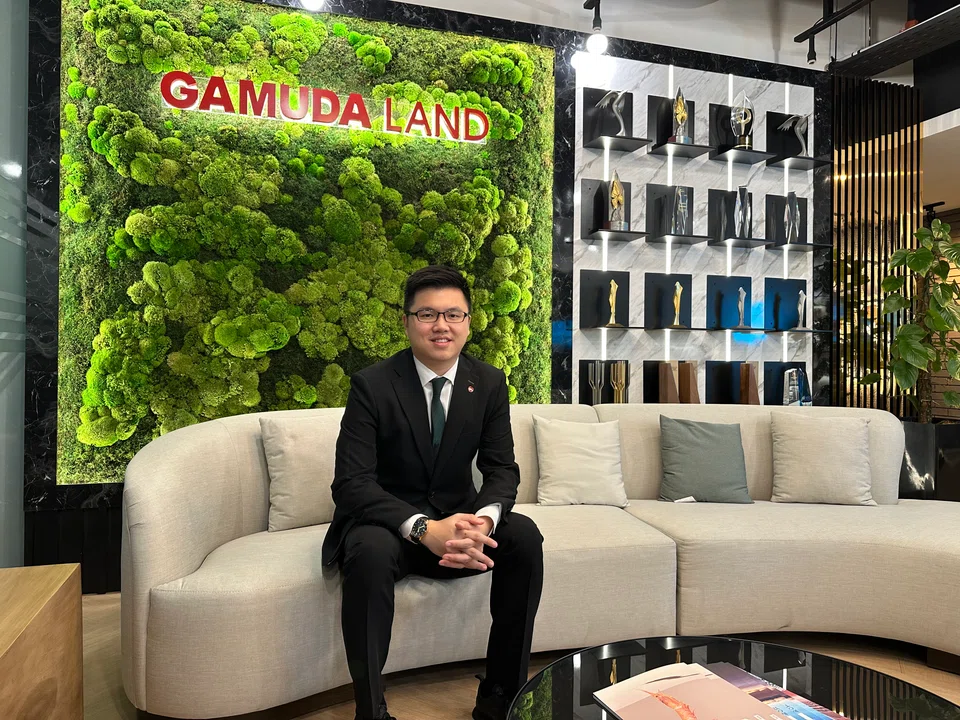
[KUALA LUMPUR] As a potential mega Sunway-IJM merger may redraw Malaysia’s property landscape, Gamuda Land is staking out a different course – grow organically, expand regionally and stay out of the merger game.
“For now, we are not looking at mergers and acquisitions. We do not feel threatened by it in any way,” said newly appointed chief executive Gim Teck Yew. He was responding to concerns that a potential Sunway-IJM merger could intensify competition for Gamuda and its property arm, Gamuda Land, across the construction and infrastructure sectors.
“Our goal is clear: Three years from now, we aim to double our revenue and profit,” Gim told The Business Times in an interview.
Gamuda Land, which posted a revenue of RM3.8 billion (S$1.2 billion) for the 2025 financial year, is set to launch about RM10 billion worth of projects across Malaysia, Vietnam and Singapore over the next 12 to 18 months.
For the first quarter of FY2026, Gamuda Land’s revenue declined 22 per cent to RM860 million, while net profit slipped 6 per cent, primarily due to the absence of a one-off United Kingdom project recognised last year.
Excluding that contribution, underlying revenue actually grew by 18 per cent, while net profit surged 62 per cent, fuelled by strong performance from Vietnam.
The upcoming pipeline will span township developments in Malaysia, quick turnaround projects (often referred to as QTPs) in Vietnam, and a mixed-use project in Singapore, reflecting the developer’s strategy of balancing long-term township assets with faster capital-recycling developments.
Gim, 35, was appointed as the new chief last December and has been based in Malaysia since January after returning from Vietnam, where he served as chief operating officer of Gamuda Land (Vietnam). He previously held positions in established developers such as Sunway Group and Mah Sing Group.
Consolidation not a priority
He noted that mergers can often create operational distractions as companies work through integration challenges, from management restructuring to aligning business processes.
Instead of pursuing corporate takeovers, the developer prefers joint ventures with strategic partners, a model it has used successfully across several projects.
For instance, the Horizon Hills township in Johor is a joint venture between Gamuda and UEM Group – the master developer of Iskandar Puteri in Johor.
“We see competitors not as enemies but as potential partners… If each party has complementary strengths, joint ventures can deliver results much faster than mergers,” he added.
According to Gamuda Land’s annual report, the company holds around 977 hectares of land bank and a remaining gross development value (GDV) of RM61 billion.
Vietnam driving profitability

Gim, who was based in Vietnam for about three and a half years, said he was struck by the strength of housing demand in the country, where some launches exceeded expectations.
At the launch of Eaton Park in Ho Chi Minh City in May 2024, the company had to rent a convention hall as the sales gallery could not cope with the crowd. Initially planning to release 400 units, the developer doubled the offering to 800 units after overwhelming interest, with the units sold out on the first day.
Despite undisclosed Vietnam-specific figures, overseas markets dominated Gamuda Land’s RM860 million revenue and RM60 million net profit in Q1 FY2026, contributing 54 per cent and 65 per cent, respectively.
Gamuda Land has sold around 95 per cent of its five QTPs in Vietnam within two years, including Eaton Park, Elysian and Springville, which together have generated combined sales of around RM4.6 billion.
“In Vietnam, profit margins for housing development are much higher, driven by strong demand,” Gim said, adding that some QTPs in Vietnam can deliver profit margins exceeding 20 per cent, while township developments can achieve around 35 per cent margins over their full development cycle.
Unlike Malaysia’s mature townships, early phases often merely break even due to heavy upfront investment in infrastructure and landscaping. Margins only improve significantly as the development matures and the environment is established, he added.
Gim attributes Vietnam’s high margins to favourable demographics, the growing middle and upper classes, as well as urbanisation, expressing confidence that the surging middle class will fuel housing demand for at least another five to eight years.
“Vietnam has a population of 100 million, and our target market, the upper end of the M40 (middle 40 per cent) and the T20 (top 20 per cent), is about 40 million people… That alone is equivalent to the population of Malaysia and Singapore combined,” he said.
However, he cautioned that not everything in the country is rosy, noting that some developers have struggled after focusing heavily on resort-town developments in coastal areas where demand may not grow as quickly as in major cities.
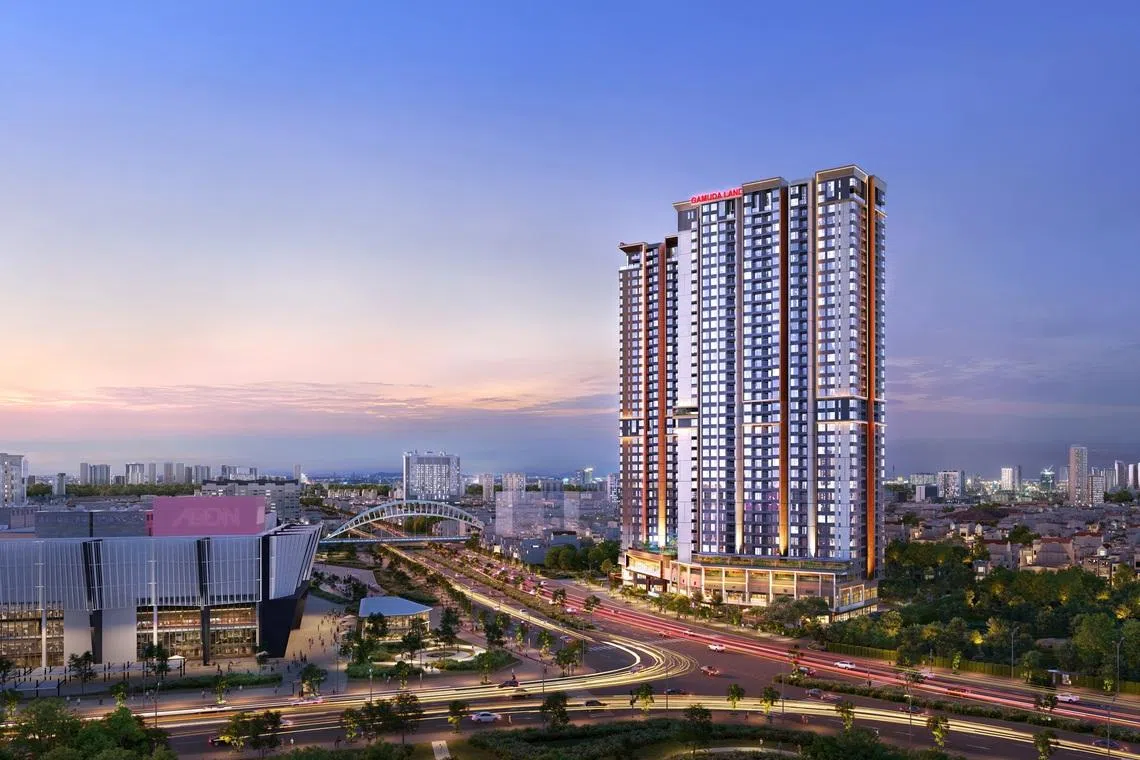
With this in mind, Gamuda Land’s next launches will focus on Ho Chi Minh City and Hanoi, as well as the northern port city of Hai Phong. Collectively, the four new acquisitions across Hai Phong and Ho Chi Minh City will carry an estimated GDV of around RM4 billion.
Gim said Hai Phong is attracting strong industrial activity as multinational companies expand production near the port, which serves as the main maritime gateway for Hanoi.
The developer plans to launch a condominium project called Ambience in May, with an estimated GDV of about RM1 billion and nearly 1,000 residential units.
Singapore’s JV project
Beyond Vietnam and Malaysia, Singapore remains an important pillar of Gamuda Land’s regional strategy.
“Singapore is a place where you can deliver sustainable revenue and margins,” Gim said, adding that two previous projects in Singapore – OLA and Gem Residences – were fully sold with decent profit margins.
Gamuda Land’s upcoming Singapore project – a mixed-use development located near an MRT station with integrated retail and transport connectivity – is expected to launch in March next year.
The Chencharu Close project in Yishun is being developed through a joint venture between Gamuda Land’s wholly owned subsidiary Gamuda (Singapore), which holds a 50 per cent stake, Singapore-based Evia MCS with a 30 per cent stake, and H108 with the remaining 20 per cent stake.
The project has an estimated GDV of S$6.6 billion and is expected to include around 865 residential units and about 100,000 square feet of retail space.
Malaysia remains core
While overseas growth rises, Malaysia remains Gamuda Land’s anchor, said Gim, adding that township developments in Johor and the Klang Valley stay central, supported by the company’s significant land banks.
In Klang Valley, Gamuda Land is preparing a new development on the former Taylor’s College site in SS15, Subang Jaya, featuring residential units alongside purpose-built student accommodation.
The project will complement the developer’s existing township portfolio, including Gamuda Gardens in Rawang and Gamuda Cove in southern Selangor, which are currently at around 20 to 30 per cent completion.
In Johor, Gamuda Land remains cautious about the rising pipeline of high-rise developments, which it believes could lead to oversupply.
“We have seen two to three cycles in Johor over the last 15 years… When the market is hot, it’s very hot, but when it turns, inventory can become a problem,” Gim said, noting that the company will continue to focus on landed homes within township developments.
He observed that such residences are still attracting buyers’ attention. For instance, recent launches at the flagship Horizon Hills township saw landed homes priced above RM2 million snapped up quickly, reflecting sustained demand for spacious houses.
“We observed that Horizon Hills has attracted strong interest from Malaysians working in Singapore as well as retirees seeking more spacious homes across the border,” he said.
The 485.6-hectare Horizon Hills township is now entering its final stages of development, with about three to four years of launches remaining.
In Penang, Gamuda Land is positioning for future launches on Silicon Island – a joint development with the state government – with industrial land sales expected to begin in late 2027, ahead of broader development from 2028.
Australia and UK markets
Outside South-east Asia, the developer is also building a portfolio of recurring-income assets in the United Kingdom, including student accommodation projects in London aimed at international students attending universities such as the London School of Economics and Imperial College London.
In Australia, Gamuda Land is exploring opportunities linked to infrastructure developments alongside its engineering division, particularly around transit-oriented projects.
For now, however, Gim emphasised that the company’s priority remains strengthening its presence in markets where it already has scale and experience.
“We have strong momentum in Malaysia, Vietnam and Singapore… Rather than rushing into new markets, we want to continue building on that momentum,” he said.
TRENDING NOW
Incidence of civil servants buying property near unannounced MRT stations ‘a concern’, but may not establish misconduct: PSD

Grab CEO’s wife Chloe Tong on life with Anthony Tan and finding her purpose

Income Insurance appoints former Manulife Singapore top man as new CEO
HDB reviewing ‘jumbo’ flat scheme after Telok Blangah unit listed for sale at S$2.18m

