Global tech giants drawn to Vietnam’s big push to become advanced manufacturing hub
[HO CHI MINH CITY] For decades, Vietnam has been the home of low-cost manufacturing facilities and cheap labour. In recent years, however, the government and the private sector have made a big push to bring in the best talent in an ongoing effort to become a regional technology manufacturing hub.
This has attracted the attention of numerous global tech giants, many of whom have beefed up their investments in Vietnam’s high-tech sectors.
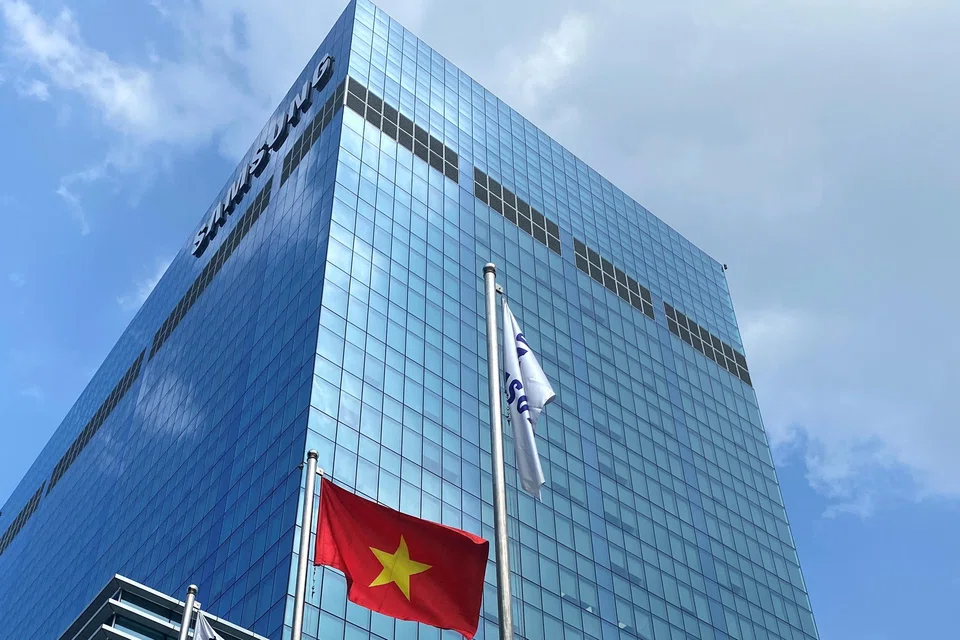
Last December, Samsung inaugurated a US$220 million research and development (R&D) centre in the capital Hanoi, its largest in South-east Asia. Nearly all of the 2,000 staff at the 16-storey facility are local tech talent who graduated from the country’s top universities.
Last Saturday (Jun 24), the centre received its highest-profile visitor to date in the form of South Korean President Yoon Suk-yeol, who said that Seoul would support more joint research activities between South Korea and Vietnam. Based on the latest figures, Samsung Electronics produces more than half of the smartphones it sells each year around the world in Vietnam.
In the first half of this year alone, several big names have announced major plans to grow their presence in Vietnam.
Apple supplier BOE Technology Group said it would invest US$400 million to build two factories in Vietnam, while US semiconductor company Marvell Technology will establish an integrated circuit design centre in Ho Chi Minh City, the economic centre of Vietnam.
LG Electronics intends to scale up its R&D operations in Vietnam, to strengthen the company’s growing electric vehicle parts business.
Last August, US aviation company Boeing held its inaugural aerospace industry forum in Vietnam, mainly to hunt for local suppliers to join its global aerospace supply chain.
Besides offering internships, scholarships and training programmes to leverage Vietnam’s workforce to fill thousands of available jobs, these multinationals and their growing presence will boost the supporting industries of these high-tech sectors, said industry observers.
This would, in turn, be a boon to the growth of Vietnam’s deep-tech startups – the next generation of innovative businesses – following decades of adopting foreign technology in industries such as electronics and mechanical engineering.
Touchstone Partners, an early-stage venture capital (VC) firm founded in Vietnam, wants to invest more in these startups, despite their capital-intensive nature and unfamiliar fundraising paths in the local market, said the company’s general partner, Ngo Thuy Ngoc Tu.
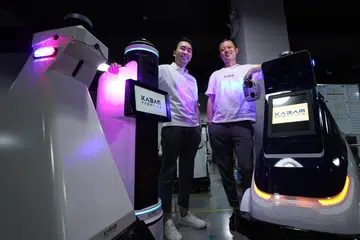
Touchstone has financed companies such as Singaporean-Vietnamese startup Forte Biotech – which provides diagnostic kits to help farmers detect infections – e-scooter manufacturer Selex and autonomous delivery robot developer Alpha Asimov.
Burgeoning deep-tech ecosystem
Paul Kallmes, a Silicon Valley veteran who specialises in intellectual property (IP) and international market entry, said that the sizeable foreign investment into Vietnam means the country must work hard to maintain its favourable environment and growing reputation.
Kallmes visited Vietnam in April this year to provide training and mentoring for researchers and scientists participating in an incubation programme called Lab2Market.
“The quality of the design and manufacturing that I encountered in Vietnam really stands out,” he said. “From smart robotic grippers to electric motorcycles to medical devices, there is a substantial amount of design and manufacturing capability, much of it done on a comparatively shoestring budget.”
Launched in 2021, Lab2Market is the first incubation programme in Vietnam that aims to commercialise research in universities and research institutes.
The programme is organised by BK Holdings (Hanoi University of Science and Technology), and co-organised by the National Startup Support Centre of Vietnam, BK Fund and the Swiss Entrepreneurship Program.
Jen Vu Huong, the manager of Lab2Market, noted that Vietnam’s government has defined innovation, science and technology as key growth drivers of the economy, with the country hoping to become a high-income nation by 2045.
“This innovation-led economy means we need to focus more on the development of new IP, and produce knowledge-intensive products for export,” she said.
Tu from Touchstone Partners echoed this viewpoint. She said Vietnam’s large talent pool in Stem (science, technology, engineering and mathematics) and strong entrepreneurial spirit will pave the way for the next wave of tech solutions in the country.
On their part, some Vietnam corporations have also taken steps to build their deep-tech capabilities through open innovation efforts.
In 2020, Becamex Investment and Industrial Development Corporation, Vietnam’s leading industrial park and township developer group, partnered with Singapore’s NUS Enterprise – the entrepreneurial arm of the National University of Singapore – to launch Block 71 Saigon, a technology-focused ecosystem builder and global connector which catalyses and aggregates the startup community.
A year later, Imex Pan Pacific Group collaborated with Vietnam National University to establish a 32 billion dong (S$1.8 million) artificial intelligence and robotics centre within the university’s information technology park.
“In a mature ecosystem, there is strong connectivity between universities, research labs, VCs and private equity funding sources. Our job in Vietnam is to connect these touch points together,” Tu said.
“Once the ecosystem is built, I believe there will be more corporates interested in investing in the R&D phase of pre-investment startups in deep-tech and hardware, which will benefit their own industries and businesses.”