Handing out billions of dollars worth of free meals puts heavy strain on Indonesia’s budget
Despite its scale, there is little sign that the programme will be an economic game changer
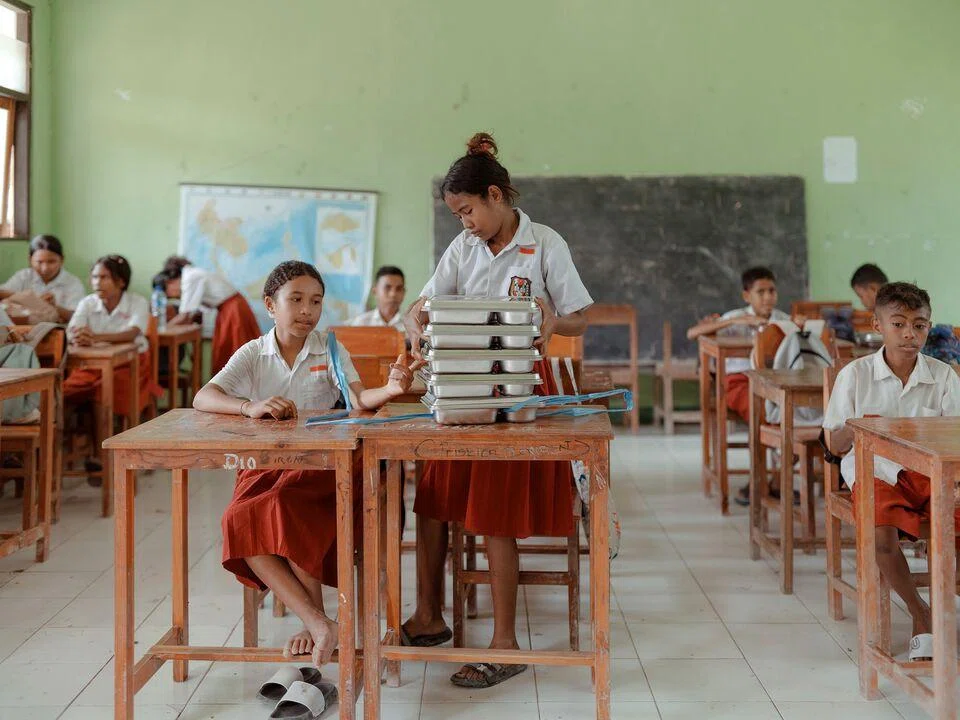
[JAKARTA] At a small, blue-and-white building in Indonesia’s southernmost province, pots and pans start clanging before dawn.
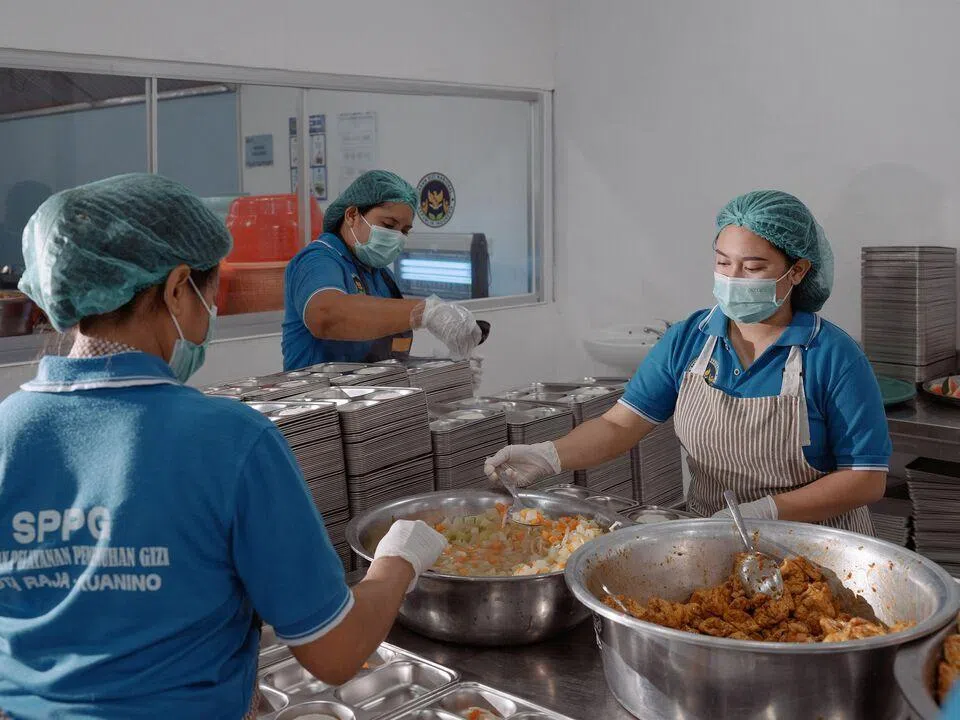
Almost every day, workers at this kitchen prepare about 2,500 meals for local schools and community health hubs.
The coastal Timor village is closer to Australia than Jakarta, one speck in a vast programme that President Prabowo Subianto wants enacted at breakneck speed to provide free meals to every child across the thousands of islands that comprise Indonesia, regardless of whether they want or need it.
“The work goes on continuously, day after day,” said Yufrianti Hautias, 24, a former teacher who now oversees the kitchen in Toineke. “As one team finishes, the next takes over.”
The programme was a pillar of the campaign that ushered Prabowo into office in 2024, and has rapidly become one of the largest of its kind in the world.
But the cost to run it is enormous, soaking up more than 6 per cent of the national budget, and visits by Bloomberg News to kitchens, schools and markets yield little evidence that the programme in its early stages is an economic game changer.
Farmers here say they have yet to see a surge in profits, and some kids are still leaving school hungry. The logistics of delivering meals over vast distances are testing remote kitchens, and critics say the programme would be more effective if it were targeted only at recipients in need.
Investors and analysts, meanwhile, doubt the meals will have the sort of multiplier effect to warrant such a large outlay, especially with Indonesia’s finances already under strain.
“I would give it an ‘F’,” said Bhima Yudhistira Adhinegara, executive director of the Jakarta-based Center of Economic and Law Studies (Celios). “The free meals programme is quite problematic in the fiscal space but also on the ground.”
SEE ALSO


Prabowo, a retired army general, sees the meals as a pathway to better nutrition and school retention, while also helping farmers, creating jobs and boosting consumption and economic growth. The programme promises a well-balanced meal on weekdays for schoolchildren, as well as six days a week for toddlers, breastfeeding mothers and pregnant women.
The government spent 51.5 trillion rupiah (S$3.8 billion) on it in 2025.
This year, it has set aside five times that amount, according to the nutrition agency overseeing the programme, and aims to serve nearly 83 million people – around 30 per cent of the population. The finance ministry earlier signalled 2026 funding could be even higher.
“I did it because I could not see our children malnourished,” Prabowo said in a March interview. “What I hear everywhere now is an increase in prosperity at the village level.”
Yet, investors are concerned that the nation may have to bust through a long-held 3 per cent budget deficit ceiling. Moody’s Ratings and Fitch Ratings have cut Indonesia’s credit outlook to negative, and the Iran war is raising worries about energy costs and inflation.
Some critics in Indonesia have questioned whether free meals are more about Prabowo’s popularity and prestige – a father figure feeding his people – than real benefits for South-east Asia’s biggest economy.
“We see the scale of the programme as a net negative development,” said Louis Lau, a San Diego-based portfolio manager at Brandes Investment Partners. “It raises questions about how the priorities within the fiscal budget are being considered, and the higher level of spending that will likely continue in 2027 and beyond.”
If anything, Prabowo wants to go further, including potentially expanding the programme to the elderly. Dadan Hindayana, who heads the nutrition agency, says he often speaks to the president several times a week.
The main guidance is “go faster”.
“What are the opportunity costs?”
There are already more than 25,000 kitchens across Indonesia, each serving up to 3,000 meals daily.
That includes the one in Timor’s East Nusa Tenggara province, among the country’s poorest areas.
On a March morning, kitchen workers in hairnets, gloves and masks sing while preparing meals: dragonfruit, rice, beans and carrots, tempeh (fermented soya beans) and a boiled egg. Filled trays are stacked, trucks are loaded, and drivers begin hours-long deliveries.
Meals are dropped off at a tiny preschool, where four children play with stones marked with numbers and letters. At an elementary school, children file into a classroom; one says a prayer before they all open their trays.
The headmistress says a free meal is always good, but to keep kids showing up and engaged, it’s more important to have funds for better facilities, including a library. The school has a single projector and three laptops, which are shared among hundreds of students.
“What are the opportunity costs of doing this programme instead of other programmes that the government could be doing with the allocated budget?” asked Jimmy Berlianto, senior researcher at the Center for Indonesian Policy Studies.
Running a kitchen in such a remote area is rife with challenges.
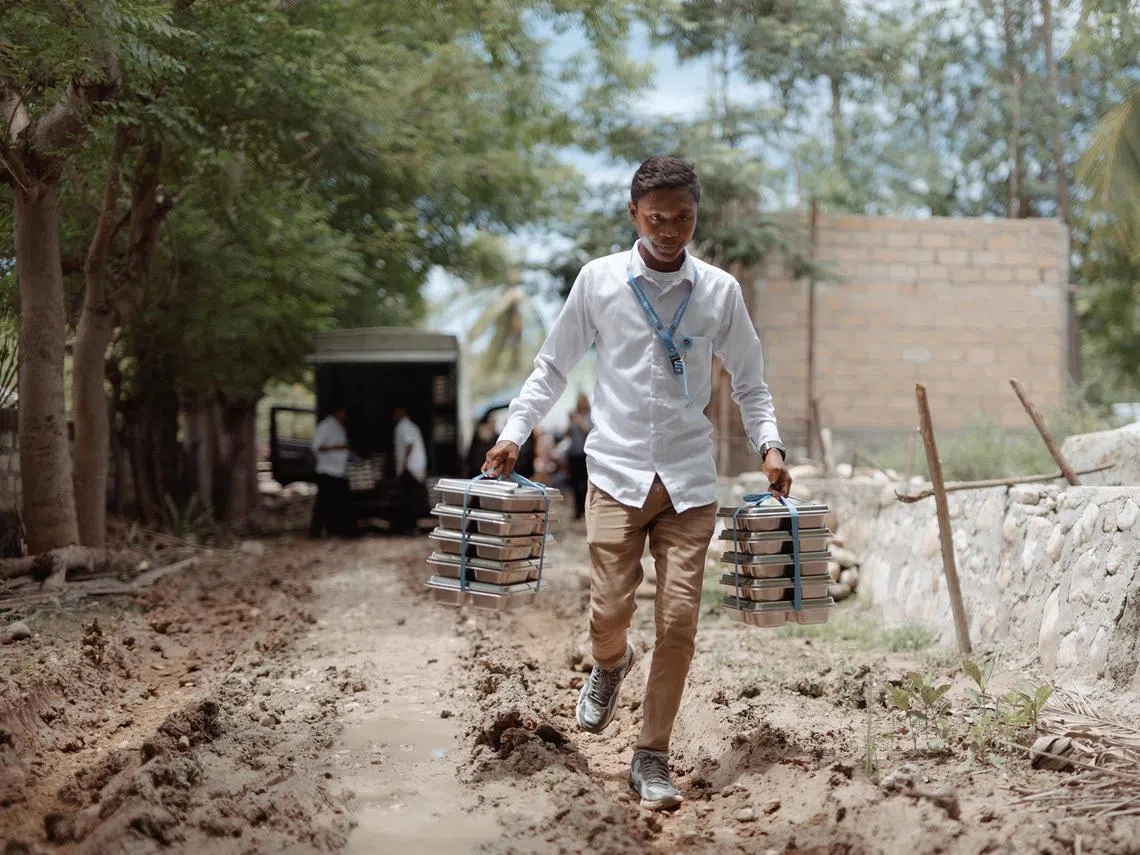
Getting fresh ingredients requires a four-hour round trip, because local farmers are unable to supply sufficient amounts. Attempting to deliver to a health hub – a small open building where pregnant and breastfeeding mothers gather – one truck gets stuck in the mud. Workers carry the trays the rest of the way.
“The distances are long and some delivery points serve just 10 or 20 people,” Hautias said. “With muddy roads and frequent flooding, getting meals to them is often a real challenge.”
Nationally, wider problems have arisen, including well-documented issues with food poisoning. Parents complain that kids come home hungry, or that meals can include ultra-processed snacks.
Hindayana acknowledged the need for fixes, but otherwise said that “the programme will go as designed”. Even so, the agency has halted the operations of more than 2,000 kitchens for issues such as food hygiene breaches or temporarily suspended payments.
Hindayana said all kitchens are being assessed and talks of an accreditation system with defined metrics, such as rating each “A”, “B” or “C”. “The first thing is quantity and the next is quality,” he said.
The government has said that the free meals are generating jobs and boosting consumption. Economic modelling by the National Research and Innovation Agency estimates the programme could add 14.5 trillion to 26 trillion rupiah to gross domestic product.
Still, that’s a fraction of the potential outlay this year alone.
Some Cabinet ministers are unhappy that free meals are taking up so much of the budget, but are fearful about raising it with Prabowo, knowing how wedded he is to the programme and because of his temper, said sources familiar with the matter, asking not to be identified given its sensitivity.
Activists are lobbying for change; there are court cases seeking to halt the programme, saying it should be targeted at regions with demonstrated need. The nutrition agency has instructed kitchen heads not to force participation.
Asked in the March interview if he would cut the programme to tame the budget, Prabowo said: “I wouldn’t touch free meals.”
However, days later, the government announced that it would largely be capped at five days a week, trimming spending by about 20 trillion rupiah. A spokesperson for the finance ministry did not immediately respond to a request for comment on whether there are any further budget cuts planned for the programme.
Benefits yet to materialise
Celios’ Adhinegara said research has found staff at kitchens, which each have about 47 workers, are classed as volunteers, paid hourly. And there is a substitutional effect on pre-existing canteens or small enterprises that used to provide school meals.
Farmers also say they have yet to see a windfall.
At a market in Kupang, the biggest city on Timor, one vendor said that she and her husband would sometimes get orders from a kitchen, but they often came late in the day, leaving them scrambling to source from farmers. It proved too stressful for the money.
Another said that he received orders for produce, such as oranges, though only sporadically.
Rinto Jami, 26, rents four plots nearby, growing green vegetables with his parents that can be harvested nearly year-round. But when a kitchen approached him to be a supplier, they named a price barely above the cost of production. He said no.
“If we were making losses, who exactly is feeding the children – the farmers or the government?” said Dina Udju Edo, Jami’s mother, as they crouched in the field, sorting vegetables.
Nutrition concerns
The core health issue behind the programme is an important one: Nearly one-fifth of Indonesian children suffered from stunting as of 2024, an issue linked to malnutrition. But hawking healthy food has also come up against a familiar challenge, convincing kids to eat it.
Pupils at a Kupang elementary school push green beans around their trays, and several roll their eyes at the sight of a fried egg covered in thick red sauce. One enterprising girl brought in chickpea snacks to add to her rice.
Novi Melani Kasaban, a nutritionist at the local kitchen, says they have struggled to get city kids to warm up to the meals. Some are used to buying snacks at stalls outside the school gate; others prefer the food they used to bring from home. They are having to convince parents and kids alike that a meal that is less tasty may be better for them.
“We follow the children’s preferences,” she said, adding that chicken katsu is a favourite. “They didn’t like sauteed vegetables, so we look for other ways to prepare them.”
To connect with kids, one delivery driver has taken to dressing up in superhero costumes. And there are signs of change: A nearby snack vendor says the 250,000 rupiah she used to sell daily is down by half. However, groups of kids still venture outside the school for a bite: small ice creams, or bowls of noodle soup.
“We have no complaint but the portion is small, so my son would ask me to pack him lunch with rice,” said Erlind Lie, a mother of two.
Polls show Prabowo remains popular, with nearly 80 per cent of Indonesians satisfied or very satisfied with his performance, according to a January survey by Indikator Politik Indonesia.
The free meals are a fulfilment of his presidential campaign, and his support was highest in villages – a boon if he runs for re-election after his five-year term.
“People here aren’t fussy, like in the city,” said Hautias from the rural Timor kitchen. “The leftovers are not much.”
Still, support for the meals themselves appears to be waning. In surveys taken in March and October 2025, there was a drop of 0.27 points on a four-point scale, even as support for Prabowo remained steady, according to a report from the Singapore-based Iseas-Yusof Ishak Institute.
For Hautias, the focus remains on the day-to-day logistics of just making the programme work. Staff in her remote kitchen cycle through in round-the-clock shifts. Afternoons are spent prepping ingredients, and cooking starts at 2 am. The meal-packing team will arrive again before dawn.
“Sundays are a bit quieter, but even then, we have to prepare for Monday distribution,” she said. “There is essentially no time for us to rest.” BLOOMBERG
Decoding Asia newsletter: your guide to navigating Asia in a new global order. Sign up here to get Decoding Asia newsletter. Delivered to your inbox. Free.
Share with us your feedback on BT's products and services