Helping Vietnam’s solar players improve quality, not just speed of growth
Advanced Vision Analytics’s tech can optimise the performance of solar panels

Sharon See
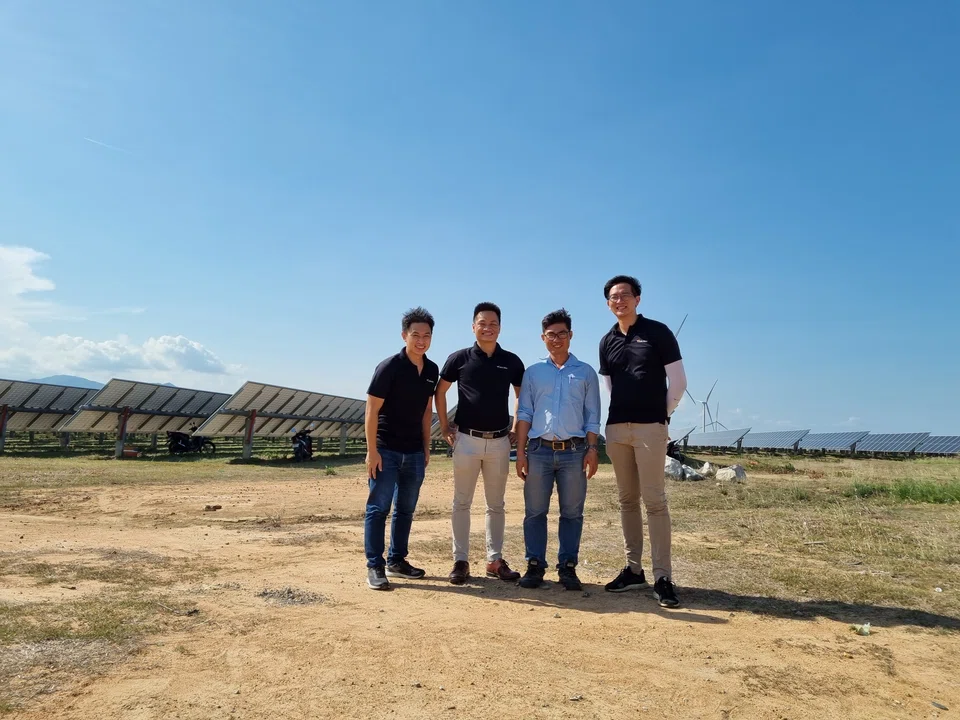
THE Philippines was a natural first market to enter in South-east Asia when Singapore-based Advanced Vision Analytics (AVA) wanted to expand.
The company started in 2017 as a business that helped solar energy players optimise the performance of their photovoltaic (PV) panels.
At the time, the Philippines had a solar power generation capacity of close to 900 megawatts (MW), making it second to only Thailand in market size. However, its market was soon dwarfed by Vietnam’s growth spurt in 2019.
As AVA’s chief executive and co-founder Lee Wei Yik put it, the company decided: “We definitely have to be there.”
Lee reckons that one of the reasons Vietnam’s solar industry has taken off so quickly is its emphasis on speed rather than quality.
“Because how are the Vietnamese able to build 50 MW of plants in three months’ time, whereas in Singapore, Sembcorp’s floating solar project took 1.5 years? It is a six to seven times difference in terms of speed,” he said in an interview with The Business Times. “What is the sacrifice there? Definitely, it’s quality.”
He added that some businesses take a short-term business perspective: they may plan to sell their assets within the year and hence do not have the incentive to build solar panels that last 20 years, unlike players in Singapore who focus on the longer term.
But all is not lost, since lower-quality solar panels can be slowly improved or optimised later, he said.
This is where Lee’s business comes in. AVA uses drones and the Internet of Things to detect defects in solar panels, and uses data analytics to improve their performance.
But Lee emphasises that the firm does not only thrive on businesses taking a short-term view. It serves a wide spectrum of clients, including buyers of solar assets who need to do due diligence before a transaction, and long-term plant owners who want to improve the quality of their assets.
Solar panels can become defective from wear and tear or poor workmanship. Such defects, if undetected, may reduce the system’s efficiency or output, resulting in a substantial drop in performance.
But the problems that solar PV systems run into are not limited to just hardware or software, added Lee. Operational inefficiencies can exacerbate the issue.
“For example, how fast the operation and maintenance team reacts to the problem – because the reaction time will determine how much (of) the production is being lost,” Lee said.
To gain a foothold in Vietnam’s booming renewable energy sector in 2019, Lee visited one company after another in the early stages of AVA’s foray there, while making dozens of cold calls in what he described as a start on “very hard ground”.
But that effort has since paid off. The Vietnam segment now accounts for more than half of AVA’s revenue, while the Philippines stands at 30 per cent, and Malaysia – which AVA also entered in 2019 – at 10 per cent.
The speed at which Vietnam’s renewable energy market is evolving, Lee said, has become a major driving force in pushing the company to innovate and develop new solutions.
“The Vietnam market has evolved so fast in terms of their adoption of technology, in terms of the competition,” he said. “Businesses like us have to push ourselves very hard to be very innovative – and be very willing to be innovative, as well. If not, we will lose the market entirely within a year or two.”
The good thing about being forced to keep up, he added, is that AVA gets a glimpse of the kind of solutions that will be needed across the rest of the region in the near future.
“Whatever right now our Vietnamese client wants, I know that in two, three or four years down the road, the entire region will need the same thing. So they are the frontier right now,” he said.
In 2020, beyond drone inspections, clients in Vietnam started to request that testing be done on every single panel. This includes a type of test called I-V curve tracing, which ensures PV panels are at optimal performance.
The following year, clients wanted electroluminescence testing to detect hidden defects in PV cells. This year, they would like a system that can integrate and analyse all the data gathered from multiple solar plants.
“They are really stepping up from the previous fundamentals and building on these things, while the rest of the region is still asking, ‘What is the benefit of doing drone inspection, what can we see?’ So it’s still a very introductory kind of data,” he said. “But in Vietnam, drone inspections are so normal, they are on another level already.”
This story is part of a new BT regional series on South-east Asian markets. In the coming months, BT journalists will head to different countries in the region to bring you the latest from the ground.