



High chilli prices feed inflation in Indonesia ahead of central bank’s rate decision

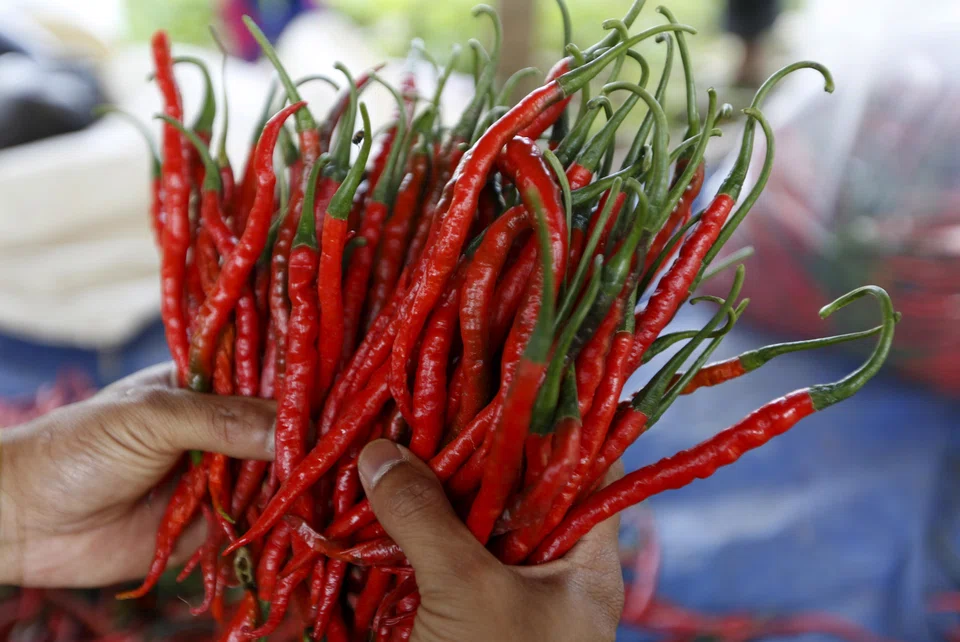
[JAKARTA] The tiny but mighty chilli padi – or bird’s eye chilli – is having an outsized impact on inflation in Indonesia, exposing gaps in the country’s food production and distribution system that the government still struggles to overcome.
This is unlikely to adversely impact Bank Indonesia’s interest rate decision on Thursday (Dec 21), but will bear watching.
Chilli prices reached another record on Monday, with some regions reporting prices above 100,000 rupiah (S$10) per kg. This was 50 per cent higher than in October, according to data compiled by the Jakarta Food Information portal.
The red variety of bird’s eye chilli – a staple food ingredient in Indonesia used as a garnish, in sambal, or served on the side – traded at 165,000 rupiah per kg in Tarakan, North Kalimantan; and 96,000 rupiah per kg in Batam.
Chillies were the primary driver of inflation in November, according to Indonesia’s statistics board, accounting for 16 basis points of the 38-basis-point month-on-month increase in the consumer price index.
Economists are not concerned yet, though. Inflation has stayed within the central bank’s 2 to 4 per cent target range this year for six consecutive months.
The rupiah has gained nearly 2 per cent since a surprise rate hike in October, easing pressure on imported prices.
David Sumual, chief economist at Bank Central Asia, said food inflation will have a smaller impact on the central bank’s upcoming decision. The focus will more likely be on global developments rather than domestic factors.
“We expect inflation to remain under control, since any domestically driven inflation would likely still be counterbalanced by the global disinflationary trend,” he said.
The red-hot chilli prices can, nevertheless, be felt across the economy.
Restaurant owner Khalimah, 49, has reduced the amount of sambal paste she serves with her best-selling ayam geprek, a crispy smashed fried chicken dish. If she is to keep her selling prices steady, she can only offer her customers half a spoonful of chilli for one portion of chicken.
“With every price rising, it’s very difficult to maintain the overhead cost. I have to juggle to keep the taste while maintaining the cost,” she told The Business Times.
Indonesia produces about two million tonnes of chillies annually, mostly in Java and Sumatra. The agri-commodity is in short supply because of a drought-induced crop failure, said National Food Agency (NFA) head Arief Prasetyo Adi.
The problem is exacerbated by the country’s underdeveloped supply-chain infrastructure. For instance, some parts of Indonesia have a larger supply of chillies than others. NFA’s Adi said efforts are underway to “distribute chillies from regions with surplus production to provinces experiencing low supply”.
Mukhammad Faisol Amir, a researcher at the Center for Indonesian Policy Studies, said both water supply and infrastructure issues need to be fixed if Indonesia is to grow or even maintain agricultural production – and not just for its chillies.
The Indonesian government is increasingly concerned about rising food prices. South-east Asia’s biggest economy also faces a shortage of rice, another staple food.
There is a recurring pattern of price hikes during festive seasons such as Christmas, New Year and Ramadan, said Radhika Rao, a chief economist of DBS.
Next year’s general election, scheduled for Feb 14, is not helping either. Campaign-related spending typically puts more money in consumers’ pockets.
Inflation in the first 11 months of this year has averaged 3.8 per cent year on year – at the higher end of the central bank’s target range. Headline inflation has receded, but prices of several items have been rising since the middle of the year.
“There are incipient pressures in a few segments, particularly food, cigarettes, utilities, and housing rents, while the risk of further adjustments to fuel prices remains low in an election year,” said Rao. She expects full-year inflation to average around 3.7 per cent.
TRENDING NOW

Cracks emerge in AI borrowing boom as CoreWeave, Oracle and SoftBank debt worries grow

Could stablecoins be the future of money?

‘How many will survive?’: Bubble fears arise as China’s humanoid robotics face reality check

Philippine power giant First Gen rebuffs foreign offers, plans up to US$2.6 billion in expansion

