Ho Chi Minh City launches first metro line, plans to fast track 7 more by 2035
Vietnam’s southern metropolis eyes bond issuances to partially fund upcoming projects with less reliance on official development assistance
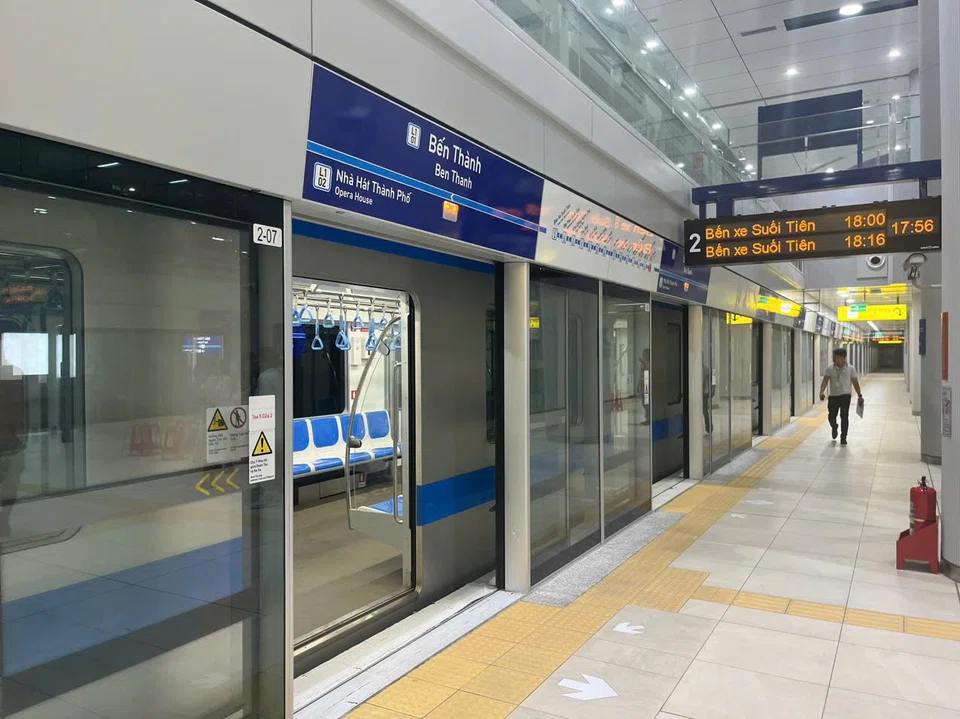
[HO CHI MINH CITY] Vietnam’s southern metropolis Ho Chi Minh City marked a major milestone in its long-awaited mass transit development on Sunday (Dec 22), with the official launch of its first metro line after a six-year delay.
The Ben Thanh-Suoi Tien section, or Metro Line No 1, is the first of eight planned routes that will form a comprehensive mass transit system for Vietnam’s largest and most populous city.
This marks the country’s third metro line, following the first two in the capital, Hanoi.
The latest line – which broke ground in 2012 – spans some 20 km and has 11 elevated stations and three underground ones. It connects the downtown area to Ho Chi Minh City’s eastern gateway, which borders Vietnam’s largest southern industrial hubs, Binh Duong and Dong Nai.
Funded primarily through Japan’s official development assistance (ODA), the project has incurred a total investment of over 43.7 trillion dong (S$2.32 billion), more than double its original cost planned in 2007.
Challenges in investment plan adjustments, site clearances, administrative procedures, technical construction, personnel and the pandemic have contributed to the six-year delay, said the project’s manager.
In addition, since Metro Line No 1 was the first project of its kind in the city, various policies and regulations had to be adjusted.
The previous two lines in Hanoi also faced similar issues and were behind schedule by six to nine years, with significant cost overruns.
Under the latest proposal introduced by the city’s People’s Committee earlier this month, Ho Chi Minh City intends to accelerate the development of the remaining seven metro lines in the next decade, from 183 km to 355 km, with an estimated investment of US$40.2 billion.
By 2045, the city aims to have three additional lines, bringing the total length of track to 510 km, 15 years ahead of the original schedule.
It also proposed 43 special mechanisms and policies to resolve bottlenecks seen in previous projects, and accelerate the development of the metro network.
While the primary funding for the urban railway system continues to come from public investment, including state revenues, bond issuances and ODA, the city is also actively seeking private investors for commercially viable metro projects.
Reduce reliance on ODA
Other countries have extensively funded Vietnam’s first metro lines. Therefore, Vietnam has relied on diverse foreign technologies, equipment and contractors for its metro development over the past decade.
Japan’s government provided about 200 billion yen (S$1.8 billion) in ODA capital for Ho Chi Minh City’s Metro Line No 1 from 2007 to 2023. The Asian Development Bank, Germany’s KfW Development Bank, and the European Investment Bank are providing loans for the construction of Metro Line No 2.
Meanwhile, in Hanoi, the first metro line used mainly Chinese ODA and the second route was financed primarily by France.
To lessen ODA dependence, Ho Chi Minh City has proposed more robust issuances of municipal bonds to mobilise capital, aligning with the government’s aim to diversify capital-raising channels to fund the urban railway network.
According to the latest proposal, about US$4.43 billion can be mobilised by municipal bond issuances and other domestic loans during the 2026-2030 period, accounting for about one-quarter of the total capital planned for Ho Chi Minh City’s metro network during the period.
Government bond issuance is also mentioned as a fundraising channel for the US$67 billion express railway project connecting Hanoi and Ho Chi Minh City.
Experts see this as an opportunity for Vietnam to develop its relatively small domestic bond market with longer maturities and new products. It will also ensure sustainable financing for critical infrastructure as well as align with Vietnam’s long-term goal of building fiscal resilience and economic independence.
However, the low yields and limited liquidity of local-currency government and municipal bonds in Vietnam make them unattractive to investors and asset managers.
As at the end of 2023, the values of listed government bonds and municipal bonds on the Hanoi Stock Exchange were equivalent to about 17.6 per cent and 0.1 per cent of the country’s gross domestic product, respectively, indicated data from the Vietnam Bond Market Association.
Government bond yields are low relative to the policy rate, private sector lending rates, and peer countries in South-east Asia, according to a study released in September by the International Monetary Fund. The investor base is also small, concentrated in banks, insurers and the Vietnam Social Security fund.
In addition, to ensure debt safety requirements, the city also needs to consider estimated revenues from metro operations, which are still largely dependent on subsidised ticket sales.
The operator of the Cat Linh-Ha Dong metro line in Hanoi, which opened in 2021, reported profits for the second consecutive year in 2023 at more than 13 billion dong after suffering losses for seven years running. However, over 85 per cent of its revenue still comes from state subsidies.
So far, vacant areas at some spacious stations in Hanoi have also not been utilised for commercial activities due to regulatory bottlenecks in the use of public properties.
In Ho Chi Minh City, since 2020, there has been no new information about the resumption of the previously approved development of an underground shopping mall located at the Ben Thanh metro station in District 1, the city’s main commercial area.
In 2016, the 18,000 square metre project was projected to cost 6.8 trillion dong and planned for completion at the same time as Metro Line No 1. However, the city later announced its postponement due to failure to attract investors.
TRENDING NOW
Grab CEO’s wife Chloe Tong on life with Anthony Tan and finding her purpose
US trade chief to consider trade deal tariff caps in excess capacity probe
Bee Cheng Hiang customers’ e-mail addresses exposed in Singapore’s first case of AI-related data breach
DFI Retail to take over Starbucks business in Asia from Maxim’s Caterers