



How a Taiwan electronics firm’s subsidiary became Thailand’s largest listed company
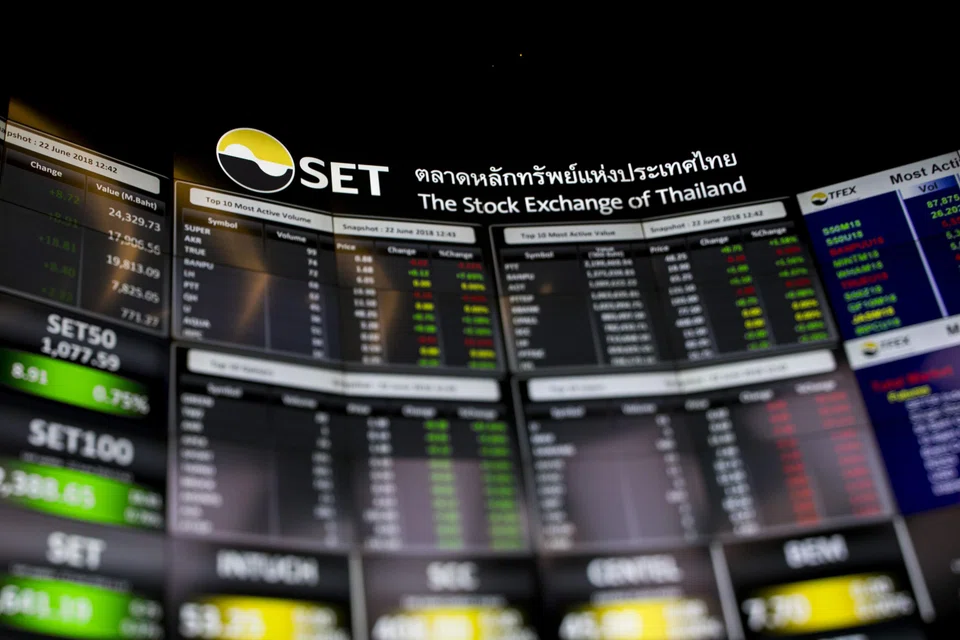
[BANGKOK] On Dec 30, the last day of trading for the Stock Exchange of Thailand (SET) in 2022, a piece of history was created.
That was the day the share price of Delta Electronics (Thailand) touched a then all-time high of 876 baht (S$35.10).
This was an increase of over 154 baht from the previous day’s close, and turned Delta – an exporter and manufacturer of power supplies and electronic components – into the largest listed company in Thailand for the day with a market capitalisation of more than 1.09 trillion baht.
The share price went even higher in the new year, reaching 930 baht on Jan 3. The stock was trading at 914 baht on Tuesday morning (Jan 24).
The question that many traders and analysts wanted to know was how a Taiwanese subsidiary ended up becoming one of the top three listed companies on the SET, alongside the other market cap leaders such as national petroleum company PTT and state-owned airport operator AOT.
Delta Thailand’s dramatic rise on the SET started sometime in the middle of 2020, not long after the Thai government introduced Covid-19-related lockdowns to curb the spread of the virus, in line with much of the rest of the world.
Delta Thailand is a subsidiary of Taiwan-based Delta Electronics, a leading power management solutions provider, and a designer and manufacturer of electronic components. Delta Thailand was set up in 1988 and went public in 1995.
Initially, the two companies were kept separate with Delta Thailand concentrating on the European Union, US, India and Asean markets. Delta Taiwan, meanwhile, focused on mainland China.
That structure changed slightly in early 2019, when Delta Taiwan acquired Delta Thailand and incorporated its revenues into those of the mother company (leading to a surge in Delta Electronics’ revenues that year).
According to its website, Delta Electronics’ consolidated sales in 2022 was NT$384.4 trillion (S$16.7 billion), up 22 per cent year on year.
Delta Thailand is expected to achieve revenues of 117.1 billion baht (S$4.47 billion) in 2022, up 38 per cent year on year, with an anticipated profit of 15.2 billion baht, up 127 per cent year on year, according to estimates by Bualuang Securities.
While those numbers provide a healthy bottom line, they don’t necessarily tell the full story behind Delta Thailand’s somewhat spectacular and volatile performance on the SET over the past three years.
Naturally, there has been a lot of talk in the market about stock speculation.
“Apart from the fundamentals, Delta Thailand has a low free float of shares, so it’s easy for the stock to go up or down,” said Napon Jaison, a tech sector analyst at Bualuang.
Huge stocks such as PTT and AOT have many more shares on SET, so they are harder to manipulate price-wise, Napon noted.
There are other reasons for Delta Thailand’s wild ride. During the pandemic, the company benefited from the global work-from-home (WFH) trend as many of the power systems and electronic components it makes are aimed at WFH products and services.
At one point in 2020, Delta Thailand’s stock price surged 1,400 per cent year on year to 838 baht, in part because it was one of the few companies doing well during (and because of) the pandemic, according to Bualuang.
With the pandemic now ebbing and other SET-listed stocks starting to pick up alongside the economic recovery, Delta Thailand’s spectacular stock price rise is expected to slow in 2023, but not altogether run out of steam.
“Fortunately, Delta Thailand has another rising star business, which is electric vehicles (EVs),” said Napon. “The economic slowdown might impact its data centre business, but the EVs will keep rising.”
In recent years, Delta Thailand has been diversifying into ODM (original design manufacture) of electric components for EVs and charging stations, so its stock price has benefited and is likely to keep benefiting from the global “good news” story about EVs.
Delta Thailand is already a major supplier of EV parts to European automobile manufacturers such as VW and BMW, and to US brands Ford and Chrysler. In Norway, it recently completed setting up an EV charging network of 1,000 stations.
In Thailand, it has expanded its factory at the Bangpoo Industrial Estate to produce a range of electronic components serving EVs. The new facility, set to open in the middle of this year, will raise Delta Thailand’s revenue from EVs to US$1.5 billion in the 2024/25 financial year, compared with US$550 million now, analysts say.
Thailand, although not a large market for Delta Thailand’s EV products, does provide a positive backdrop for the global EV boom story.
Several Chinese EVs producers such as MG, Great Wall and BYD have chosen Thailand as their regional production base.
Government subsidies helped to boost sales of EV cars to 12,600 units last year, compared with 1,900 units in 2021, according to estimates by LMS Automotive.






