How the Vietnam-Singapore Industrial Park grew 20-fold in 26 years

Sharon See
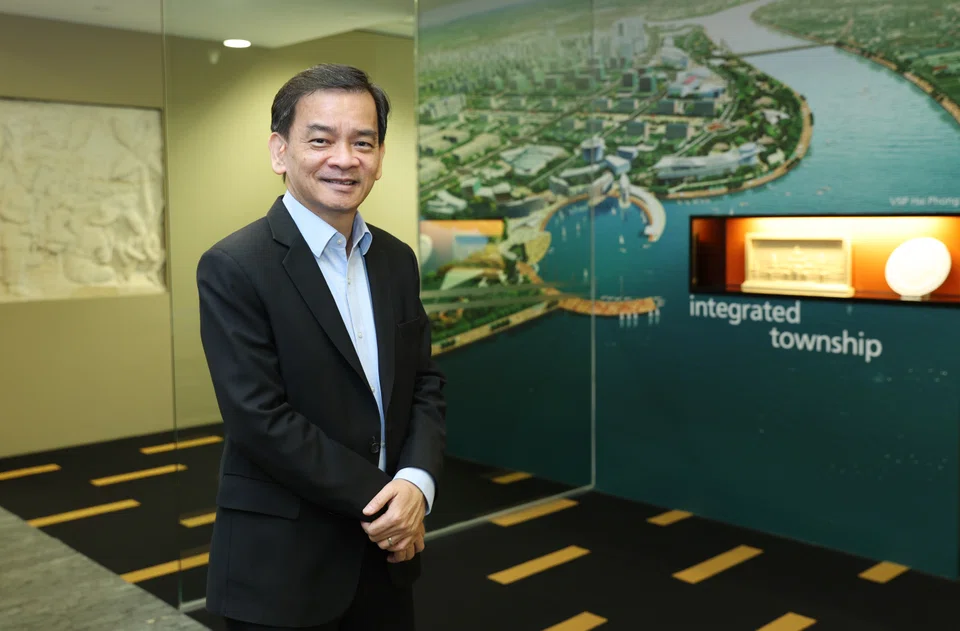
IN its early days, attracting foreign investors to the Vietnam-Singapore Industrial Park (VSIP) was a “hard sell”, said the Singapore chair of the industrial park’s operator.
The year was 1996, about 2 decades after the Vietnam War and just 2 years after the United States lifted its trade embargo on the socialist republic.
While Vietnam was industrialising rapidly thanks to a series of economic reforms introduced in 1986, many of its development indicators still lagged behind most of its Asean neighbours.
“When I went to Silicon Valley or Japan to promote Vietnam, we had to tell people why Vietnam, why south Vietnam, why VSIP,” said Kelvin Teo, co-chairman of VSIP Group and chief executive of Sembcorp Development, in an interview with The Business Times.
“We play a role like EDB’s … like investor promotion,” he said, referring to Singapore’s Economic Development Board. “We go out to tell people how competitive Vietnam is as a young and upcoming country, explain the competitive advantage, (and) then bring in investment.”
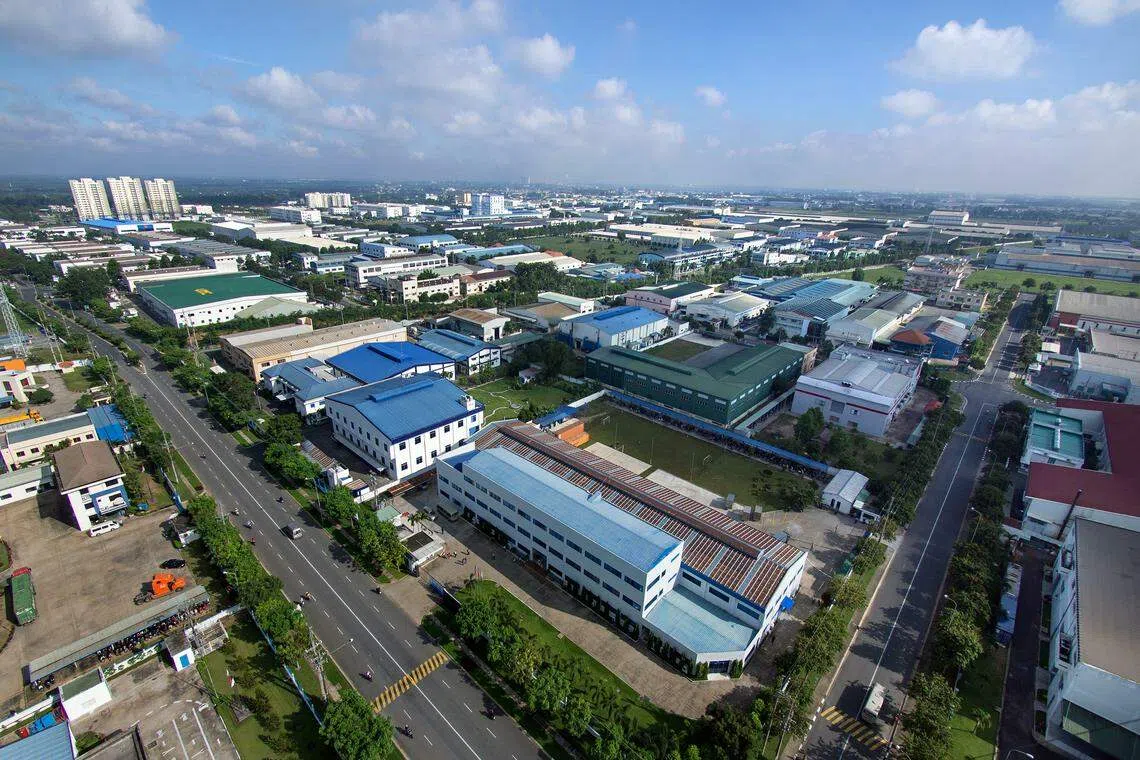
VSIP began from a 500 hectare (ha) plot in Binh Duong province – north of Ho Chi Minh City – as a joint venture between Sembcorp Development, a unit of Sembcorp Industries, and Vietnam’s state-owned Becamex IDC. The group now manages 11 industrial parks on nearly 10,000 ha of land across the country.
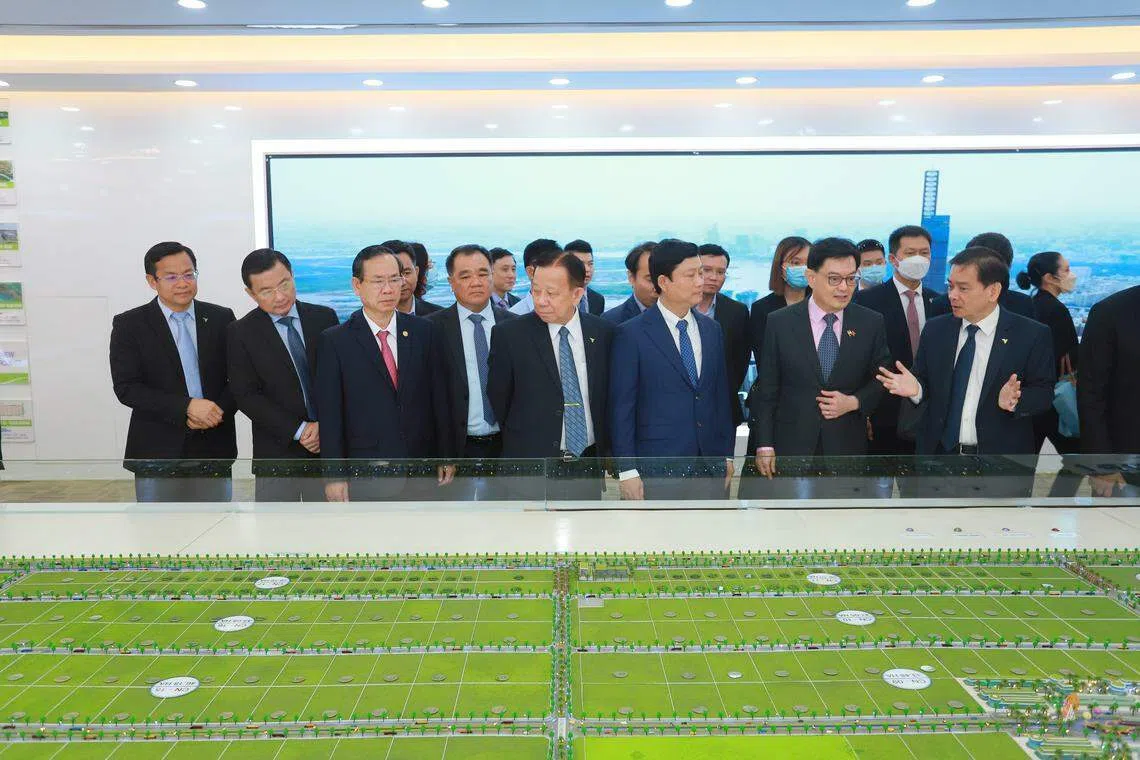
On Wednesday (Sep 14), Singapore’s Deputy Prime Minister (DPM) Heng Swee Keat visited VSIP Binh Duong I during an official visit to Vietnam and was given a tour of how VSIP has contributed to Vietnam’s economic development.
Said Teo of Heng’s visit: “We are honoured to receive DPM Heng in VSIP Binh Duong. Our flagship project has progressed so much over the past 26 years, from industrial park, to integrated township and industrial park, and now, the new smart and sustainable.”
Despite the length of time, one could say little has changed in Vietnam’s appeal towards investors: its political and social stability, the young and hard-working workforce as well as the fairly sizeable domestic market given its population of close to 100 million.
Unlike its early years, however, Vietnam’s reputation as a manufacturing hub now sells itself, helping to draw multinational corporations (MNCs) from all over the world.
“Sembcorp, as a Singapore company, again has to find new value add to this business,” said Teo.
With close to 400 industrial parks now scattered across the country, competition is no doubt keen. But Teo appeared unfazed, emphasising instead the importance of understanding the needs of the customer.
“We always say that if you have money, you can build a lot of industrial parks. The key thing is, can you find the customers to fill the space that you’ve created?” he said.
Green focus
VSIP’s strength, he said, stems from providing the right amount of infrastructure that suits the requirements of MNCs.
At a basic level, it’s about having reliable power, potable water and good support. But what sets a good developer apart is its ability to anticipate future demand – what customers want in 5-10 years.
In this current climate, said Teo, what many companies are looking for are green solutions: “They’ll ask the developer, ‘can you help me to meet my ESG (environment, social and governance) goals?’ Or, ‘my boss has this decarbonisation goal’, ‘I want to reduce my carbon dioxide emissions by 2030 or 2050, can you provide a solution?’”
Enter VSIP Binh Duong III, the latest industrial park that just broke ground in March.
It’s designed to be “smart and sustainable” and has a 50 ha solar farm to boot – a feature that quickly drew Danish toymaker Lego.
“They had been sourcing (throughout) the whole of Vietnam. (They came to us) because we could promise that we’ll provide them with green energy to innovate, to run their operations,” said Teo.
The facility will be Lego’s first carbon-neutral factory, with production due to start in 2024, the company announced last December.
“It’s a demonstration of how industrial parks and renewable solutions can be side by side,” he said. “We want to help our customers to achieve net zero. That’s a target that we’re setting for ourselves.”
The trend appears unstoppable, he said, and is one that VSIP takes seriously: “Today, if you look at Apple, Nike, adidas, they tell their contract manufacturers, ‘if you don’t have a green solution, I might not give you orders’.”
US-China tensions
But there is another, arguably bigger reason why some companies are choosing to base their plants in Vietnam.
Teo said he has received “a lot of inquiries” from potential customers keen to spread their manufacturing base across at least 3 countries.
Vietnam, strategically placed between China and other parts of South-east Asia, is a prime spot for those looking to diversify their supply chains in the region – and away from China.
While Vietnam is often said to be a key beneficiary of trade – and perhaps geopolitical – tensions between the US and China, Teo believes the country’s economic fortunes really began the moment it joined the World Trade Organization (WTO) in 2007.
“It really opened up Vietnam as a market. People started to understand and realise the potential of Vietnam, and Vietnam also leveraged on the fact they joined WTO,” he said, referring to a reduction in tariffs.
For Sembcorp, this milestone also marked a turning point, as it was shortly before this that VSIP built its second park, 10 years after the first one.
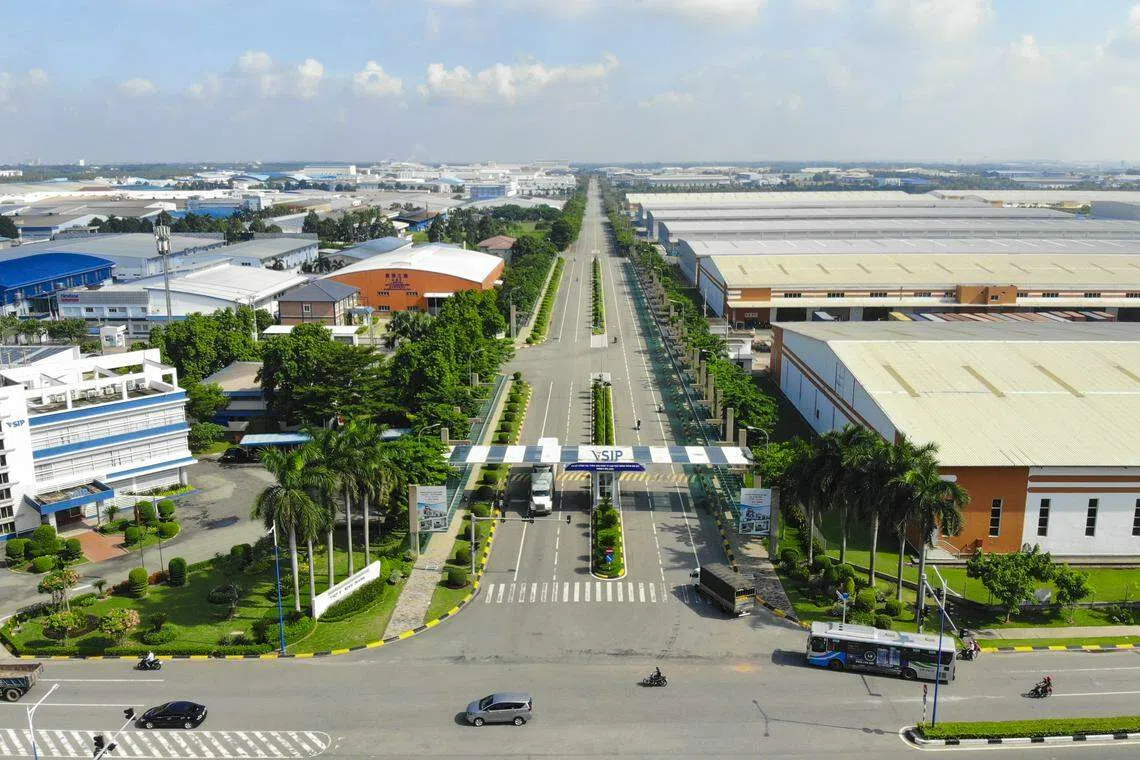
It went on to build 9 parks in the 16 years that followed.
Teo noted that costs in China had also begun to rise in the lead up to and after 2010.
“Businessmen always look at where’s the cheapest location. When China became more expensive, they looked at where are the alternatives, and Vietnam happened to be in very close proximity,” he said.
Weathering storms
VSIP’s entry into Vietnam in 1996 – a year before the Asian Financial Crisis hit – was perhaps both a blessing and a curse.
“Nobody could imagine what had happened,” Teo recalled. “Most of the companies, especially foreign companies, withdrew and exited from Vietnam. But Sembcorp, as a Singapore company, we decided not to.”
The company was in this for the long term, he reasoned.
“We used the few years of the lack of investments in the region to prepare, train our colleagues, improve the system, (and) prepare the land bank,” he said.
This allowed VSIP to capture growth opportunities once the economy recovered, said Teo, but more importantly, it instilled a certain sense of trust in VSIP’s Vietnam partners.
Singapore’s overall strong international branding also worked in Sembcorp’s favour, Teo said, offering international investors an assurance of good corporate governance and transparency.
The majority of VSIP’s 859 customers are non-Singapore companies. Over a quarter are from the US, followed by the European Union (17 per cent) and Singapore (16 per cent).
As of Jun 30 this year, these customers have brought foreign direct investment valued at US$16.2 billion and helped to create over 300,000 jobs, said Sembcorp.
Teo noted that VSIP’s product offerings have also evolved over the years, from being purely an industrial park developer to one that develops townships.
By incorporating industrial, residential and commercial facilities, the VSIPs offer a “live, play, learn together” experience – a value-add that Teo said is “uniquely Singapore”.
At the same time, there has also been a gradual shift in the industrial parks’ tenant mix. The early days were about employment creation, said Teo, which explains the labour-intensive industries such as textiles, garment and shoe-making.
As Vietnam’s economy grew, VSIP moved up the value chain, drawing customers specialising in precision engineering, electronics and pharmaceuticals.
“We had the privilege to witness the progress of the economic development of Vietnam. VSIP grew according to Vietnam’s growth,” he said.
Teo remains bullish about Vietnam’s long-term prospects, even as inflation continues to be an immediate challenge.
Lauding the country’s focus on infrastructure building and tertiary-level training, Teo said: “We are positive on Vietnam because we believe that it’s a country with a young population focused on economic reform. And they’ve got the track record to prove it over the last 20-plus years, even with the change in leadership.”
This is part of a new BT regional series on South-east Asian markets. In the coming months, BT journalists will head to countries in the region to bring you the latest from the ground.