How a Vietnamese beauty startup landed a US$38 million exit
The Skinetiq deal with Marico marks a rare startup exit in Vietnam

LONG before Hannah Nguyen built skincare startup Skinetiq, she was experimenting with and creating natural makeup products on a coffee farm in rural Vietnam.
As a child, Nguyen would crush berries from the garden into makeshift lipstick and blush, while she used coffee branches as hair curlers. “I was into beauty since I was five or six,” she says in a recent interview with Tech in Asia.
Years later, that early fascination turned into a business and, eventually, a multimillion-dollar exit. Skinetiq, which Nguyen co-founded in 2020 with Vietnamese entrepreneur Bui Ngoc Anh, was valued at around US$38 million after the team agreed to sell a 75 per cent equity stake to India’s consumer goods giant Marico last month.
Nguyen, a cosmetologist trained in the US, built a career in Vietnam managing global beauty brands such as Burberry, Hugo Boss, and Make Up For Ever. At the time, she realised that Vietnamese consumers were “so basic with skincare.”
In 2016, she started a Facebook blog to share skincare advice. The page quickly gained traction. Today, it has about 1.5 million followers.
By 2018, Nguyen began organising promotional campaigns with international beauty brands for her followers. The first three-day campaign generated about US$100,000 in sales. “That shocked me,” she says.
Skinetiq grew out of that success. But few beauty influencers in the country have managed to turn online followings into companies with meaningful exits, especially in a market where counterfeit products remain widespread.
So what did Nguyen do differently?
Building a beauty ecosystem
Nguyen built Skinetiq into a beauty ecosystem, where content, product recommendations, and sales reinforce one another. Followers who trust her reviews often go on to buy the products she highlights.
Her team now runs more than 10 campaigns each month for beauty brands across social media platforms. Skinetiq also moved early to build its own products rather than remain just a distributor.

In 2023, the company launched Candid, a skincare line centred around retinoid, which helps reduce inflammation, unclog pores, minimise wrinkles, and regulate skin cell turnover. Nguyen worked with cosmetics manufacturer Kolmar Korea to develop a formula using encapsulated retinoid, a technology designed to stabilise the ingredient and reduce irritation.
Within three years, Candid had become one of Vietnam’s top-selling retinoid brands across major ecommerce platforms, she says. Last year, Skinetiq generated US$16.5 million in revenue, which was driven largely by its own skincare line.
That result has come in one of Asia’s most difficult beauty markets. Counterfeit cosmetics remain widespread in Vietnam, with authorities regularly seizing fake products carrying the names of well-known brands. The problem extends online, where scammers frequently impersonate legitimate brands and influencers.
At one point, Nguyen’s team identified more than 700 fake Facebook pages posing as her. Efforts to shut them down have had limited success.
Rather than relying solely on enforcement, Skinetiq has turned the problem into part of its strategy. The company pushes consumers to buy through official channels and positions trust and authenticity as part of its value proposition.
While Nguyen remains the brand’s public face, she says most sales no longer depend on her personal influence. Her social commerce platforms generate about 30 per cent of Skinetiq’s revenue, with the rest coming through broader ecommerce distribution.
That shift has made the business less reliant on its founder, a crucial factor as the company grows.
“That’s important if you want to sell,” Nguyen says.
Why Marico made the cut
The Skinetiq deal with Marico drew widespread coverage in local media, marking a rare exit for startup founders in Vietnam, particularly in the beauty industry and for a company only a few years old.

Skinetiq’s US$38 million valuation appears reasonable. With about US$16.5 million in revenue and a 25 per cent Ebitda margin, it generates roughly US$4.1 million in Ebitda, Tech in Asia understands.
Nguyen says one reason for the sale was that she also runs a “much larger” multichannel social commerce business. Managing both simultaneously has been difficult, she says.
The buyer, India’s FMCG group Marico, may seem an unlikely match at first. But Saugata Gupta, the company’s managing director and chief executive, says the deal fits its strategy of building “a portfolio of digital-first consumer brands with strong product-market fit and healthy unit economics.”
Founded in 1990, the Indian FMCG group, best known for brands such as Parachute for hair care and Safolla for cooking oil, reported turnover of about US$1.3 billion in fiscal year 2025. It has deep experience in traditional retail distribution across emerging markets in Asia and Africa.
In recent years, it has been expanding beyond its traditional FMCG portfolio through acquisitions and investments in emerging brands. In Vietnam, the company already owns International Consumers Product Corporation, the maker of X-Men, a men’s grooming brand.
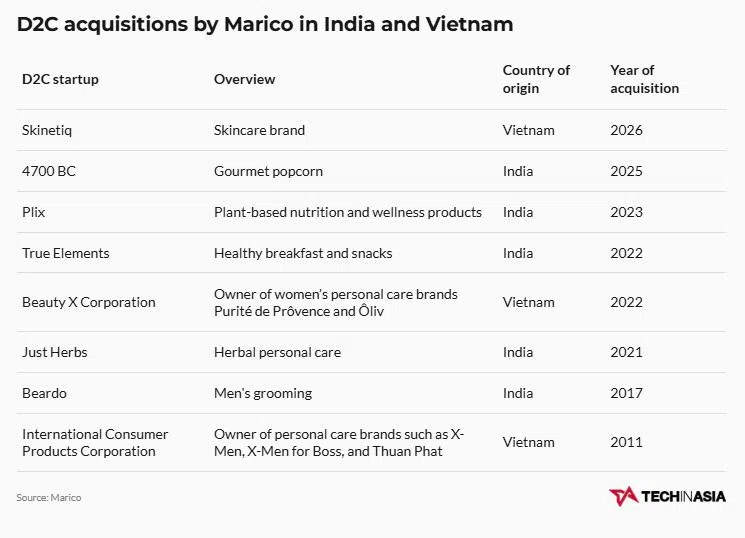
As for Skinetiq, Marico sees “a significant runway” for expansion and is targeting a threefold increase in scale by 2030, Gupta says.
The deal is also expected to boost the Indian company’s online commerce capabilities as Skinetiq built much of its growth through social commerce and influencer-led marketing.
Replicating those capabilities internally can be difficult for large FMCG companies like Marico, says Derek Burke, co-founder and chief executive of social networking startup Umego. Large firms, he notes, are typically structured around manufacturing scale and distribution networks.
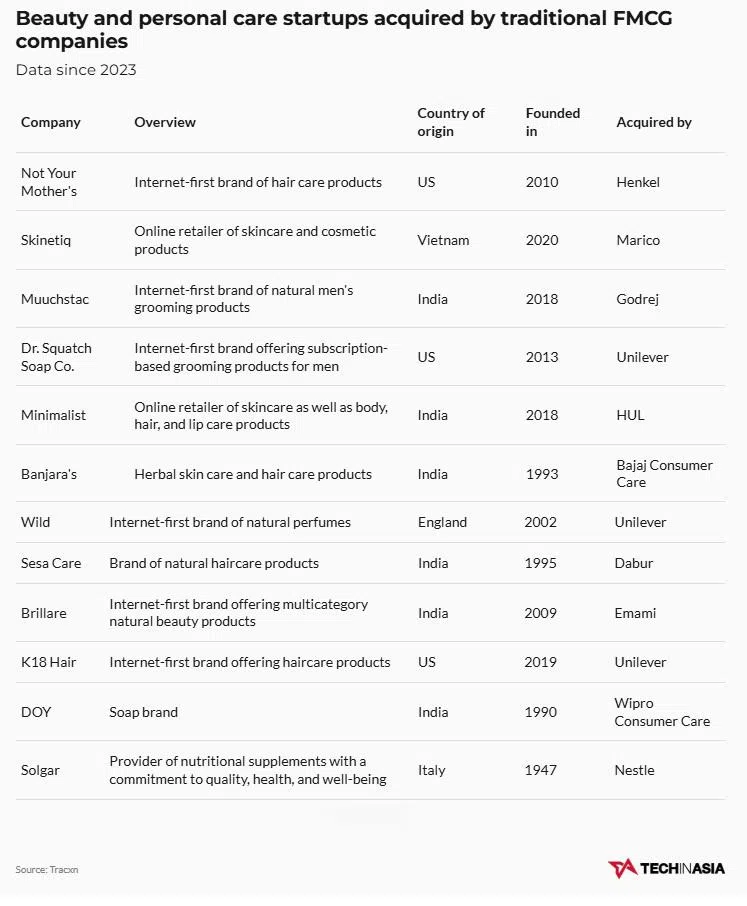
Renu Bisht, co-founder of Datum Intell, says FMCG companies often struggle to build new beauty brands from scratch because their innovation cycles are slower.
They also tend to lack a native understanding of Gen Z beauty trends, pushing many consumer giants to turn to acquisitions to strengthen their position in the beauty segment.
Post M&A plan
The acquisition will be completed over a two-year transition period, during which the Skinetiq co-founders will continue to run the business as Marico gradually integrates operations. Nguyen says the 40-member team will stay on board, with the startup continuing to hire as it scales its operations.
At the moment, Marico does not plan to introduce Skinetiq’s Candid to India. However, doing so in the future could be complicated due to potential trademark conflicts with another pharmaceutical brand, also called Candid, owned by Glenmark Pharmaceuticals.
Still, Marico’s Gupta sees “meaningful potential” to expand Skinetiq across South-east Asia as its retail network could deepen the skincare startup’s presence in physical stores.
Nguyen notes that Marico could also expand official distribution for Skinetiq, reducing the appeal of grey-market sellers, referring to those who import and resell products through unofficial channels without authorisation from the brand.
She estimates that Skinetiq could grow its revenue by 4x to 5x in the coming years. Personally, she will remain involved as a consultant after the company’s acquisition is complete and continue promoting its products through her social commerce platforms.
As for exit advice for other founders: “Don’t build a company just to sell it,” she says. “Build something that lasts. The exit will come later.”
Editor’s note: The US$38 million valuation is based on the current exchange rate. TECH IN ASIA