



How will South-east Asia groove to the Fed’s moves?
These are the economic scorecards of the region’s largest economies as they prepare to navigate the impact of interest rate cuts

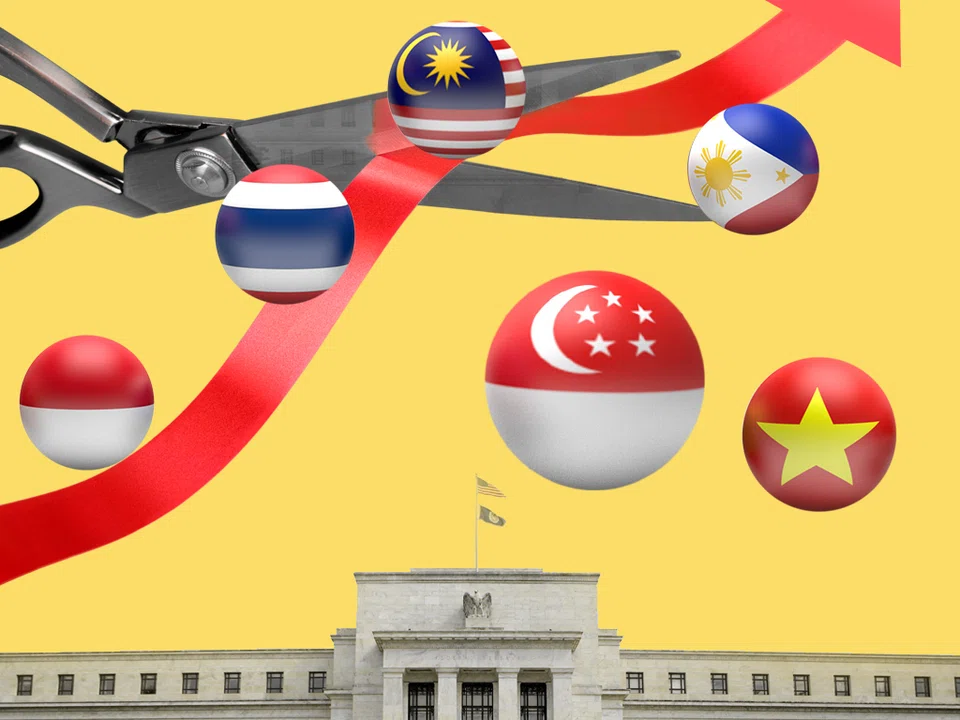
THE Business Times maps out South-east Asia’s economic landscape, spotlighting key factors such as interest rates, growth, currency stability and inflation that regional policymakers will carefully assess as they navigate the impact of the US Federal Reserve’s upcoming rate cuts.
Indonesia: First to follow Fed’s lead?
Bank Indonesia (BI) could well be the first central bank in Asean to begin its easing cycle following the Fed’s rate cut.
Analysts predict that BI will lower its policy rate by 25 basis points (bps) in the fourth quarter, with a further 75 bps cut expected next year.
The case for rate cuts is driven by a strengthening rupiah and stable inflation, which was highlighted by BI governor Perry Warjiyo during the August meeting.
The rupiah, which hit a four-year low in June, has since rebounded, averaging around 15,450 per US dollar, reflecting improved market sentiment. Inflation has also steadily declined, reaching 2.12 per cent in August, the lowest since February 2022 and down from its peak in February 2023.
The easing cycle comes as Indonesia, South-east Asia’s largest economy, grapples with falling consumer purchasing power after BI hiked rates by a total of 50 bps since last October. Lower rates are expected to revive household consumption, which makes up 53 per cent of the economy, and thus help the country meet its 5.2 per cent growth target this year.
Ari Jahja, Macquarie Capital’s Indonesia research head, expects the rate cuts to benefit key sectors such as banking, healthcare, and infrastructure, potentially boosting economic growth in the coming years. Other important sectors such as auto could see a boost as well, with lower rates driving increased demand through reduced financing costs.
Such economic momentum could also lay a sturdy foundation for the incoming administration under president-elect Prabowo Subianto, who takes office in October. – By Elisa Valenta
Thailand: Easing ahead
The Bank of Thailand (BOT) is expected to start its easing cycle after the Fed’s September cut, despite previously resisting government pressure and holding its benchmark rate at a decade-high 2.5 per cent.
Analysts predict that the first rate cut will occur in Q4 this year. OCBC expects a 0.25 point reduction in the first quarter of 2025, while MUFG Bank forecasts an additional 0.25 point cut in the second quarter, bringing Thailand’s key policy rate to 1.75 per cent by the end of 2025. However, CGS International economist Gun Hathaisattha believes that the BOT will hold off until the first half of next year to assess the impact of the government’s digital wallet programme. Similarly, Maybank analyst Chak Reungsinpinya predicts no cuts this year due to improving economic growth and potential inflationary pressures.
Thailand’s headline inflation slowed to 0.35 per cent in August, down from July’s 0.83 per cent. However, inflation is expected to rise in September, driven by increasing diesel prices and flood-related food shortages. The new minimum-wage scheme, set to take effect in October, may further fuel inflation.
The Thai baht has recovered much of its losses against the US dollar, and is now trading in the 33 baht to 34 baht per US dollar range after depreciating by more than 8 per cent at its lowest point in April. Looking ahead, the currency is expected to strengthen further, supported by increased government spending and improving exports, which is crucial to Thailand’s economy.
Although recent bouts of political turmoil surrounding the ousting of Srettha Thavisin as prime minister have not significantly affected the baht, uncertainty could continue to cloud the nation’s economic prospects. – By Goh Ruoxue
Malaysia: Keeping OPR steady for now
Economists widely expect Bank Negara Malaysia (BNM) to keep the overnight policy rate (OPR) steady at 3 per cent for the rest of the year, with some predicting that it will hold until mid-2025. BNM deputy governor Adnan Zaylani Mohamad Zahid reaffirmed Malaysia’s solid growth outlook, projecting around 5 per cent growth for 2024 as well as stable inflation, which gives little reason to adjust interest rates.
“There’s no real compelling reason or any pressure on interest rates to move in either direction at this stage, though we have to be open to consider the risks going forward,” said Adnan in London last week.
BNM last adjusted the OPR in May 2023, marking the end of a year-long tightening cycle that raised rates by 125 bps.
Economists also credit expectations of lower US interest rates for bolstering the ringgit, which has seen a remarkable recovery. After being the worst-performing currency in emerging Asia last year, the ringgit surged to an 18-month high of 4.3110 against the US dollar in August, appreciating 6 per cent since the beginning of the year.
MIDF Research attributes the ringgit’s strength to market expectations of policy easing by major central banks, especially the Fed. Economists believe that Malaysia’s strong growth momentum, driven by structural reforms, is likely to continue attracting foreign investment.
Julia Goh, UOB Malaysia’s senior economist, expects the ringgit’s stability to persist but thinks the pace of appreciation will be slower, with forecasts of 4.28 in Q4 2024 and 4.24 in Q1 2025, as investors may shift focus to other regional currencies.
In Q2 of this year, Malaysia’s gross domestic product grew by 5.9 per cent year on year, up from 4.2 per cent in Q1. With political stability and pro-business policies, the country is well-positioned to capture investment as global investors look for safe, growth-oriented markets. Steady interest rates and foreign inflows will likely benefit sectors such as tech, automotive, renewable energy and tourism. – By Tan Ai Leng
The Philippines: Most dovish of them all
The Philippines kick-started the region’s rate cuts in August with a pre-emptive quarter-point decrease to 6.25 per cent – its first cut in almost four years – amid robust domestic demand prospects and projections that headline inflation will trend downwards. A second cut is expected in October or December, a case further reinforced by August’s soft consumer-price print and signalling from the central bank’s governor. Last month, the country’s headline inflation eased to a seven-month low of 3.3 per cent, falling back to within Bangko Sentral ng Pilipinas’ (BSP) target range of 2 to 4 per cent.
Inflationary pressures in the Philippines are among the highest in Asia due to the nation’s dependence on imports – especially food, which dominates the population’s household expenses. To rein in prices, its central bank had in 2022 embarked on an aggressive monetary-tightening cycle that left the nation’s key policy rate at a 17-year high of 6.5 per cent.
Several houses, such as Bank of America, DBS and OCBC, expect the Philippines’ key policy rate to end next year at 5 per cent with a cumulative 100 bps of rate cuts in 2025, while MUFG Bank pencilled in 50 bps of cuts through 2025.
Since end-July, the Philippine peso has trimmed much of its losses against the US dollar. From a 20-month low in June that was a whisker away from the psychologically key 59 pesos per US dollar benchmark, the local currency strengthened considerably – amid weak US prints and robust domestic growth figures – and is hovering around the 56 pesos threshold.
But MUFG Bank analysts expect “some modest underperformance” from the Philippine peso into next year. A pick-up in infrastructure and import needs is anticipated to widen the country’s current account deficit in 2025. This, coupled with incoming rate cuts and geopolitical risks to growth, is expected to translate into the Philippine peso trending lower against the US dollar. – By Goh Ruoxue
Vietnam: To stand pat
Most economists expect Vietnam’s central bank, State Bank of Vietnam (SBV), to hold policy rates steady for the rest of 2024, as the Fed’s anticipated rate cuts come into view. According to Maybank, the strengthening dong, combined with softening inflation, allows the SBV to maintain its stance.
Vietnam has pursued an accommodative monetary policy, cutting rates four times in 2023 by a total of 150 bps, despite global rate hikes. This widened interest-rate differentials, putting pressure on the dong, which depreciated 5 per cent in early 2024 before strengthening by 1.7 per cent in August.
Analysts expect the dong to recover further in the second half of 2024, driven by Vietnam’s strong growth momentum, manufacturing rebound and trade expansion. Exports and imports grew by 14.5 per cent and 12.4 per cent, respectively, year on year in August. Inflation eased to a seven-month low of 3.45 per cent last month. It is expected to cool further in the coming months, driven by favourable base effects and a stronger dong as the Fed’s rate cuts approach.
However, challenges persist, with sluggish domestic demand and credit growth amid the slow recovery of the real-estate sector. Retail sales rose 8.5 per cent in the first eight months, compared with 10.3 per cent last year. Meanwhile, credit growth until Aug 26 in the banking sector reached 6.63 per cent, well below the 15 per cent target for 2024.
Public investment has also been slow, with capital realised from the state budget growing just 1.3 per cent year on year in August, as officials remain hesitant amid anti-corruption efforts and legal bottlenecks. Additionally, Typhoon Yagi has caused widespread damage in northern provinces, further affecting business activities. – By Jamille Tran
Singapore
For a comprehensive coverage on Singapore read here






