



“I believe in acting with conviction”: Indosat’s CEO is banking on an ‘AI north star’ to grow the telco
The nation’s second-largest telco has been investing heavily in an artificial intelligence strategy under CEO Vikram Sinha

The strategies and stories that shape today’s leaders
[JAKARTA] Telecommunications companies make money from connectivity. For decades that meant fixed lines, mobile phone services, and data and Internet. Some of the derring-do even diversified into cable television.
For these companies, revenue has largely grown until the 2010s when growth started slowing or even declining due to a mix of various reasons including market saturation and new connectivity options.
Vikram Sinha, the chief executive of Indosat Ooredoo Hutchison, Indonesia’s largest private telecommunications operator, calls the mid-2000s a missed opportunity for many telecom operators.
The pivotal moment arguably happened in 2007 when Apple introduced the iPhone and later, the Apple App Store in 2008. This created the market infrastructure that allowed what has since been called the “app economy” to boom.
“We in telco, we lost that opportunity. We were so inward looking,” Sinha told The Business Times in an interview at Indosat’s headquarters in Jakarta.
Revenue from in-app purchases, excluding mobile games, reached US$69.2 billion last year, growing almost 20 times from the US$3.5 billion in 2014 indicated data from the digital market intelligence and data analytics firm Sensor Tower.
While a large part of that revenue came from developed markets such as the US, mainland China and Japan, revenue from emerging markets in South-east Asia such as Thailand and Indonesia have been growing steadily.
“I think the same opportunity has been given to us again with AI (artificial intelligence),” Sinha said. “Our core business is connectivity. Connectivity plus compute, which is intelligence, and delivering that at edge in a sovereign manner is the need of the hour.”
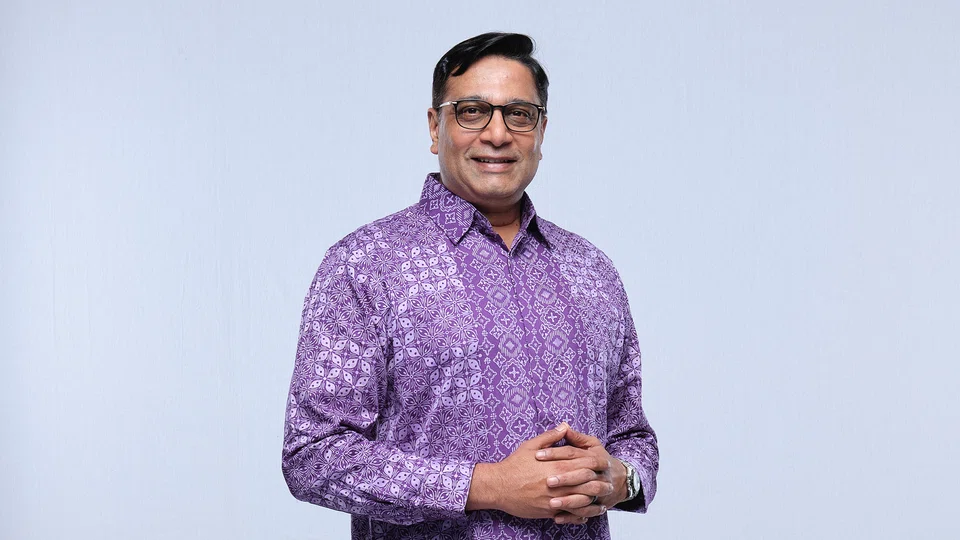
Sinha joined what was then Indosat Ooredoo in 2019 and became CEO in January 2022 following the merger between Indosat Ooredoo and Hutchison 3 Indonesia, creating Indosat Ooredoo Hutchison. Prior to becoming Indosat’s CEO, Sinha was CEO of Ooredoo Myanmar and Ooredoo Maldives.
SEE ALSO


Since becoming Indosat’s CEO, Sinha, who is currently 51, has said publicly on many occasions he wants to transform Indosat from a telco to a “techco” or technology company, and that he wants to bring AI solutions to Indosat. He also said that Indosat’s AI strategy aligns with Indonesia’s own digital transformation strategy.
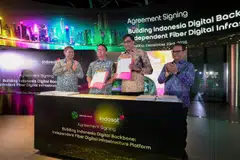
In December, Indosat announced it was carving out its fibre assets into a new entity, FiberCo, valued at an enterprise value of about 14.6 trillion rupiah (S$1.12 billion). The entity is a joint venture involving the Indonesian conglomerate the Arsari Group, and Singapore-based private equity firm Northstar Group. Fiberco is expected to operate a comprehensive and integrated network spanning more than 86,000 km across Indonesia.
Sinha said the joint venture was a strategic transaction as the proceeds would fuel crucial investments for the telco’s 5G rollout and also act as a foundation for Indosat’s AI push.
As AI applications increasingly look to become part of our lives, sovereign AI has become a growing global movement as governments look to invest in their own AI capabilities over concerns such as data privacy and security.
Sovereign AI refers to a nation’s capabilities to produce AI that uses its own infrastructure, data, workforce and business networks.
For Indonesia, Sinha argues there is no company better placed to deliver those sovereign AI solutions than a domestic telco operator.
“We can do it at the edge because we have 55,000 BTS stations,” Sinha said. BTS, or base transceiver station, is the equipment that facilitates wireless communication between a user’s equipment and a network.
In mid-November, Indosat announced it was collaborating with Nokia and Nvidia to build an “AI Grid” that would combine Indosat’s network with Nokia and Nvidia’s technologies to help bring generative AI closer to millions of Indonesians.
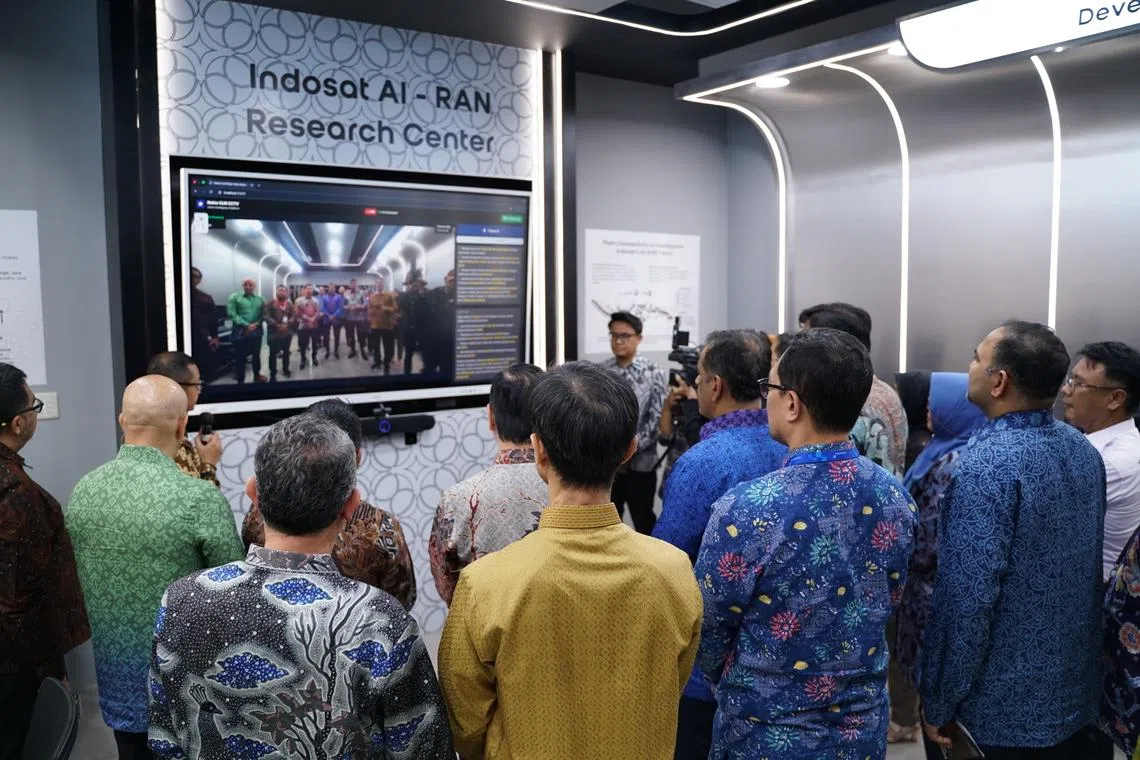
The collaboration is also part of a broader Indonesia’s Digital Vision 2045 initiative that is aimed at building infrastructure and developing local digital talent.
The AI Grid will be connected to Indosat’s central AI data centre, which houses Nvidia graphic processing units (GPUs). The company said that this set-up will enable heavier AI workloads to be handled in the data centre while lighter real-time AI processing can be managed at the edge. It noted that this will cut down latency and deliver faster response times for users across the country when using most AI applications.
Indosat managed to procure advanced Nvidia GPUs in 2024, and has started a GPU-as-a-service business at the enterprise level as well. Sinha met Nvidia CEO Jensen Huang on multiple occasions over that year, and has privately cited Huang’s influence on him when it comes to AI.
The Indonesian telco was one of the earliest companies in South-east Asia to get access to Nvidia’s Blackwell Chips.
Indosat has started booking revenues since October with more than 22 domestic companies renting these GPUs. For 2025, Indosat is expected to book up to US$35 million in AI revenue, and that is expected to double this year.
Sinha is not the only one who is betting on AI to help diversify Indosat’s revenue. Telkom Indonesia has expanded into data centre infrastructure. Regionally, players such as Singapore’s Singtel and Malaysia’s Maxis are investing heavily in data centre infrastructure as well.
Etta Rusdiana Putra, an equity analyst at Maybank Sekuritas Indonesia, thinks Indosat is going the GPU route because it intends to monetise the GPU server shortage. Etta noted that capital expenditure for GPUs is also lower when compared to data centre infrastructure, and that some clients may also have limited access to purchase directly from Nvidia.
Yet diversifying its revenue may also be necessary for Indosat. The majority of Indonesian consumers tend to use prepaid mobile services instead of postpaid. While that represents flexibility for the consumer, it also means that Indosat’s mobile services revenue is prone to fluctuation or could take a hit when consumer sentiment is negative.
Indosat’s cellular revenue for the three months ending Sep 30, 2025 reached 34.56 billion rupiah, down 2 per cent from the same period a year ago. Indonesia’s consumer sentiment index averaged 116.7 for the three months ending Sep 30, 2025, indicated Bank Indonesia data. The consumer sentiment index averaged 123.7 over the same period in 2024. A reading over 100 represents optimism.
Beyond enterprise, Indosat is also working with other domestic companies such as GoTo on Sahabat AI, a large language model (LLM) designed specifically for Bahasa Indonesia.
The LLM operates in Bahasa Indonesia, the country’s national language, along with five other local languages including Javanese, the most spoken regional language. The Sahabat AI model powers search on at least two of Indosat’s consumer-facing apps.
A local language LLM could reach millions of rural Indonesians who do not speak Bahasa Indonesia or English. Getting users hooked on AI services could lead to consumers topping up their data more often.
Indosat has also been building out its infrastructure to expand 4G and 5G coverage to reach rural Indonesians. Sinha noted that the company has invested close to US$2 billion to expand coverage over the past three years.
To Sinha, the investments at the consumer and enterprise level point towards the company’s “AI north star”, on which it is banking for future growth.
“Our AI north star has three pillars. First, Indosat is going to become an AI native telco. Second is techco, which is AI cloud and security. The third one is Sahabat. What we are doing with AI, helps us come back close to double-digit growth on core,” Sinha said.
Three questions with Indosat Ooredoo Hutchison CEO Vikram Sinha
Q: Was there a pivotal moment in your career or personal life that changed your approach to leadership?
I have learned how critical it is to surround yourself with a strong team of people that you trust. My defining leadership experience was steering Indosat Ooredoo through its merger with Hutchison 3 Indonesia in 2022. It was a daunting task – one that many of my friends warned me that I might fail as most telco mergers lead to value destruction.
But I took the risk, and acted with conviction. I deliberately surround myself with people who are better than me, empower them to make decisions, and trust them to execute. Positive intent, courage, are just as important as capability in a team. With those elements, we can achieve difficult things and make anything happen.
Q: What is one piece of unconventional wisdom you swear by that most business schools would tell you is wrong?
I believe in acting with conviction. I think it is better to take a plunge and fail than not do anything because not doing anything is a bigger risk. But when you act with conviction and you have the right people around you, all with a positive intent, then magic can happen. The important thing is to not look back. Once you decide, act with conviction and don’t look back.
I’ve been trying to master the art of letting go and focusing on what is in my control. Focus on what we can control, give our best and enjoy the journey. When you are trying to do hard things, you need yourself along the way.
Finally, don’t be afraid to make mistakes. But if you make a mistake, be honest and upfront about it. I tell all my employees that it is okay to make mistakes, but make mistakes with integrity, learn from those mistakes and improve.
When you feel burn-out creeping in, what’s your non-business-related “panic button” activity or routine that reliably resets your focus?
My family, my wife and my two children are the biggest emotional support. I always try to spend at least one day a week -– Saturdays – with them. My life as the CEO of a large, listed Indonesian company is very busy and I travel a lot, but my family have always been very supportive of me. To reset, I make sure to block my calendar for two holidays a year.
When I have the time, I also enjoy playing golf, running and working out, often with the team from Indosat. I am also an avid reader, particularly books that can help me be better at my role, such as those by Simon Sinek, Kate Smaje or other leadership writers.
Decoding Asia newsletter: your guide to navigating Asia in a new global order. Sign up here to get Decoding Asia newsletter. Delivered to your inbox. Free.
Copyright SPH Media. All rights reserved.
TRENDING NOW

Singapore identifies 7 firms responsible for haze fires, notices issued urging action: Grace Fu

Philippine power giant First Gen rebuffs foreign offers, plans up to US$2.6 billion in expansion
DBS remains analysts’ pick ahead of Q3 earnings after Singapore banks’ share slump
Indonesia imposes US$116 million in fines over manipulation of Sinar Mas, Prajogo-linked stocks

