


Asean Business logo
SPONSORED BYUOB logo

‘I’m still around’: Soon to turn 100, Dr Mahathir continues to shape Malaysia’s politics

Whether you admire him or not, the former PM is the architect of the country’s modern identity, a legacy shaped during his first tenure and marked by both complexity and impact

Summarise
Tan Ai Leng
Published Fri, Feb 14, 2025 · 05:00 AM
    • Malaysia's longest-serving prime minister Mahathir Mohamad's legacy is a complex tapestry of accomplishments and controversies.
    • Malaysia's longest-serving prime minister Mahathir Mohamad's legacy is a complex tapestry of accomplishments and controversies. PHOTO: MAHATHIR MOHAMAD FACEBOOK

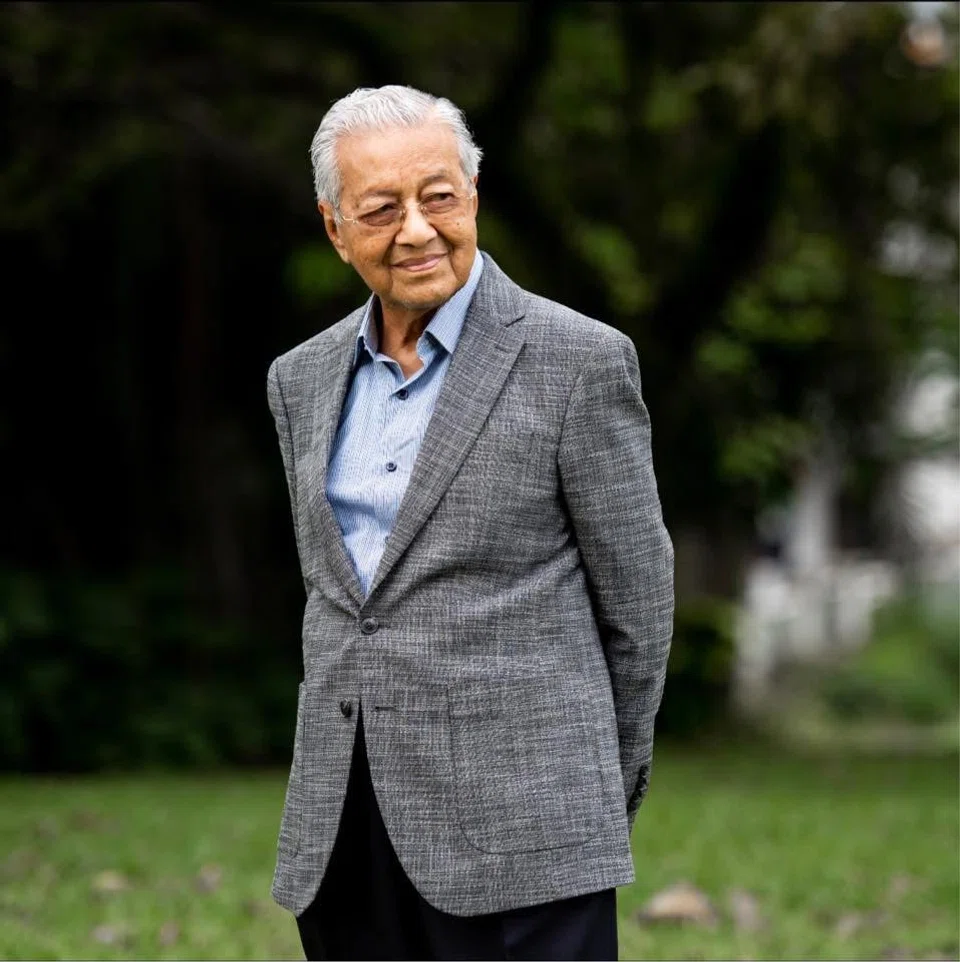
    [KUALA LUMPUR] As Malaysia’s longest-serving prime minister, Dr Mahathir Mohamad is set to mark an extraordinary milestone in July this year – turning 100. Although no longer in office, with a slow gait, and a once-imposing stature now softened by age – still, a marvel to many – he remains a towering figure in Malaysia’s political landscape.

    “By mid-2025 I will be 100 years old. Insya-Allah (Arabic for “if God wills”) if I’m still breathing, it would be a long journey full of challenges,” he posted in a reflective New Year message on Facebook on the final day of 2024.

    “So far, I have been blessed with relatively good health, still able to stand, walk, and think clearly. A century is a long time... I am fortunate to be able to pass through such important moments in the country’s history,” he wrote.

    Renowned for his bold vision, sharp wit, and biting retorts – famously calling George Soros a “moron” for his role in the Asian financial crisis, among others – Dr Mahathir modernised Malaysia and cultivated a new class of billionaires who would go on to reshape the country’s corporate landscape.

    Critics decried this as cronyism as Dr Mahathir doled out lucrative concessions to those he handpicked – figures such as Robert Kuok, the late Ananda Krishnan, Syed Mokhtar Albukhary, Genting’s Lim Goh Tong and Berjaya’s Vincent Tan – many of whom would then go on to build regional and global empires.

    His rule was marked by a hard-handed, at times ruthless, approach to governance and he was also known for countering Western influence, serving as South-east Asia’s voice and championing the sovereignty of developing nations on the global stage.

    The Petronas Twin Towers in Kuala Lumpur was once the tallest building in the world (1998 to 2004). PHOTO: BT FILE

    He had a knack for iconic structures, from the Petronas Towers (the world’s tallest building from 1998 to 2004) to major infrastructure projects such as Kuala Lumpur International Airport, Putrajaya, the North-South Expressway, and the Malaysian National Sports Complex.

    However, his penchant for grandiose undertakings was often criticised as creating “white elephants” – projects that showcased Malaysia’s development more than addressing the country’s immediate needs.

    One of Dr Mahathir’s most defining moves was on the foreign policy front. At a time when the West dominated, he turned towards industrialised Asian powers, primarily Japan and to a lesser extent South Korea, championing the “Look East” policy that reshaped Malaysia’s economic future. He remains a respected and beloved figure in these countries.

    Dr Mahathir’s relationship with Singapore and founding prime minister Lee Kuan Yew was marked by both rivalry and respect. Despite public clashes over issues such as race, regional politics, water rights, and the construction of bridges – to name a few – the two men appeared to share a mutual respect for each other’s abilities. 

    During his first tenure as prime minister, he spearheaded Malaysia’s industrialisation, with Proton, the national carmaker, being one of his flagship initiatives.

    Initially a blockbuster, Proton eventually hit a roadblock – waning market share and an inability to compete globally led to near-insolvency and multiple rescue attempts involving taxpayers’ money. This was until a controlling stake was sold to China’s Geely more than a decade ago, shifting the brand from national pride to foreign ownership.

    Proton remains one of the top-selling car brands in Malaysia, securing its sixth consecutive year in second place in 2024 with over 150,000 units sold, driven by its “evergreen” sedan, the Saga, and the popular compact SUV, the X50.

    This story, however, is not limited to Proton. It reflects Dr Mahathir’s multifaceted legacy – pioneering and visionary yet divisive, earning both admiration and criticism at home and abroad.

    Prof Wong Chin Huat, a political scientist at Sunway University, said: “Under his watch, industrialisation and the service sector gained momentum, infrastructure such as highways and airports flourished, and Malaysia became a regional hub for affordable higher education.”

    Prof Lau Zhe Wei, an associate professor at the International Islamic University Malaysia, calls Dr Mahathir the “father of modernisation”, citing his authoritarian governance as key to implementing transformative policies and mega projects that reshaped Malaysia’s economy, society, and global standing.

    Father of controversy

    Despite stepping down from formal political roles, former prime minister Mahathir Mohamad’s influence remains significant. PHOTO: MAHATHIR MOHAMAD / FACEBOOK

    Dr Mahathir’s tenure was also an intense one for the nation, marked by the judicial crisis in 1988 – when he dismissed senior judges – constitutional amendments that reduced the monarchy’s powers, and efforts to alter party structures for greater control.

    Dr Mahathir’s 1987 crackdown, including Operation Lalang, saw over 100 opposition figures and activists detained without trial, shocking the nation. While it solidified his grip on power, it hurt the nation’s democratic fabric, and eroded public trust in political institutions, leaving a lasting impact on the country’s political landscape.

    “He perfected Machiavellianism in Malaysia,” Prof Wong said, citing the former prime minister’s willingness to achieve his goals at any cost.

    Critics argued that some of these moves prioritised short-term political gains over long-term institutional integrity.

    To counter the influence of the Islamist party PAS, Dr Mahathir pursued bureaucratic Islamisation despite being a modernist.

    He also lifted entry barriers for private higher education under his Vision 2020 plan, which aimed to make Malaysia a developed nation by 2020.

    His pragmatic alliances have also drawn attention. In 2018, he reunited with former rival Anwar Ibrahim to oust Barisan Nasional, only to break ties with Anwar two years later.

    Prof Wong quipped that Dr Mahathir’s pursuit of power may be the secret to his longevity and sharp mind, as he remains convinced of his indispensability.

    Bold crisis leadership

    The 99-year-old former prime minister Mahathir Mohamad remained active on social media. PHOTO: MAHATHIR MOHAMAD, FACEBOOK

    For many, the political titan is a figure who steered Malaysia through tough times, including the 1997 Asian financial crisis.

    As financial institutions tottered on soured loans and corporations buckled under crippling debt, the ringgit tumbled to historic lows and capital fled the country.

    In response, Dr Mahathir imposed capital controls, pegging the ringgit to the US dollar and restricting foreign currency transactions to stem the outflow. He also banned the trading of Malaysian shares on Singapore’s over-the-counter market, Clob, in 1998 to curb the massive sell-off in Malaysian equities.

    Though controversial – the moves earned the ire of foreign investors and the International Monetary Fund – his unprecedented measures proved crucial to stabilising Malaysia’s economy and giving it the breathing room to recover.

    Never too old

    A historical moment in Malaysia’s history: The Pakatan Harapan alliance led by Mahathir Mohamad (centre) defeated the long-dominant Barisan Nasional in the 2018 general election. PHOTO: MAHATHIR MOHAMAD, FACEBOOK

    Dr Mahathir’s return to power in 2018 at 92 was dramatic: leading Pakatan Harapan to a historic victory that toppled the decades-long rule of Barisan Nasional, and bringing together a coalition that included political heavyweights Anwar Ibrahim –- the country’s current prime minister – Muhyiddin Yassin, and opposition stalwart Lim Kit Siang.

    However, his second tenure was brief and fraught with internal conflicts, which ultimately weakened the coalition.

    Tensions between the party factions, especially over the issue of succession and Dr Mahathir’s pledge to hand over power to Anwar, created a volatile political environment. Despite this, his time in office remains a pivotal chapter in Malaysia’s modern political history.

    As Dr Mahathir approaches 100, his speeches are sparking controversy. Once praised for his pragmatism, he now faces criticism for divisive comments on race and religion, keeping him at the centre of public debate.

    One recent example was his critique of business signage in a Kuala Lumpur mall; he questioned whether Malaysia had “become part of China” after noticing that Chinese characters were larger than Malay text. In response to public backlash, businesses updated their signage to prioritise Malay, and local authorities conducted inspections to ensure cultural compliance.

    Dr Mahathir and Dr Siti Hasmah Mohamad Ali have been married for 65 years. PHOTO: MAHATHIR MOHAMAD, FACEBOOK

    Dr Mahathir’s leadership offers both inspiration and cautionary tales. Wong emphasised the importance of retiring at the height of one’s political achievements to leave a lasting positive legacy.

    “Had Mahathir bowed out in early 1997 or before May 2020 to make way for Anwar, he would have been widely respected for his contributions,” Wong said.

    Dr Mahathir’s ability to stay relevant till today highlights his unique position in Malaysian history as a centenarian leader whose vision, determination, and controversies have shaped the nation. 

    As he turns 100 in a few months’ time, his legacy remains debated, said Lau. Even so, “he will forever be remembered as the architect of modern Malaysia and a figure whose influence transcends generations”, he added.

    Ten most memorable quotes from Malaysia’s former prime minister Dr Mahathir Mohamad

    Dr Mahathir remains at the centre of attention due to his acerbic remarks. PHOTO: REUTERS

    1. There is no guarantee that the prime minister will be a Malay as anyone can be the prime minister… I am sure that if we’re not careful, the next election will come and if the votes get bought off, we’ll elect people who are not good and they will mortgage our country. (November 2024, commenting on Malaysia’s political situation)

    2. I am still around, I am still alive, I have to do something. (August 2024, during an interview in London)

    3. Those who hardly use their body eventually become paralysed. If we don’t use our brains, we become stupid. (2019, when interviewed by local TV, commenting that Malays should work harder and not depend on government handouts)

    4. What I feel is not important. What the people feel is very important, they feel that I should go back. (January 2019, after he won the 2018 election and returned to helm the country)

    5. All have been raped by the previous government… They have taken the money. Now they have lost the money. (2018, commenting on the 1MDB case)

    6. We need an opposition to remind us if we are making mistakes. When you are not opposed, you think everything you do is right. (January 2017 post on X)

    7. Even in South Africa, the Commonwealth were not doing anything, and their attitude was to tolerate apartheid in South Africa. There was a lot of lip service being paid to the need to stop this practice, but nothing was done. (2015 interview with oral history practitioner Dr Sue Onslow)

    8. If Singapore does not want to demolish the Causeway and replace it with a bridge, then we can build half a bridge (the Crooked Bridge) on our side of the Causeway. We do not need to touch Singapore’s side of the Causeway. (February 2003)

    9. Malaysia needs the ISA (Internal Security Act). The ISA is a preventive law. We detain people as they are thinking of committing a crime and even before they commit a crime. It is no use trying to arrest people after they have committed a crime because by then they will already be very far away and we cannot catch them. (September 2002, after the Sep 11 attacks)

    10. I’m brash and abrasive but that’s because I’ve noticed when people are nice and polite they never get anywhere. (1998, when responding to his harsh comments on currency speculations)



