



Indonesia adapts 1940s dry-ice technology in fight to clear haze
Indonesia is battling its worst fire season in years

INDONESIA is repurposing a weather-modification technique pioneered in the 1940s in its latest attempt to combat thick haze from forest fires that’s disrupted flights and forced schools to close across parts of South-east Asia.
Aircraft will disperse pellets of dry ice above South Sumatra province in an experimental approach that authorities hope will reduce the hazardous smoke that’s blanketed the region for weeks, disrupting economic activity and damaging public health.
The first trial is expected on Thursday, Tri Handoko Seto, deputy for weather modification at Indonesia’s Meteorology, Climatology and Geophysics Agency, told Bloomberg News.
The aircraft will initially target provincial capital Palembang and an adjacent district, state news agency Antara quoted local governor Herman Deru as saying.
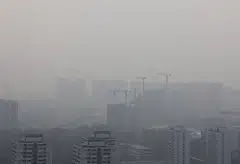
Indonesia is battling its worst fire season in years. Prolonged dryness, exacerbated by a powerful El Nino, has created conditions for land-clearing fires to burn out of control, smothering large parts of Sumatra and Borneo in dense smog and noxious fumes.
The effects are being felt beyond Indonesia, with nearby Singapore and Kuala Lumpur ranking among the world’s 10 most polluted major cities in recent weeks.
More than 70 weather-modification operations have been conducted in South Sumatra alone, according to the provincial government, but thick smoke continues to blanket parts of the region.
The use of dry ice, or solid carbon dioxide, in weather modification dates to 1946, when American researcher Vincent Schaefer discovered it could induce ice formation in clouds.
The US military experimented with dropping crushed dry ice into a hurricane in 1947, the same year that Australian scientists also used the method to induce rainfall.
SEE ALSO



In Indonesia’s case, the technique aims to break up atmospheric temperature inversions that trap cooler air and wildfire smoke near the ground.
In theory, as the dry ice rapidly cools the surrounding air, the inversion will be disrupted and pollution should be able to disperse, said Budi Harsoyo, director of weather-modification operations at the meteorological agency.
Rather than attempting to clear smoke across entire provinces, authorities plan to focus on areas upwind of airports, Harsoyo said, where improved visibility could help allow water-bombing and cloud-seeding aircraft to resume operations.
Unlike conventional seeding, the dry-ice method doesn’t require existing clouds and isn’t intended to produce rainfall.
Harsoyo added that the technique’s effectiveness against wildfire haze in tropical conditions had yet to be established.
Meanwhile, the wildfires continue to burn. Dry weather is forecast to persist in the coming days, except for parts of northern and central Sumatra and Borneo, where there may be some showers, according to the Asean Specialised Meteorological Centre.
The fire weather index remains very high across a large swath of Indonesia, according to the national weather agency, meaning any blazes that develop are very difficult to control.
Wildfire haze has affected 1,813 domestic flights since Aug 11, according to the Transport Ministry, while Malaysia ordered schools across three states and parts of four others to close because of unhealthy air quality.
Malaysia has also stepped up its conventional cloud-seeding operations, carrying out 11 missions since late August, state news agency Bernama reported, citing Deputy Minister of Natural Resources and Environmental Sustainability Syed Ibrahim Syed Noh.
The latest operation targeted Johor, after worsening air pollution prompted authorities to expand efforts beyond northern Peninsular Malaysia, said the Malaysian Meteorological Department. BLOOMBERG
Decoding Asia newsletter: your guide to navigating Asia in a new global order. Sign up here to get Decoding Asia newsletter. Delivered to your inbox. Free.
Share with us your feedback on BT's products and services
TRENDING NOW

Once staunchly pro-China, Malaysian Chinese businesses are now distancing themselves from Beijing

Looking beyond looming CEO succession, should UOB potentially pursue a transformative merger?

Could stablecoins be the future of money?

Grab CEO’s wife Chloe Tong on life with Anthony Tan and finding her purpose

