



Indonesia agritech startup helps ageing rice farmers improve yields
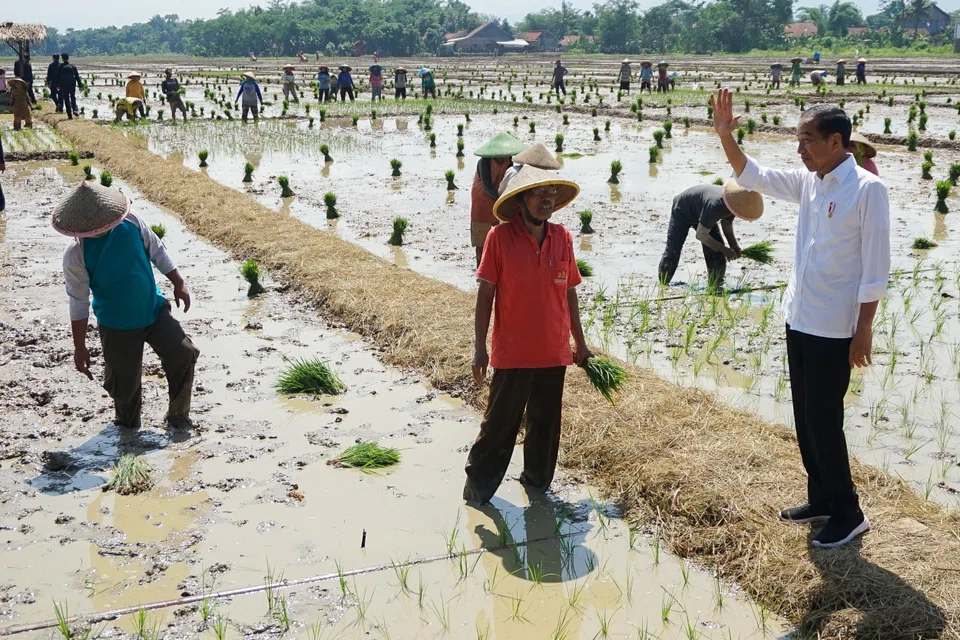
[JAKARTA] With local farming on the decline as younger workers shun agricultural jobs, agritech startups such as Agri Sparta may hold the key to bigger rice harvests for Indonesia.
“To achieve food security, Indonesia has no choice but to adopt technology to feed its rapidly growing population,” its chief executive officer Galang Ramadhan told The Business Times.
Ramadhan’s company is one of the many startups that are attempting to use innovation, artificial intelligence (AI) and deep tech to solve the country’s food security issues.
Hungry for more
Rice is central to Indonesians’ diets, yet domestic supply is struggling to keep up with its growing population.
According to the country’s National Research and Innovation Agency, Indonesians consume 114.6 kg of rice per person per year, one of the highest per capita consumption rates in the world.
The country of 270 million people is the third-largest rice producer in the world after China and India, producing nearly 35 million tonnes a year. Yet it still needs to import 2 to 3 million tonnes of rice per year to meet local consumption.
So critical is rice to Indonesia’s food security that it has been a hot topic among candidates for the upcoming presidential election. Proposals range from opening new forest lands for rice cultivation, to helping farmers improve yields.
Increasing rice production is critical as the population grows. However, with production dominated by smallholder farmers rather than private or state-owned enterprises, increasing yields has been a major challenge for the sector.
Fewer farmers
A fundamental problem is that the number of farmers is declining, even as there are more mouths to feed.
According to the National Development Planning Agency, Indonesia’s population will grow to reach 305 million by 2035, and 330 million by 2050. However, the number of farmers has dropped to 38.7 million in 2021, from 42.4 million in 2011.
“Looking at the food and rice sector in general, we are close to a cliff edge,” said Ramadhan.
“The average age of an Indonesian farmer is 56, so we are facing a sharp decline in production as children are not following their parents into farming,” he added. “That is the risk we need to mitigate over the next five years.”
Agri Sparta works with farmers to improve yields by using drone-mounted cameras to monitor the crops, and AI to analyse data and identify fields that require intervention.
“We use computer vision and AI to monitor the rice fields and identify the health of the rice plants,” said Ramadhan. “Our basic premise is to help farmers uplift their yields on the current available production land.”
Estimating that a rice farmer produces 5 tonnes of padi – unmilled rice – per hectare per year, he said: “Our goal is to raise that to 6.5 tonnes per hectare per year and in the process improve both rice production as well as the income of the farmers.”
An agricultural revolution
In a sector dominated by ageing farmers and low yields, the adoption of AI and other new technologies could potentially unleash an agricultural revolution in Indonesia.
Indonesia’s agriculture, forestry and fishery sector contributed US$158 billion to gross domestic product in 2021.
In a recent survey of 200 Indonesian farmers across six provinces, McKinsey & Company estimated that accelerating the adoption of agricultural technology could generate up to US$6.6 billion more each year. This additional economic output would come from improved yields and reduced costs.
With more than 200 agritech startups, the market is expected to grow rapidly.
Working with rice farmers in east and central Java, Agri Sparta currently has about 200 hectares under management, producing between 3,500 to 4,000 tonnes of rice.
The company buys the harvest off the farmers, processes the crop and then sells it to the rice distributors.
“There is growth but our margins are low,” admitted Ramadhan. “Because of El Nino, yields are down so we have to pay a higher price to farmers – but when we sell to rice distributors, the government places a ceiling so our margins are squeezed.”

Still, the company aims to achieve profitability over the next two years, as investors have become more demanding when it comes to financial results.
“In 2020 and 2021, investors did not require such due diligence even in Series B funding rounds, but now even in Series A, investors want audited financial statements,” he noted.
In April 2023, Agri Sparta raised US$125,000 in a pre-seed round. It is exploring raising additional funds in the first quarter of 2024.
In an increasingly tough business climate, agritech startups are focusing on efficiency and specialisation, said Ramadhan. “The phenomenon we see now is that agritech players are focusing on specific crops rather than investing in diverse projects.”
He expects AI to be a gamechanger as it is applied to more areas, including fertiliser use, irrigation and other agro-chemical inputs. “AI will play a critical role in compensating for the rapidly ageing farming community.”






