Indonesia bets on bigger spending, tighter resource control to drive 2027 growth
The outcome could shape the country’s economic trajectory relative to that of its South-east Asian peers

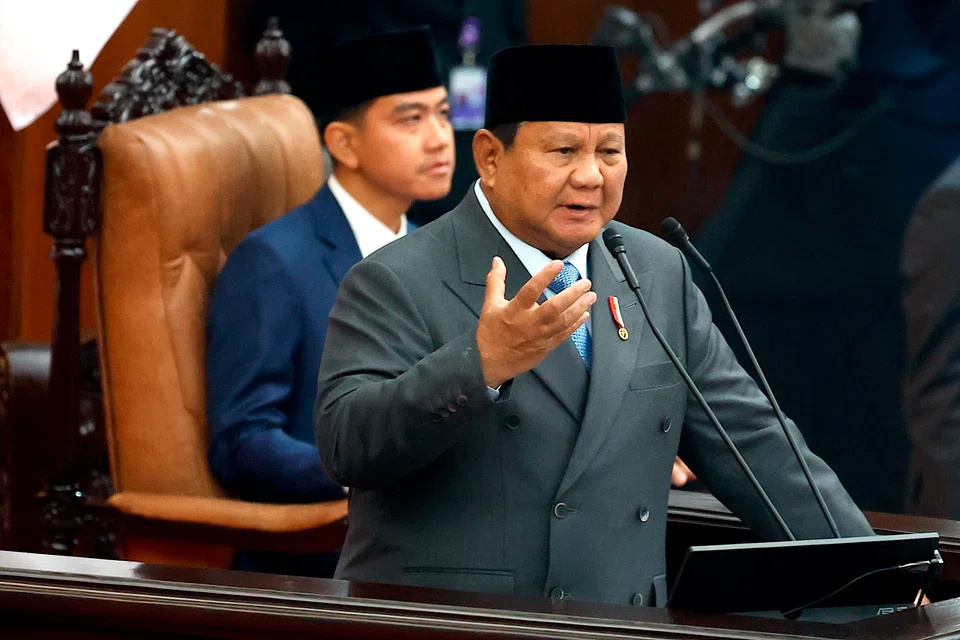
[JAKARTA] Indonesia is preparing for a more expansive economic programme in 2027, with President Prabowo Subianto seeking to accelerate growth through higher government spending and giving the state a bigger role in managing the country’s vast natural resources.
Whether Indonesia can translate its more ambitious fiscal push and need for greater control over natural resources into faster, more sustainable growth without compromising governance and policy credibility remains to be seen.
The outcome could also shape the country’s economic trajectory relative to that of its South-east Asian peers, many of which are competing for the same investment flows as the region enters a new phase of growth.
On Friday (Aug 14), Prabowo unveiled a 2027 Budget targeting economic growth of 5.8 to 6.5 per cent, with spending focused on self-sufficiency in food and energy, industrialisation, infrastructure, education, healthcare and poverty reduction.
The 74-year-old president proposed a Budget of about US$230 billion, up 6.62 per cent from the previous year, while targeting a fiscal deficit of 2.4 per cent of gross domestic product, down from the 2.85 per cent projected for 2026.
The government and parliament have nearly six weeks to review and deliberate on the proposed spending and taxation plan before it is finalised and passes into law in October.
Nafan Aji Gusta, senior market analyst at Mirae Asset Sekuritas, said that the narrower deficit target sends a strong signal that the government is committed to a more prudent fiscal policy, following concerns that Prabowo could breach Indonesia’s 3 per cent deficit ceiling.
“The pro-welfare budget proposal is sufficient to provide an initial boost to positive sentiment,” Nafan explained. “However, the sustainability of that positive sentiment will depend heavily on transparency and efficiency in budget disbursement, as well as the optimisation of state revenues.”
A tall order
The strategy is a significant test of Prabowo’s ambition to lift economic growth towards 8 per cent by 2029, from 5.3 per cent in the second quarter of this year.

The challenge comes as Indonesia grapples with a weaker rupiah and higher costs for import-dependent businesses, even as the fallout from the Iran war has pushed up global energy prices and added to fuel-cost pressures at home.
Josua Pardede, chief economist at Permata Bank, said that the government’s 2027 growth target of 5.8 to 6.5 per cent is ambitious but achievable, provided the fiscal push translates into stronger economic activity.
He noted: “This is an ambitious rather than impossible target, but it cannot be achieved merely through larger government expenditure.”
He pointed out that reaching the upper end of the target, however, would require broader improvements in productivity and investment beyond higher government spending.
The Jakarta Composite Index closed 1.59 per cent higher on Friday as Prabowo was still delivering his speech, while the rupiah weakened 0.28 per cent to 17,872 per US dollar.
Prabowo is also seeking greater state control over Indonesia’s natural resources, following his surprise move to expand the role of Danantara Sumberdaya Indonesia in monitoring commodity exports.
The government is also planning to launch a commodity exchange on Jan 1, 2027, which would establish domestic benchmark prices for key exports such as nickel, tin and coal.
In his speech, Prabowo stressed that Indonesia should capture more of the value generated by its commodities rather than allow this wealth from resources such as coal, palm oil, nickel and other minerals to leak overseas.
He said that the move is intended to give Indonesia greater influence over how its resources are priced and traded globally. This push fits into his broader economic philosophy of greater national self-reliance.
Harry Su, managing director of research at Samuel Sekuritas Indonesia, explained that the speed and scale of national programmes could create governance risks if implementation moves faster than oversight mechanisms.
He pointed to the free nutritious meals programme, which has faced food-safety incidents and corruption concerns, as an example of the challenges that can emerge when large national programmes are rolled out rapidly.
Developing world-class hubs
In a speech lasting more than 90 minutes, Prabowo placed food and energy security, downstream processing and industrialisation at the centre of his administration’s economic agenda, in a drive to turn the nation’s vast commodity wealth into higher-value domestic production and greater state revenue.
He also announced plans to establish an International Financial Centre in Jakarta and Bali, aiming to develop both cities into world-class hubs for finance, investment, fintech, arbitration and commercial dispute resolution.
Under its push to reduce the country’s reliance on coal, Indonesia has set a target of installing 30 gigawatts of solar power capacity while phasing out 13 gigawatts of diesel-fired plants.
Fakhrul Fulvian, chief economist at Trimegah Sekuritas, said that investors are likely to focus on the government’s broader policy direction, but will be watching for more details on how the programmes will be implemented.
He added: “The vision is becoming clearer. But investors and businesses typically don’t just ask where we are going. They also want to know how we will get there, what the priorities are, and how each policy will translate into investment, jobs and higher productivity.”
Decoding Asia newsletter: your guide to navigating Asia in a new global order. Sign up here to get Decoding Asia newsletter. Delivered to your inbox. Free.
Copyright SPH Media. All rights reserved.