Indonesia central bank keeps rates on hold as uncertainties ease
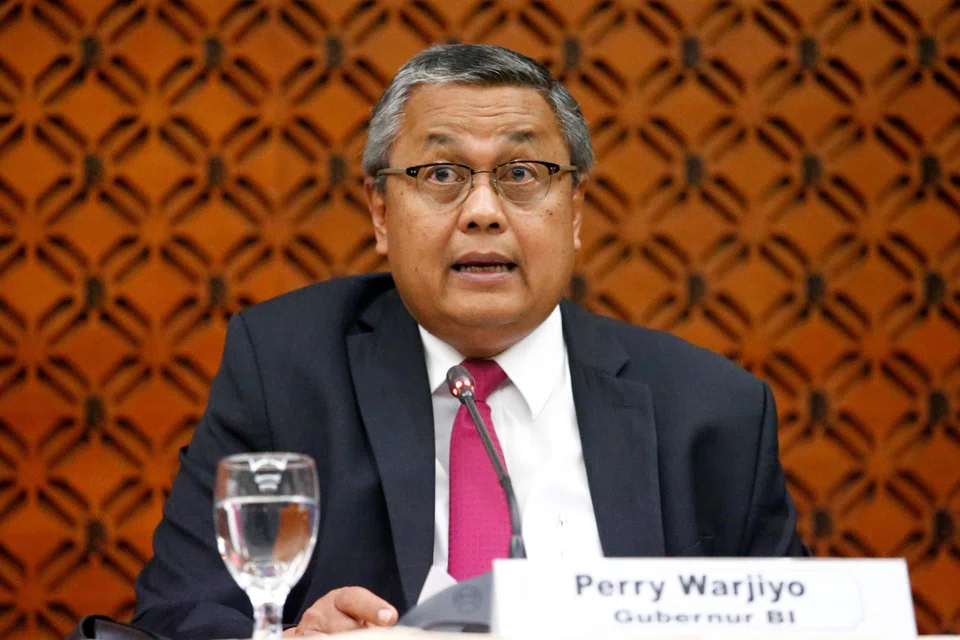
INDONESIA’S central bank held policy rates steady for the sixth straight review on Tuesday (Jul 25), saying current levels are enough to ensure inflation stays within its target this year while global uncertainties are expected to ease.
Bank Indonesia (BI) also kept its 2023 economic growth projections unchanged in a range of 4.5 per cent to 5.3 per cent. South-east Asia’s largest economy grew 5.3 per cent last year.
The central bank kept the benchmark seven-day reverse repurchase rate at 5.75 per cent, where it has been since January, as widely expected in a Reuters poll. Its two other rates were also left unchanged.
“The policy focus is oriented towards strengthening rupiah stability to manage imported inflation and mitigate the contagion effect of global financial market uncertainty,” BI governor Perry Warjiyo said in Jakarta. “Going forward, with expectation that the global financial market uncertainty will ease, Bank Indonesia predicts the rupiah exchange rate will appreciate.”
The rupiah gained 0.2 per cent against the US dollar on Tuesday (Jul 25), while the benchmark stock index was up 0.3 per cent.
Warjiyo said economic growth appeared stronger than previously anticipated in the second quarter, but he added that demand for corporate loans had slowed.
BI will from Oct 1 relax rules on required reserves for banks that lend to some sectors such as property, tourism and metal smelting to support credit growth. These incentives, Warjiyo said, will free up 47.9 trillion rupiah (S$4.2 billion) in liquidity to spur bank lending after loan growth eased to a 15-month low in June. That was enough for the governor to trim this year’s credit expansion forecast to a range of 9 per cent to 11 per cent from a previous 10 per cent to 12 per cent.
Banks that lend to priority sectors, including commodity downstreaming, can cut their reserve requirement ratio (RRR) by as much as 4 percentage points, compared to the previous set of perks totalling 2.8 percentage points. The average RRR is currently set at 9 per cent for conventional lenders and 7.5 per cent for Shariah-compliant banks.
Indonesia’s extended pause while offering liquidity-boosting measures underscores the balancing act that policymakers must manage amid currency weakness, sluggish trade and moderating consumption.



The rupiah has been one of the worst performers in Asia this month, amid BI’s dollar buffer falling further to a six-month low in June and commodity prices taking a deeper tumble on exports. The central bank expects two more quarter-point hikes from the Federal Reserve this week, and again in September.
“While BI noted that bank lending growth was slowing, it opted to support credit with macro-prudential measures instead of a rate cut – again in line with our view that the central bank is still reluctant to ease policy, especially in the face of more tightening from the Fed,” said Brian Tan, senior economist at Barclays in Singapore.
The rupiah came under pressure last year when the US Federal Reserve began aggresively raising rates.
This year, the rupiah has performed well with a 3.8 per cent gain so far, the best among emerging Asian currencies, supported by capital inflows. But it remains sensitive to market risk appetite and bets over US monetary tightening.
BI’s Tuesday decision comes as market participants brace for a likely rate hike by the Fed later this week.
BI expects the Fed to raise rates by 25 basis points (bps) this week followed by 25 bps more in September, and for uncertainty around its tightening cycle to abate by then, Warjiyo said. But he said Indonesia’s rate policy would be dependent on domestic inflation and economic growth.
Shoring up the rupiah
As inflation slows, BI will have room to start cutting rates in September, possibly a 50-bps reduction in total by the end of 2023, said Fakhrul Fulvian, an economist with Trimegah Securities.
BI raised rates by a total of 225 basis points between August to January.
Inflation in Indonesia shot up last year amid rising food and energy prices but returned to BI’s 2 per cent to 4 per cent target range earlier than expected in May and is forecast to continue easing. June’s inflation was 3.52 per cent.
Some analysts predict BI will begin easing monetary policy to bolster the economy amid an expected slowdown in growth as weaker demand and falling commodity prices hit exports. REUTERS, BLOOMBERG
Decoding Asia newsletter: your guide to navigating Asia in a new global order. Sign up here to get Decoding Asia newsletter. Delivered to your inbox. Free.
Share with us your feedback on BT's products and services