



Indonesia chases Asian digital payments clout with China, India QR links
The tie-ups could lift tourist spending and boost the rupiah

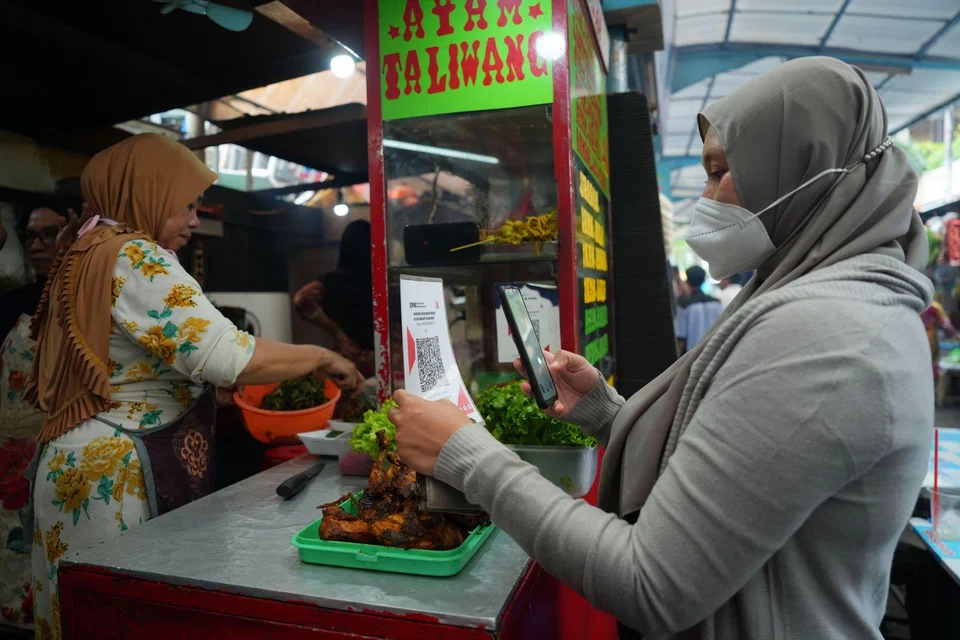
[JAKARTA] Indonesia is expanding its national QR payment system’s reach into India, just months after linking up with China, as it looks to capture more of Asia’s fast-growing cross-border digital payment flows.
The link, targeted for completion by end-2026, would connect Indonesia’s Quick Response Code Indonesian Standard (QRIS) with India’s real-time bank payment network Unified Payments Interface (UPI).
This would allow consumers and merchants in both countries to make and accept payments using their existing banking and e-wallet apps.
Together with the China connection launched in April, it would place QRIS at the intersection of three of Asia’s largest QR payment markets.
The links could bring more spending from Chinese and Indian visitors to millions of Indonesia’s merchants, most of them small businesses. They also support Jakarta’s push to use local currencies for more cross-border payments, cutting costs and reducing reliance on global card networks and the US dollar.
Roshan Raj Behera, a partner at Redseer Strategy Consultants, said Indonesia has emerged as one of Asean’s most ambitious players in cross-border QR payments. “Indonesia stands out for the pace of QRIS expansion,” he said.
Indonesian President Prabowo Subianto said during talks with Indian Prime Minister Narendra Modi in Jakarta recently that work on linking QRIS and UPI was progressing, with the cross-border payment network targeted to go live by the end of the year.
The planned India linkage marks Indonesia’s latest push to build a regional payment ecosystem based on local currencies and QR technology, reducing reliance on traditional card networks and lowering transaction costs for consumers and merchants.
Singapore and Thailand were early pioneers, with the PayNow-PromptPay linkage setting the regional benchmark.
Roshan noted, however, that Indonesia has rapidly expanded QRIS from a domestic standard launched in 2019 into a network with live and planned payment links across South-east Asia and markets in Asia and the Middle East.

Looking east
The expansion into India follows Bank Indonesia’s launch of cross-border QR payment connectivity with the People’s Bank of China in April, extending the efforts of South-east Asia’s largest economy to connect QRIS with Asia’s biggest payment ecosystems.
Under the arrangement, Indonesian travellers can use QRIS-enabled e-wallets and banking apps to make payments by scanning more than 80 million Alipay and UnionPay QR codes across China.
Meanwhile, Chinese visitors using the Alipay or UnionPay apps can pay at more than 40 million QRIS merchants across Indonesia, most of them micro, small-and-medium enterprises (MSMEs), which make up more than 99 per cent of businesses nationwide.
China is the world’s largest QR payment market, processing more than 1.2 billion mobile and QR code transactions daily, while India’s UPI handles over 400 million transactions a day.
Indonesia’s QRIS, by comparison, processes about 170 million transactions daily.
Although both countries dwarf Indonesia in domestic payment volumes, Roshan said that Indonesia has an opportunity to distinguish itself through interoperability.
“China will remain ahead on domestic scale and trade-linked payment volumes. Indonesia’s stronger opportunity is interoperability,” he added.
Unlike China’s QR ecosystem, which is dominated by large platform players such as Alipay and WeChat Pay, QRIS was designed as a common national standard across banks and digital wallets, making it easier to connect with overseas payment systems.
The framework also supports direct local-currency settlement, reducing foreign exchange costs and dependence on third currencies such as the US dollar.
Rapid surge
Since its launch nearly seven years ago, QRIS has grown rapidly, reaching more than 62 million users as consumers and merchants increasingly embrace digital payments.
Beyond China, QRIS has expanded its international footprint to several Asean markets, along with Japan, South Korea and Saudi Arabia.
The rapid expansion of cross-border QR payments is already translating into higher usage.
Data from Bank Indonesia showed that the value of cross-border QRIS transactions jumped 380 per cent year on year to 2.71 trillion rupiah (US$151 million) in the first five months of 2026, while transaction volume rose 339 per cent to 2.06 million.
Foreign visitors accounted for the bulk of activity, with inbound transactions reaching 2.25 trillion rupiah, or 83 per cent of the total.
Malaysian users contributed the largest share at 58 per cent, followed by Chinese visitors at 39 per cent. Meanwhile, Indonesians spent 466 billion rupiah using QRIS abroad, with Malaysia and Thailand emerging as the top destinations.
Filianingsih Hendarta, deputy governor of Bank Indonesia, attributed the sharp increase in cross-border QRIS transactions to stronger cross-border mobility, the continued recovery in tourism, and the expansion of payment connectivity partnerships between Bank Indonesia and its overseas counterparts.
Window of opportunity
Industry players said the benefits of cross-border QR payments extend beyond convenience.
Vince Iswara, CEO of Indonesia e-wallet Dana, said consumers and tourists enjoy faster, lower-cost transactions with less reliance on cash, while small businesses can accept digital payments without the higher fees charged by traditional card networks.
Dana, one of Indonesia’s largest e-wallet platforms, serves more than 200 million registered users and processes around 70 million domestic transactions each day.
Indonesia’s QRIS network is also relatively inexpensive for merchants. Most businesses pay a merchant discount rate of 0.7 per cent on QRIS transactions, significantly lower than the fees typically charged by credit card networks.

The lower cost has helped drive adoption among MSMEs, which make up the vast majority of QRIS merchants.
Iswara said the recently launched payment linkage with China presents opportunities not only for Indonesian travellers, but also for millions of local businesses seeking overseas customers.
“We see this as an opportunity for Indonesia to go abroad,” Iswara told The Business Times in an interview.
Beyond tourism, Iswara said cross-border QR payments could eventually enable Indonesian MSMEs to sell directly to overseas consumers through QR-enabled payments.
China, in particular, represents a significant opportunity because of the extensive trade relationship and remittance flows between the two countries.
“China is currently the largest destination for outbound remittances from Indonesia,” he said. “With this connectivity, transactions become more affordable while also helping us increase inbound spending from China.”
Dana expects the China corridor to drive triple-digit growth in cross-border transactions, although the company declined to provide detailed projections.
Iswara added that the growth rate “will be far higher than 100 per cent”.
Beyond bilateral cooperation
Roshan from Redseer said the next challenge for Asia’s expanding QR payment network will be moving beyond bilateral agreements.
While country-to-country payment linkages are useful for building transaction volumes and trust, each new corridor requires separate technical integration, legal agreements, compliance standards and foreign exchange settlement arrangements, he noted.
This could make it hard for the system to scale as more countries join.
“The long-term solution is a multilateral network,” Roshan said, pointing to the Bank for International Settlements’ Project Nexus, which would allow countries to connect once to a common platform rather than negotiate bilateral links individually.
“If the region is still relying mainly on country-by-country bilateral links by 2031, it would mean the payment infrastructure has not kept pace with the opportunity.”
TRENDING NOW

Philippine power giant First Gen rebuffs foreign offers, plans up to US$2.6 billion in expansion

Cliff Tan has 7 million followers and a 4-month waitlist. Why won’t he expand his business?

Could stablecoins be the future of money?

From finance aspirant to Asean CEO: TUV SUD’s Jonas Strahberger on finding people who believe in you

