



In Indonesia, a concerted effort to get motorcycle riders to switch to electric

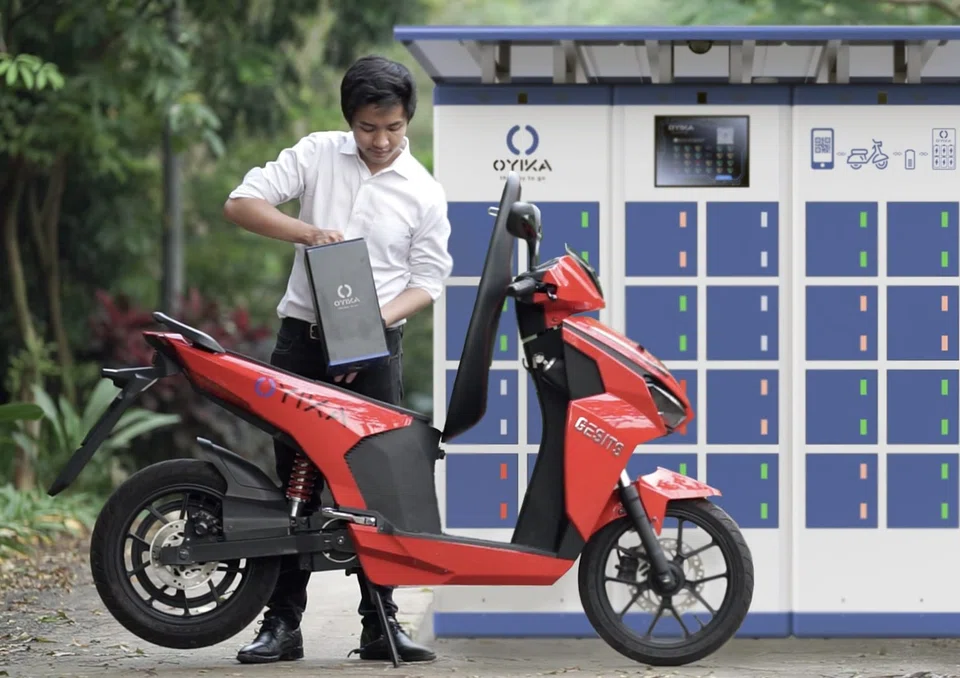
[JAKARTA] Singapore companies are looking to muscle their way into the Indonesia market to take advantage of what is expected to be a boom in sales of electric motorbikes. There are some 120 million motorbikes in Indonesia, but it’s estimated that only 1 per cent of these are electric.
According to latest available industry data, Indonesia sold fewer than 40,000 electric motorbikes between 2019 and last year, even though the country’s total motorbike sales in 2022 alone reached 5.22 million units.
The government has said it wants the take-up rate to go up, with a target of having at least 1.2 million electric motorbikes and 35,000 electric cars on the roads by 2024.
There’s also a target of two million sales of electric motorbikes in 2025, with the authorities going all out to attract billions of dollars in domestic and foreign investment to process the country’s vast nickel reserves into materials to produce electric vehicle (EV) batteries.
As part of the plans to cut carbon emissions, the Indonesian government last December announced a subsidy of eight million rupiah (S$703) that will be offered on every sale of a fully electric motorbike. The subsidy is much higher for cars – 80 million rupiah for an electric car, and 40 million rupiah for a hybrid car.
The government also intends to cover five million rupiah of the cost to convert a combustion engine motorbike into an electric one.
The likes of e-mobility startup Oyika and smart electric motorbike and energy storage solutions startup Ion Mobility are among those eager to take advantage of Indonesia’s low production costs and cater to the expected higher demand for these bikes in the coming years.
Oyika offers single-use, weekly and monthly packages for electric motorbike riders to swap their existing batteries for freshly charged ones at stations around the country.
Chief technology officer Roderick Chia said the company wanted to make its batteries “bike agnostic”, and it had to design these batteries to be of a certain size in order to fit most bikes in the markets where it is active. A fully charged battery can enable a rider to go as far as 50 km, and a typical electric motorbike can carry up to two batteries.
Besides Indonesia, Oyika currently has operations in Cambodia, Thailand and Malaysia, with plans to expand to Vietnam later this year.
As for Ion Mobility, it produces electric motorbikes with a focus on the lucrative Indonesian market. Last November, the company launched an electric scooter in Jakarta. It also signed a deal with Indonesia’s national grid operator Perusahaan Listrik Negara to expand the latter’s charging network.
In February this year, Ion Mobility announced new investments of US$18.7 million in its Series A funding round.
The company’s chief executive James Chan noted that while electric motorbikes have yet to leave a significant imprint in Indonesia for now, what will push the needle is the cost of owning such bikes.
Giving his take on how electric motorbikes fare against their petrol-powered counterparts, Chan said that, on average, an electric motorbike will cost half or one third as much to maintain. In some cases, there could be nearly no maintenance costs at all.
Indonesia will achieve “mass market acceptance” once consumers understand the savings they can enjoy and think about the total cost of ownership, rather than just look at the sticker price of electric motorbikes, said Chan.
Ion Mobility currently assembles its batteries in Singapore, with Chan sharing that the company is currently unable to procure lithium ion cells and semiconductors in Indonesia. Still, he is looking at ways to move the bulk of the production to Indonesia in the next two years.
“We are planning for 50 per cent by the end of this year, and 80 per cent by the end of next year,” said Chan, adding that Ion Mobility’s “end-to-end” production line and facilities put them in a better place to shift their production than their competitors.
Meanwhile, Oyika’s Chia said his company’s batteries are currently assembled in China, and the long-term plan is to relocate its assembly to Indonesia. “The volume in Indonesia is huge, so we may have more than one assembly plant,” he said, adding that Oyika will also ramp up its hiring in Indonesia to cope with the greater workload.
This story is part of an ongoing BT regional series on South-east Asian markets. In the coming months, BT journalists will head to different countries in the region to bring you the latest from the ground.
TRENDING NOW

High Court rules against Julius Baer’s Singapore trust arm in US$50 million family trust dispute

MSCI proposes standalone status for Indonesia; Jakarta stocks plunge 8%

Once staunchly pro-China, Malaysian Chinese businesses are now distancing themselves from Beijing

No chicken feed: How Malayan Flour Mills built an empire from flour to fowl

