Indonesia exports of ‘white gold’ soar on China’s hefty appetite for bird’s nests
As more Indonesian companies look to tap into China’s surging demand for bird’s nests, this is set to revitalise its economy

[JAKARTA] Indonesia’s prominence as a significant exporter of edible bird’s nests is poised for further growth with surging demand from China.
Indonesian officials said that more companies are likely to begin selling bird’s nests to China this year, which means that the South-east Asian country’s role as a major source market is poised to get even larger.
Agus Karyono, head of the Indonesia Animal Quarantine Agency, said that four Indonesian companies are currently under final review and have been audited by China’s General Administration of Customs for approval to export later this year.
If given the green light, these newcomers will join the existing 41 exporters on the list and cement the country’s position as a key exporter in this lucrative market.
“The response from China so far has been encouraging, and it’s highly probable they will commence exports by year-end,” Karyono told The Business Times.
The bird’s nest industry, once a niche market, has now become a thriving sector in Indonesia’s economy.
Helped by its tropical climate that’s suitable for swiftlets to breed, Indonesia produces around 1,500 tonnes of bird’s nests annually.
The country dominates the global edible bird’s nest trade, capturing up to 80 per cent of market share globally, according to the Indonesia Bird’s Nest Entrepreneurs Association.
Based on data from the Statistics Indonesia, the country’s bird’s nest exports surged to a substantial value of US$590.6 million in 2022, rising 14.2 per cent from the previous year’s figure of US$517 million.
It predominantly exported its bird’s nests to China, amounting to an average of 400 tonnes a year – a 50 per cent surge from 2014, when China first opened its market to imported nests.
Besides China, Indonesia also ships its bird’s nests to Hong Kong, Singapore and the US.
Caviar of the East
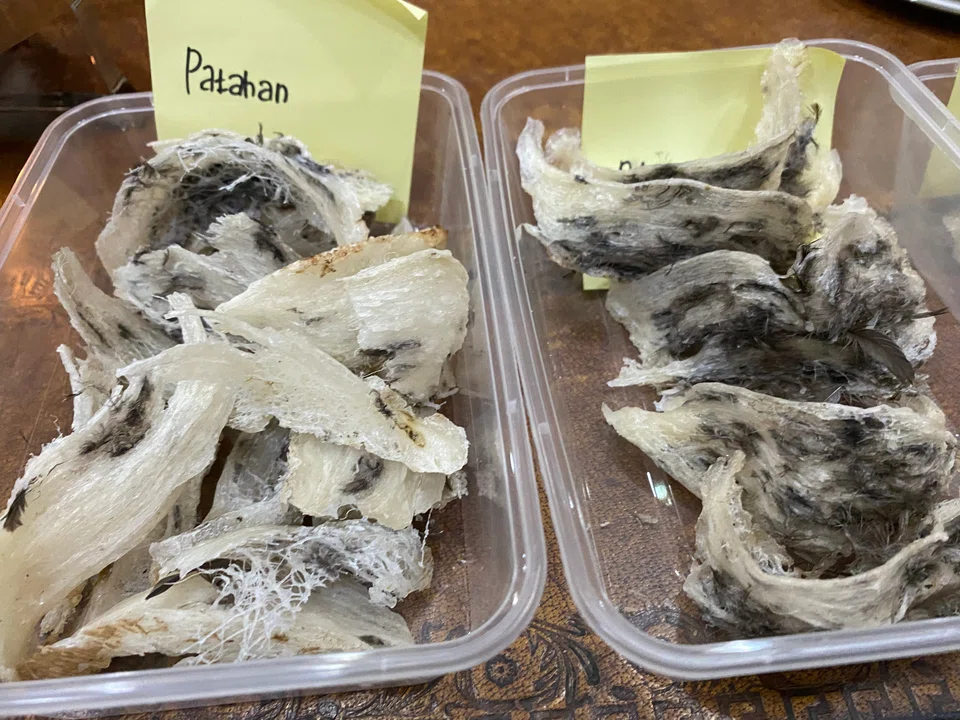
Bird’s nests are primarily made from the solidified saliva of swiftlets which harden upon exposure to air, forming the characteristic cup-shaped structures.
The ingredients, often dubbed the “Caviar of the East”, hold a revered place in Chinese culture, esteemed for their alleged health advantages and as symbols of status.
Due to its exceptional nutritional value, the price is staggering.
A lower-grade Indonesian bird’s nest weighing 1 kg is priced at 12 million rupiah (S$1,007) to 17 million rupiah, while premium-grade nests sell for 28 million rupiah to 40 million rupiah.
Having witnessed the astonishing prices local producers fetch for their prized nests, Indra Syafi’i, a 42-year-old former construction worker, is one of many drawn to the lucrative potential of this unconventional trade.
In the verdant hills of the Gunung Putri region in Bogor, West Java, Syafi’i harvested his nests from a 18-square-metre nesting house every two months, averaging around 800 g per harvest.
“High-quality bird’s nests should have a fine, firm and fragile texture. They are semi-transparent or translucent,” he told The Business Times.
Unlike some producers who refine or enhance their nests, Syafi’i opts to sell his harvest in its purest form, relying on a network of collectors in Bogor and Jakarta to broker deals on his behalf.
Crucial milestone
Boedi Mranata, chairman of the Indonesia Bird’s Nest Entrepreneurs Association, said securing approval from the Chinese government is seen as a crucial milestone for an industry that heavily relies on environmental conditions.
“Gaining access to the Chinese market is no small feat. Companies vying for export permits must first pass rigorous health inspection tests, and it takes trial-and-error,” he told BT.
Mranata, who has been in the business for more than 30 years, described bird’s nests as a high-risk food product due to the potential for contamination from bird droppings, feathers, and other environmental factors during harvesting and processing.
The avian flu epidemic of 2015 prompted China to enforce stricter import regulations for bird’s nests, presenting challenges for exporters attempting to access a market valued at an estimated US$530 million.
Despite strict requirements from China, the association has noticed a rise in the number of bird’s nest exporters obtaining licences.
Indonesia is not the only country producing bird’s nests. Its dominant position is now being challenged by the burgeoning presence of Cambodia and Vietnam, both of which have made significant strides in ramping up production and refining their export capabilities.
“But Indonesia’s bird’s nest is distinct from that of other countries due to its versatility of quality and characteristics,” Mranata said.
He said Indonesia recently witnessed an increase in the demand for lower-grade varieties these past years, fuelled by the growing interest of Chinese companies in manufacturing instant bird’s nest drinks.
Mranata pointed out that under President Joko Widodo’s administration, Indonesia has been advocating a swift entry into the Chinese market, including through government-to-government diplomacy.
Indonesia, traditionally recognised for exporting raw mineral resources, is trying to promote bird’s nests as a lucrative source of export earnings similar to crude palm oil and coal.
During multiple visits to China last year, Widodo lauded bird’s nests as “white gold”, presenting them to President Xi Jinping as symbolic tokens of trade diplomacy between the two nations.
“I hope this effort will continue under the new government,” Mranata said.
TRENDING NOW
Genting Singapore trails MBS, but helps anchor Malaysian parent group’s finances
Siti Hasmah Mohamad Ali, wife of former Malaysian PM Mahathir Mohamad, dies aged 100
He built the Vingroup empire. Now South-east Asia’s richest man is handing some key roles to his sons
Why US midterm elections could power the next stock market rally