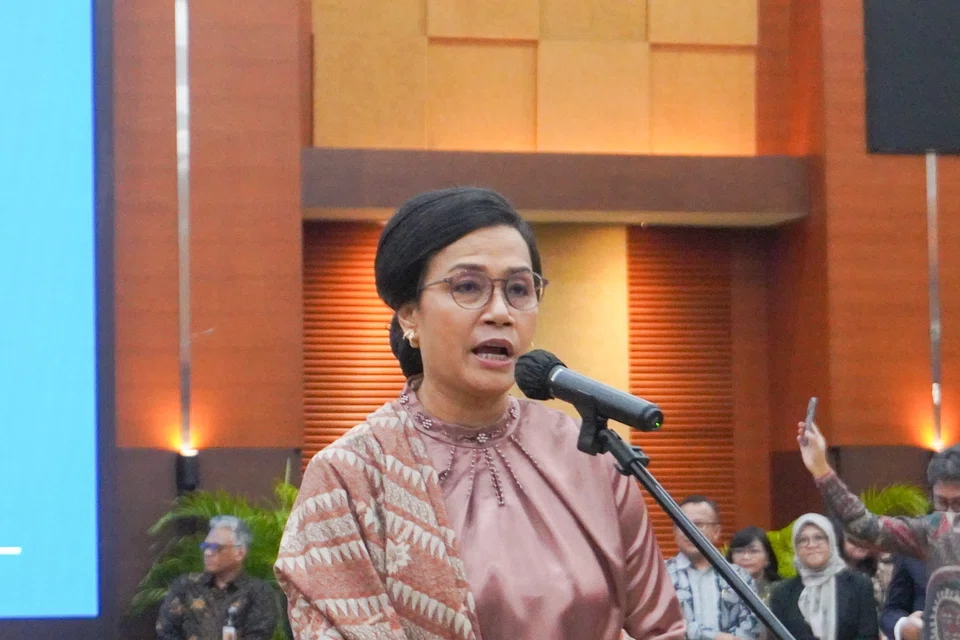
Indonesia finance minister Sri Mulyani’s sudden exit: What you need to know
The removal of one of Indonesia’s most prominent financial and political figures in surprise Cabinet reshuffle could deepen risks for the economy and unnerve investors

[JAKARTA] Financial markets reeled after the sudden exit of Sri Mulyani Indrawati, the former World Bank managing director long regarded as one of Indonesia’s most credible technocrats and known for driving reforms, as well as keeping a tight rein on public finances.
The long-serving finance minister was replaced by economist Purbaya Yudhi Sadewa in an abrupt Cabinet reshuffle on Monday (Sep 8).
Analysts warn that her departure heightens risks for an economy already strained by public discontent over mounting economic pressures.
Respected for her international networks and fiscal discipline, Sri Mulyani was regarded as a steadying hand who gave investors confidence in Indonesia’s often unpredictable policy landscape.
The Business Times outlines why her departure matters and what it could mean for the country’s economic trajectory.
Who is she?
Sri Mulyani, 63, is widely recognised as one of Indonesia’s most respected technocrats.
Born in Lampung, Sumatra, to a family of academics, she studied economics at the University of Indonesia before earning her PhD from the University of Illinois. She began her career as an economist at her alma mater, specialising in monetary economics and banking, before moving into government.
Steady hand under three presidents
She has served as finance minister under three presidents and across five Cabinets.
First appointed in 2005 by then president Susilo Bambang Yudhoyono, she left in 2010 to become a managing director at the World Bank.
The post changed hands several times before former president Joko Widodo called her back in 2016, a role she held until the end of his second term in the Indonesia Maju Cabinet (2019–2024).
Sri Mulyani’s first major test as finance minister came during the 2008 global financial crisis, when Indonesia’s economy came under much strain. At its height, yields on 10-year government bonds spiked to 21 per cent, while the Jakarta Composite Index shed half its value.
The turmoil struck as global markets were unravelling and Indonesia was still recovering from the twin shocks of the 2004 Aceh tsunami and the 2006 Yogyakarta earthquake.
In the years that followed, she pushed through key reforms to strengthen the state’s finances, improving tax collection and expanding the revenue base through measures such as the landmark tax amnesty programme.
Her toughest challenge came with the Covid-19 pandemic. In 2020, Indonesia experienced surging health expenditures and emergency social spending drove the budget deficit to 6.09 per cent of gross domestic product – well above the legal ceiling of 3 per cent.
Sri Mulyani prioritised funding for pandemic response, social assistance, and economic recovery, while securing then president Jokowi’s approval for an unprecedented burden-sharing arrangement with Bank Indonesia, which bought government bonds to ease fiscal pressure.
The deficit narrowed to 4.65 per cent in 2021 and is projected to remain below 3 per cent of GDP by 2025, marking a return to fiscal discipline.
Rumors of her resignation circulated ahead of the 2024 presidential election, particularly after she was summoned to testify at the Constitutional Court’s election dispute hearings. Yet, she stayed on overseeing the passage of the 2025 state budget in September 2024.
While many expected her departure to mark the end of an era, she was unexpectedly invited by president-elect Prabowo Subianto the following month to once again be considered for the finance minister post.
“The challenges ahead are increasingly complex, but we must stay optimistic that with strong synergy and collaboration, we can overcome them,” Sri Mulyani said after being sworn in by President Prabowo in October 2024.
What led to her exit
Sri Mulyani’s removal on the Sep 8 Cabinet reshuffle marked the end of an era. President Prabowo offered no official explanation, but her departure came against a backdrop of mounting political pressure, swelling street protests, and the fiscal strain of financing his expansive social agenda.
As Prabowo rolled out expansive social programmes such as free meals and healthcare, tensions grew over how to finance them without breaking fiscal discipline. Sri Mulyani, known for her prudence, was increasingly seen as a constraint on Prabowo’s political agenda.
Just weeks before her exit, her home was looted during protests, which she described as not only the loss of property but also of safety, justice, and humanity.
In a personal Instagram post, Sri Mulyani revealed this feeling while noting that even a cherished oil painting of flowers was stolen. Yet, she reaffirmed her resolve to serve, writing: “Never grow weary of loving Indonesia.”
Why her exit matters
The removal of Sri Mulyani, long regarded as an anchor of policy credibility, has unsettled investors and raised fresh doubts about fiscal sustainability amid President Prabowo’s costly campaign pledges.
The reshuffle triggered an immediate market reaction, with Jakarta’s benchmark index falling 1.28 per cent and the rupiah weakening by more than 1 per cent in offshore trading. On Tuesday, the index fell as much as 1.7 per cent at the open, while the rupiah weakened nearly 1 per cent to 16,445 per dollar.
Nomura analysts described her ouster as a negative shock, especially following recent public protests over economic hardship.
Filling her shoes – Purbaya
Her successor, Purbaya Yudhi Sadewa, 61 – a veteran economist and former head of the Deposit Insurance – steps in at a time when growth is faltering and fiscal pressures are intensifying.
Although he is less known, Purbaya has held senior advisory and deputy roles across multiple ministries since 2010, spanning economic affairs, maritime, political and the presidential office.
He is succeeding Sri Mulyani, who was a steady hand and had steered the country’s finance ministry for 14 of the past 20 years. Analysts say his first job would be to quickly build credibility with both Indonesians and investors and imbue confidence that there will be a smooth transition of power.
MUFG FX strategist Lloyd Chan said the leadership change at the Finance Ministry has heightened concerns over Indonesia’s fiscal outlook, citing uncertainty around Purbaya’s near-term policy direction.
The latest developments are unfolding at a crucial time, with deliberations on the 2026 state budget under way, raising fresh worries about the prospect of a widening deficit.
Purbaya’s immediate challenges include reconciling Prabowo’s costly social agenda – such as free meals and healthcare – with the need for fiscal discipline, while also preserving policy credibility during the sensitive 2026 budget deliberations.
“The task isn’t easy,” Purbaya said at a formal handover ceremony on Tuesday.