



Indonesia mulls review of clean energy exports to prioritise national interest
Country’s reassessment of its policy could potentially pose a challenge to Singapore’s planned low-carbon electricity imports

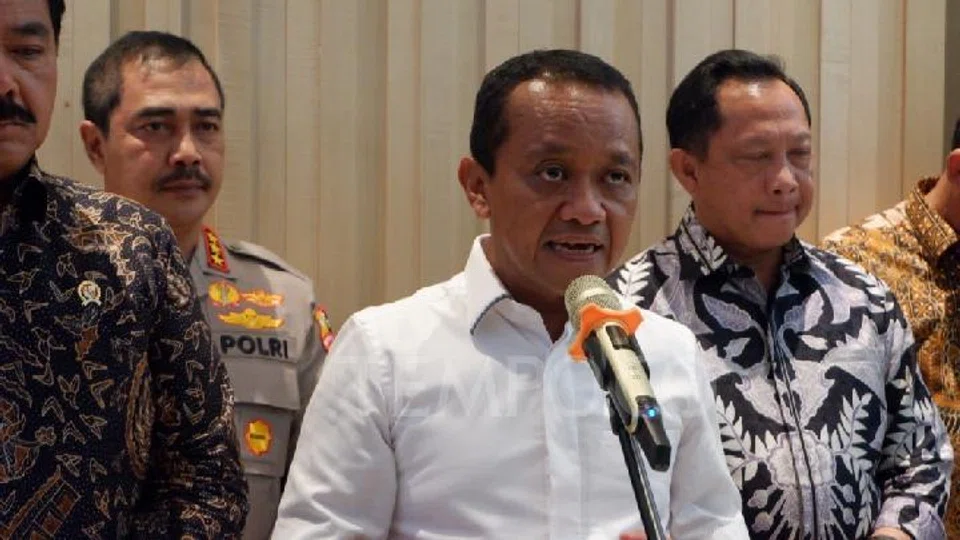
[JAKARTA] Indonesia may review plans to export clean electricity as the government prioritises national interests and sustainability in allocating natural energy resources, according to a senior minister of Indonesia.
It is not clear if the move would disrupt Singapore’s plans to import low-carbon electricity from Indonesia but, if it does, it could potentially throw a spanner in the works of its decarbonisation goals for the power sector which accounts for 40 per cent of the city-state’s carbon emissions.
Indonesia’s Minister of Energy and Mineral Resources Bahlil Lahadalia said that export of energy resources “is not just a B2B (business-to-business) matter”.
“This has to be a government-to-government conversation first. We’re talking about the interests of our nation,” Lahadalia stated on Monday (Nov 25), highlighting the critical importance of aligning energy export initiatives with Indonesia’s long-term priorities.
Lahadalia underscored that Indonesia’s rich renewable energy resources, such as solar and hydropower, must be leveraged strategically. While exporting clean energy offers economic opportunities, meeting domestic renewable energy demands remains a priority.
“As a nation committed to free trade, exporting is always an option. However, we must carefully consider the benefits for Indonesia. It cannot be a situation where they (other countries) gain while we incur losses,” he explained.
The remark follows reports earlier this month about a statement by Hashim Djojohadikusumo, the president’s Special Envoy for Climate Change and Energy, at the recent COP29 conference in Baku, Azerbaijan. CNBC Indonesia reported that he said the Indonesian government is reassessing plans to export electricity to Singapore.
He said that the rethink is led by among other things, whether it better serves the country’s interest for Indonesia to generate clean energy for domestic needs to drive investments in the data centre industry, a booming sector in South-east Asia that is also a major energy guzzler.
The Business Times has reached out to Singapore’s Energy Market Authority for comment.
Indonesia’s decision to reassess its electricity export policy also follows an announcement under President Prabowo Subianto’s regime that the country is mulling raising its renewable energy capacity to drive economic growth, which he has set at an ambitious target of 8 per cent a year in the coming years.
During a G20 meeting last week, Prabowo stated that Indonesia aims to achieve net-zero emissions by 2050, targeting the adoption of 100 per cent renewable and environmentally friendly energy within the next decade – or even sooner.
Potential setback
This latest development could potentially set back Singapore’s efforts for low-carbon electricity imports to decarbonise the power sector. The city-state is seeking to import around 6 GW of low-carbon electricity by 2035.
Putra Adhiguna, managing director of the think-tank Energy Shift Institute, emphasised that Indonesia’s perceived policy inconsistencies could undermine its appeal as a reliable partner for Singapore, which requires long-term agreements spanning over 20 years.
Adhiguna told BT: “In the fast-moving energy transition space, this could prompt Singapore to explore other alternatives.”
South-east Asia’s largest economy has set its sights on exporting around 3.4 gigawatts of clean energy to Singapore by 2030, tapping the power of solar farms that are steadily taking shape in the archipelago.
In September, the EMA granted conditional licences to five Indonesia-based projects and conditional approvals to two projects to import a total of 2 GW and 1.4 GW of low-carbon electricity respectively from Indonesia to Singapore.
While Indonesia is striving to increase the share of renewable energy in its electricity mix, renewables currently account for less than 15 per cent of the country’s total energy consumption. Currently, around 67 per cent of power plants in Indonesia use coal as their primary fuel source.
Despite being blessed with year-round sunlight, solar energy usage in Indonesia remains low, reaching just around 149.2 MWp as at January 2024, according to Ministry of Energy data. This is in sharp contrast to the country’s vast solar potential, estimated at 4.8 kWh/m², or the equivalent of 112,000 GWp.
Adhiguna also emphasised the urgency for Indonesia to accelerate the adoption of solar energy domestically. “Expanding beyond 2 GW of exports without significant domestic solar growth will raise concerns locally. However, the first few gigawatts of exports are necessary to kickstart Indonesia’s solar manufacturing sector, as adoption remains sluggish,” he noted.
Adhiguna suggested that completing the initial 2 GW export agreement could lay the groundwork for stronger cooperation. He emphasised that encouraging Singapore to support Indonesia’s domestic renewable energy sector would foster a mutually beneficial partnership.
Decoding Asia newsletter: your guide to navigating Asia in a new global order. Sign up here to get Decoding Asia newsletter. Delivered to your inbox. Free.
Copyright SPH Media. All rights reserved.
TRENDING NOW

Two Singapore-listed palm oil firms named in Greenpeace report on Indonesian plantation fires

Singapore Airlines flight returns to San Francisco after ‘unruly’ passenger incident

Singapore looking into which companies responsible for haze-causing fires: PM Wong

Deluge IPO 3.86 times subscribed ahead of SGX debut

