



Indonesia risks falling behind in regional EV race despite rich nickel reserves
Indonesia’s domestic market for EVs is showing signs of growth, but its adoption still lags regional peers, dampening investor sentiment

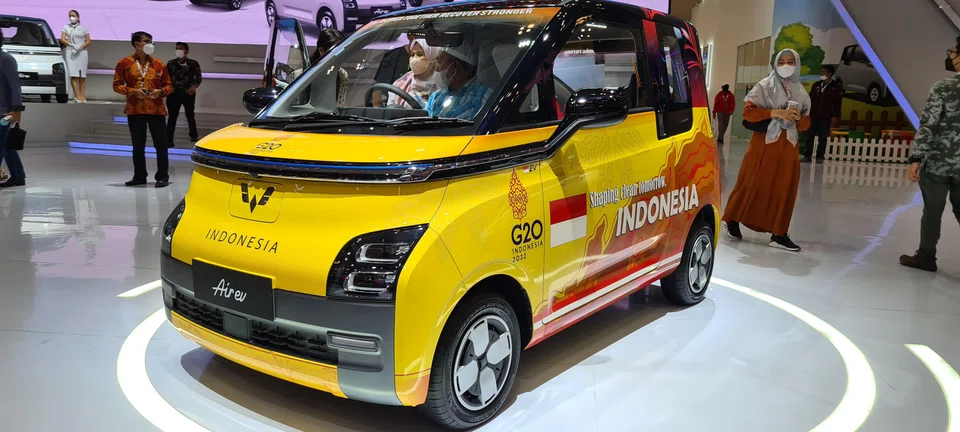
[JAKARTA] Even as the electric vehicle (EV) race heats up in South-east Asia, Indonesia – the region’s largest economy – is lagging in domestic EV adoption. This is despite the country’s abundant reserves of nickel, a key component in EV batteries.
Market watchers warn that Indonesia needs to accelerate its adoption rate rapidly if it wants to become a significant player in the EV ecosystem supply chain.
Indonesia faces stiff competition from other countries in the region, such as Thailand and Vietnam, which are actively promoting their EV industries, Jakarta-based think tank Energy Shift Institute managing director Putra Adhiguna told The Business Times.
While Indonesia is in a race to attract foreign direct investments (FDI) in the global EV market, he said the country’s battery and industry development ultimately depends on domestic demand.
“The slow uptake of EVs might prompt global manufacturers to reconsider their investment prospects in Indonesia,” said Adhiguna.
He further added that international cooperation towards a responsible battery supply chain is crucial for ensuring the industry’s sustainability.
In recent years, Indonesia’s EV downstream industry has attracted US$42 billion in FDI, following President Joko Widodo’s decision to ban nickel ore exports in 2020.
The mineral is an essential raw material for lithium-ion batteries used in EVs. Indonesia produces more than half of the world’s raw nickel.
A substantial portion of the FDI comes from China, according to official investment data out of Indonesia.
Despite the influx, Indonesia’s EV large-scale adoption rate remains at a mere 0.1 per cent, lower than Thailand’s 0.7 per cent according to a McKinsey report.
Less than 2 per cent of the vehicles on Indonesian roads are electric, with the vast majority still dominated by combustion engine vehicles.
A PwC Indonesia survey last year highlighted that the high initial cost of EVs is a barrier for consumers.
Other issues include insufficient charging infrastructure, lack of spare parts and repair services, range anxiety, limited public awareness, short battery life, and limited EV models.
On the back of the global EV boom, spurred by exploding demand, Adhiguna said the sector has seen a surge in new battery manufacturing facilities, encouraged by government incentives in the country.
“This has led to an oversupply of batteries, as demand for EVs has not kept pace with production capacity,” he said.
Indonesia’s EV battery factories have a capacity of 10 gigawatt-hours (GWh), accounting for just 0.4 per cent of global battery production – a figure that pales in comparison to its substantial nickel reserves.
The government has set goals to produce EV batteries with a total capacity of 140 GWh per year by 2030. One-third of this production is planned for export, while the remainder will support the domestic EV industry.
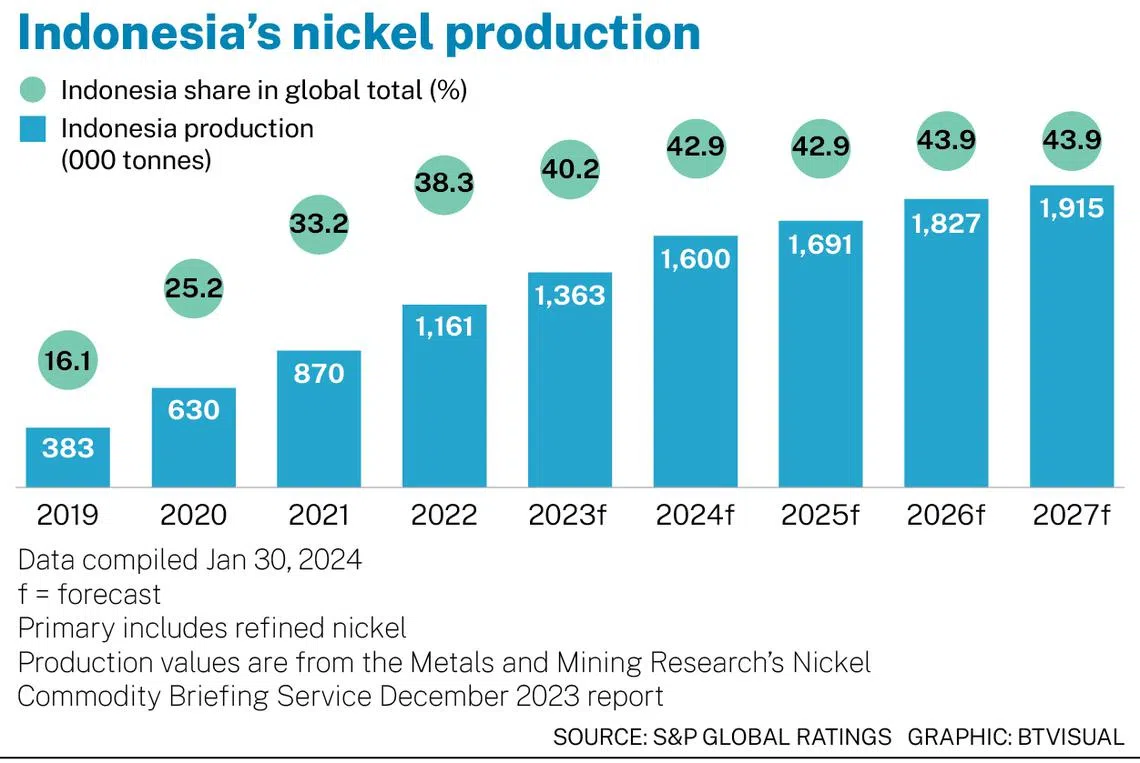
Energising the EV sector
Outgoing President Widodo has set an ambitious target to position Indonesia at the centre of the EV ecosystem by actively courting global players like Tesla and BYD to invest and establish manufacturing facilities in the country.
President-elect Prabowo Subianto has also signalled strong support to continue this vision over the next five years.
Indonesia, once an oil exporter, aims to produce 600,000 electric cars by 2030 to reduce its imported oil consumption. This would cut fuel consumption by 7.5 million barrels and reduce emissions by 2.76 million tonnes.
To boost domestic EV manufacturing, Indonesia has introduced financial and tax incentives, including a zero per cent export duty, lower import tariffs and a tax holiday for EV-makers.
These incentives have enticed Chinese companies such as Neta and Wuling to establish local assembly lines in Indonesia for producing EVs, expanding their market presence and reducing the country’s dependence on imports.
Recently, BYD also announced its intentions to construct a production facility in Indonesia by 2024, with an investment of US$1.5 billion and an annual production capacity of 150,000 units.
Slow but steady
Indonesia’s EV market, while still in its nascent stages, is gradually showing encouraging signs of growth.
The presence of Chinese EV brands with more affordable options, combined with government tax incentives, has gradually attracted middle-income consumers, said Yohannes Nangoi, president of the Association of Indonesia Automotive Industries (Gaikindo).
For instance, the government has reduced the value-added tax on electric cars from 11 per cent to 1 per cent, decreasing the starting price of the cheapest Wuling Air in Indonesia from over 245 million rupiah (S$20,335) to less than 224 million rupiah.
Last year, around 17,119 electric cars were sold in the country, dominated by Chinese brands such as Wuling and South Korea’s Hyundai. The number rose by 65.22 per cent compared to 2022, according to Gaikindo’s data.
The country’s vast archipelago, coupled with increasing urbanisation and a growing middle class, presents a substantial market for EVs, said analysts from BMI – a Fitch Solutions unit – in a March report.
Backed by substantial government subsidies, BMI forecasts a 37.9 per cent increase in total EV sales in Indonesia in 2024 and a further 20.5 per cent rise in 2025, reaching 23,600 units and 28,500 units, respectively.
The research house expects Indonesia’s EV fleet to surge but to remain below 2 per cent of total fleet by 2033.
Hendra Lie, automotive leader at PwC Indonesia, pointed out that government subsidies alone will not be effective in boosting demand for EVs.
“Driving changes in customer behaviour is the key factor in accelerating its adoption. This should begin with more campaigns by stakeholders to introduce and provide positive customer experiences with EV technology,” he told BT.
Currently, Indonesia has 7,000 public electric charging stations and 97 public EV charging stations across the country. However, the installation is not well distributed, with 88 per cent of the total stations located in Java and Bali.
TRENDING NOW

Once staunchly pro-China, Malaysian Chinese businesses are now distancing themselves from Beijing

Stocks to watch: HPL, Aims Apac Reit, Zico, Advanced Systems Automation, ComfortDelGro

‘How many will survive?’: Bubble fears arise as China’s humanoid robotics face reality check

Smaller board lots can’t fix a market run by three banks

