



Indonesia rushes to ease buyback rules as market turmoil triggers urgent action
The move, aimed at restoring investor confidence, comes on the heels of a sharp decline in the local stock market on Mar 18

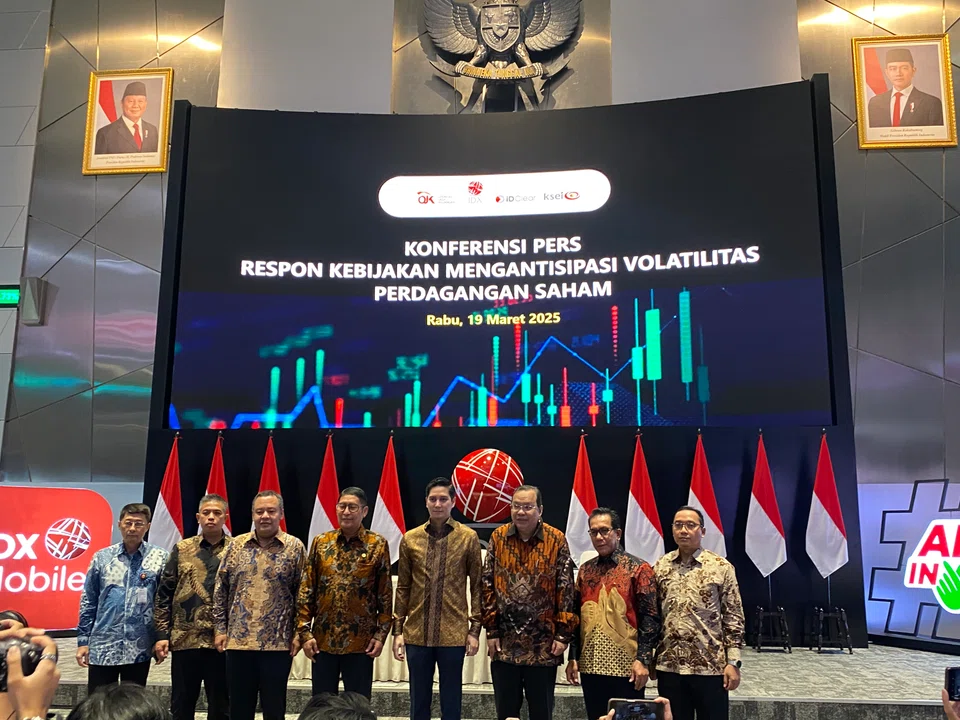
[JAKARTA] In a bid to support the market and prevent another potential rout, Indonesia’s securities regulator took sweeping action on Wednesday (Mar 19) by fast-tracking a buyback policy that was previously in the works.
The Financial Services Authority (FSA) on Tuesday reinstated a rule to allow publicly listed companies to conduct share buybacks without shareholder approval. It was previously implemented during the 2020 pandemic crisis to help restore investor confidence.
This policy will be in effect for six months, allowing companies to buy back up to 20 per cent of their paid-up capital.
“This move provides greater flexibility for issuers while ensuring market stability,” said Inarno Djajadi, head of capital market supervision at FSA, at a media briefing on Wednesday.
This came on the heels of a sharp decline in the local stock market on Tuesday, driven by rising concerns over President Prabowo Subianto’s recent policies as well as rumours – which were quickly shot down – that Finance Minister Sri Mulyani Indrawati was stepping down.
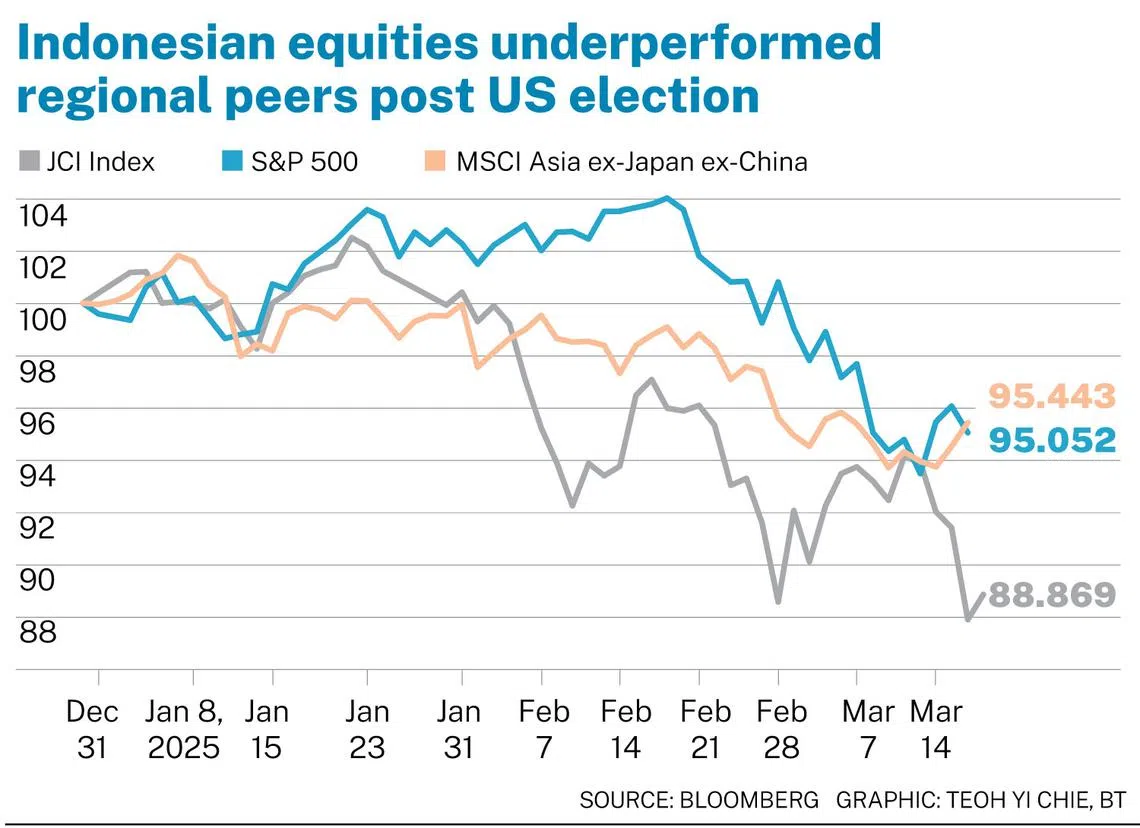
The Jakarta Composite Index plunged as much as 7 per cent during intraday trading on Tuesday, triggering a 30-minute trading halt to stem further chaos. The market rebounded on Wednesday, closing 1.4 per cent higher.
The buyback policy also comes after the capital market authority delayed the implementation of short-selling in early March, following a meeting with market participants.
Inarno said that FSA has observed a rise in buyback requests from companies, including blue-chip firms, but did not disclose specific figures.
Notably, several companies had already planned to seek shareholder approval for buybacks before Wednesday’s regulatory announcement streamlined the process, he added.
Herditya Wicaksana, an analyst at MNC Sekuritas, believes a well-timed share buyback could stabilise the market, as cash-rich firms with undervalued stocks may seize the opportunity to repurchase shares and reduce public holdings.
“A buyback can also serve as a signal of confidence to investors about the company’s future performance,” he said.
Foreign capital retreats
Indonesian equities have slid back to levels not seen since the April 2020 pandemic downturn, with the index dropping more than 12 per cent since the start of January, culminating in yesterday’s sharp decline. The sell-off has spread across equities, bonds and the rupiah.
Analysts pointed out domestic policy uncertainties, combined with global market dynamics – ranging from trade wars and geopolitical tensions in Europe and the Middle East to recession risks in major economies – have weighed on investor sentiment.
Foreign investors aggressively unloaded Indonesian equities, recording a net sell of 2.5 trillion rupiah (S$201.7 million) on Tuesday, according to the Indonesia Stock Exchange. Institutional investors sold shares in major banks, including Bank Central Asia, Bank Mandiri, Bank Rakyat Indonesia and Bank Negara Indonesia.
Lloyd Chan, FX strategist at MUFG, noted that investors are increasingly concerned that Indonesia’s fiscal deficit could exceed government projections, triggering a broader sell-off in the country’s equity market.
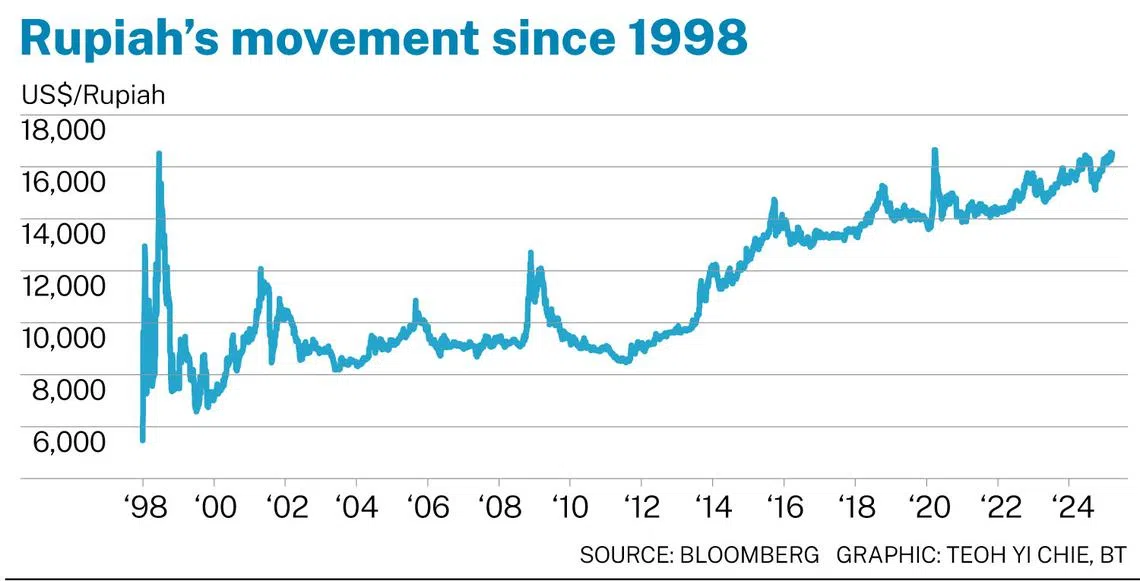
He warned that mounting selling pressure could further weaken the rupiah, potentially pushing it to 16,625 rupiah per US dollar by the second quarter of 2025.
The currency has become one of the region’s biggest underperformers, losing nearly 2 per cent year to date and hovering at 16,520 rupiah per US dollar, nearing its lowest point in the last five years.
Time to raise the alarm?
The recent trading halt – a measure last implemented during the 2020 pandemic turmoil – has sparked debate over whether Indonesia is on the brink of a financial crisis, reminiscent of the 1998 Asian financial crisis, which was triggered by the collapsing rupiah.
At the time, panic over the plunging rupiah and uncertainty surrounding government fiscal policies fuelled an exodus of foreign capital, sending shock waves through the economy.
However, analysts argue that the current situation is different, and a similar crisis is unlikely.
Irwanti, chief investment officer at Schroders Indonesia, said: “We believe panic selling is the main cause behind the activation of the recent circuit breaker as fundamentally, there hasn’t been much change in recent days, despite ongoing uncertainty.
“While we acknowledge the pressure on economic growth due to weak consumer purchasing power, the current situation is fundamentally different from the 1997 crisis.”
She urged investors to keep their heads cool as the market is set for a recovery.
Indonesian blue-chip companies, she said, remain fundamentally strong, with manageable debt levels and sustained business growth, positioning them well for long-term market recovery.
Key sectors, including consumer goods and commodities, remain fundamental drivers of South-east Asia’s largest economy.
She believes that the rupiah’s recovery, positive macroeconomic developments, and clear policies from Prabowo’s administration will serve as key catalysts to bring foreign investors back into the Indonesian market.
BI stands pat
As securities regulators act swiftly to halt the market slide, Bank Indonesia (BI) decided on Wednesday to keep its benchmark interest rate unchanged at 5.75 per cent amid market jitters.
This move aligned with the expectations of 19 out of 31 analysts polled by Reuters.
BI governor Perry Warjiyo highlighted that while there is still room for monetary easing to boost economic growth, the timing of such a move is critical. Concerns over capital outflows, coupled with the risks of a trade war and the direction of the US Federal Reserve policies, have led BI to adopt a cautious stance on cutting interest rates.
“We will continue to monitor inflation and economic growth prospects while assessing the room for rate cuts, all while keeping a close eye on the rupiah,” he said in a media briefing on Wednesday.
Analysts have warned that a rate cut at this time is too risky, fearing it could further weaken the rupiah amid the stock market meltdown.
“BI’s decision today seemed focused on maintaining rupiah stability,” said Lavanya Venkateswaran, senior Asean economist at OCBC.
She anticipates that the central bank has room to cut rates this year but expects the reduction to be modest, with a potential 25-basis-point cut.
The economist notes that Indonesia faces risks to sustaining its growth this year, with slower domestic demand likely to affect near-term growth due to recent cuts in government spending.
“We have revised our 2025 GDP (gross domestic product) growth forecast to 4.9 per cent, down from 5 per cent in 2024, with the first quarter of this year expected to be around 4.8 per cent,” she added.
The central bank projects Indonesia’s economic growth to range between 4.7 and 5.5 per cent, amid Prabowo’s decision to cut government spending earlier this year.






