Indonesia’s economic diplomacy set to maintain course under Prabowo

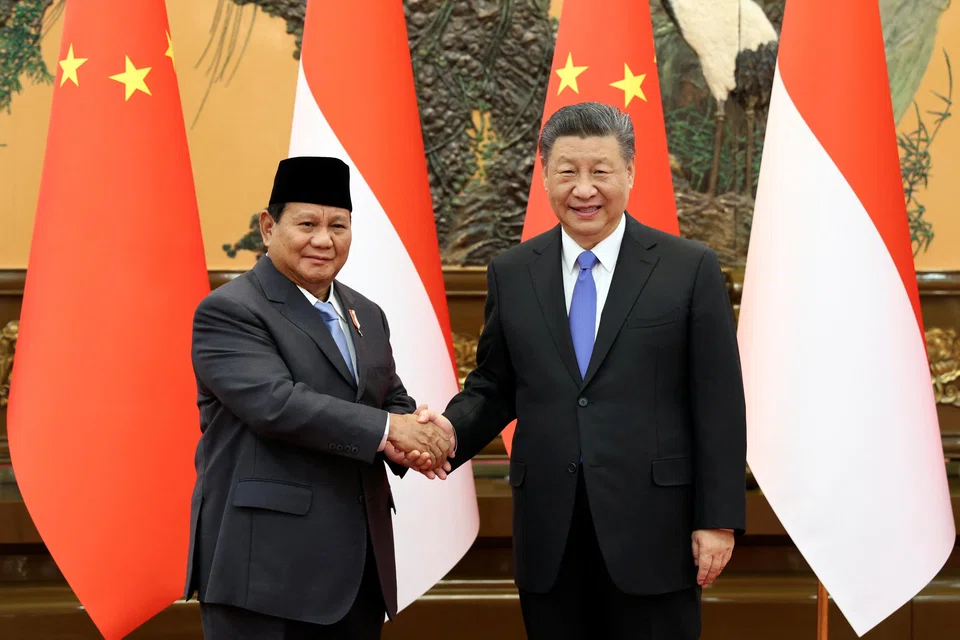
[JAKARTA] Indonesia’s stance towards China will likely remain steady under the leadership of president-elect Prabowo Subianto, indicating that the 72-year-old politician will prioritise continuity over change, analysts said.
Defence Minister Prabowo, declared the winner in last February’s election, met Chinese President Xi Jinping on Monday (April 1) in Beijing.
This is the first overseas trip Prabowo has made following the General Election Commission’s official announcement of his victory on March 20.
Prabowo’s overseas trip has defied tradition in yet another way, according to Zulfikar Rakhmat, director of the China-Indonesia Center of Economic and Law Studies (Celios).
His visit is seen as a prompt effort to continue the engagement and seek Chinese investments in the infrastructure and security sectors, which have been tailored by outgoing President Joko Widodo for the last decade.
Rakhmat noted that Beijing and Jakarta generally experience fewer tension flashpoints compared to China’s relationships with neighbours such as the Philippines or Vietnam. “China sees Indonesia as an important partner in the region and aims to ensure that the policies that have been beneficial to them can continue under Prabowo’s leadership,” he told The Business Times.
During his visit, Prabowo pledged to maintain stronger ties with China amid the simmering tension in the South China Sea.
Prabowo, set to assume office officially on Oct 20, said that the Indonesian government would prioritise aligning development strategies with China and fostering strategic cooperation in areas such as economy, trade and poverty alleviation.
He also committed to fulfil the needs of Indonesia’s military hardware, boost cooperation in the defence industry and establish productive dialogues. “I view China as one of the key partners in ensuring regional peace and stability,” Prabowo said in an official statement.
Meanwhile, Xi stated that Beijing would collaborate with Jakarta in constructing a Sino-Indonesian community aimed at a shared future, fostering regional and global influence to contribute to peace, stability, and prosperity worldwide, Xinhua reported.
Xi highlighted China’s strategic and long-term perspective on its relations with Indonesia, citing the Jakarta-Bandung High Speed Railway Project as an exemplary demonstration of high-quality cooperation, marking the onset of a new developmental phase.
Prabowo has notably engaged extensively with China, meeting several times with Xiao Qian, the former Chinese ambassador to Indonesia, between 2018 and 2022.
Keeping the balance
Indonesia has upheld a consistent balance between supporting the US and China despite their strategic rivalry for many years.
Siwage Dharma Negara, a senior fellow at the Iseas-Yusof Ishak Institute, suggested that Prabowo is likely to continue to keep tensions in check as they rise.
Prabowo has previously said that Indonesia was committed to its policy of non-alignment, and would keep good ties with both China and the US.
“Indonesia has been keeping its free and active foreign policy, which is trying to benefit (from relations) with major powers. So there will always be that balancing act,” Siwage noted.
He emphasised the importance of Indonesia engaging with the US from the standpoint of foreign direct investment (FDI) and highlighted that Indonesia cannot depend solely on a single type of foreign capital from one source, such as China. “There has been a spike in Chinese investment in Indonesia since 2015 – when Widodo began to take office. So there is an interest to balance these FDI sources.”
In the past 10 years, China and Indonesia have raised bilateral relations to the highest level in history.
China is Indonesia’s largest trading partner and second source of investment for Indonesia, with Chinese exports to Indonesia surging to US$71.32 billion in 2022, up from less than US$40 billion in 2014, Statistics Bureau data showed.
Indonesia is currently ranked among the top countries involved in the initiative known as China’s New Silk Road, with an estimated project value of 312.4 trillion rupiah (S$26.6 billion), according to AidData records from 2021. South-east Asia’s largest economy received US$7.4 billion investment from Chinese companies last year, according to data from the State’s Investment Coordinating Board.
Billions of dollars have been poured into pushing the development of downstream supply chains, such as the nickel smelter industry, tourism, and electric vehicle (EV) manufacturing.
Prabowo, whose running mate was Gibran Rakabuming Raka, Widodo’s eldest son, has vowed to continue previous government key policies in raw mineral downstreaming and building a new capital in Borneo.
“It is understandable that the government is not sparing any effort to attract foreign investors to help Indonesia build a city from scratch,” said Siwage.
Analysts widely perceive that Widodo supports Prabowo, his former political rival turned ally, and is banking on him to safeguard his legacy.