Indonesia’s Jakarta-Bandung high-speed rail extension to Surabaya not a priority: official

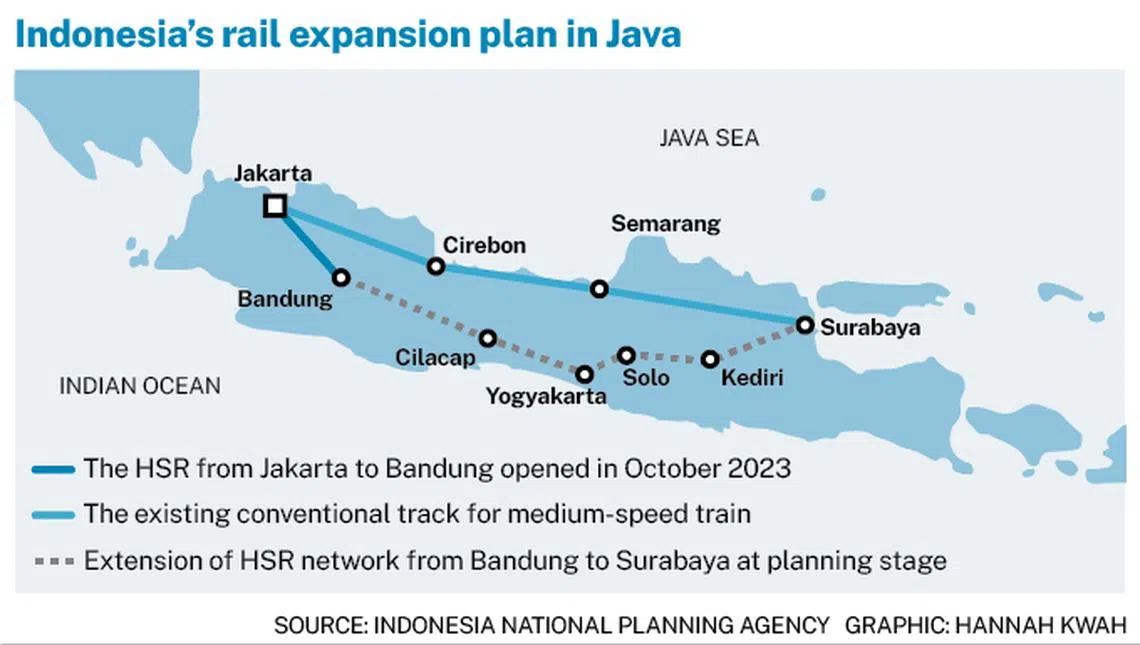
[JAKARTA] Indonesia is considering extending its Jakarta-Bandung high-speed rail (HSR) to the country’s second-biggest city, Surabaya. But the plan may face significant challenges ranging from hefty costs to land issues.
Adita Irawati, spokesperson for Indonesia’s Transportation Ministry, told The Business Times that while the proposal for a Jakarta-Surabaya link is currently under discussion with China’s state-owned China Railway Group, it is no longer on the country’s national strategic list of projects.
“It (the study) is still ongoing, but will not be prioritised,” she said.
Such projects usually receive government support such as land-clearing assistance and tax incentives. This further means that the fate of the project’s extension remains uncertain under the administration of the new president-elect, Prabowo Subianto.
Indonesia’s Jakarta-Bandung HSR – the country’s first such link – was officially launched last October and is also South-east Asia’s first HSR.
Extending the HSR service to Surabaya is urgently needed to balance efficiency and profitability, said Djoko Setijowarno, vice-chairman of the Indonesian Transportation Society (MTI).
He argued that the relatively short distance of 142 km poses a challenge for the existing project’s profitability, as most HSR run over a 400 km distance. He added that the Jakarta-Surabaya line will generate more passenger traffic than the current shorter distance.
“The investment of Jakarta-Bandung rail is too expensive for such a distance,” he said.
He noted that a more efficient transportation infrastructure with better connectivity can accelerate economic growth by facilitating the movement of people and goods in Indonesia.
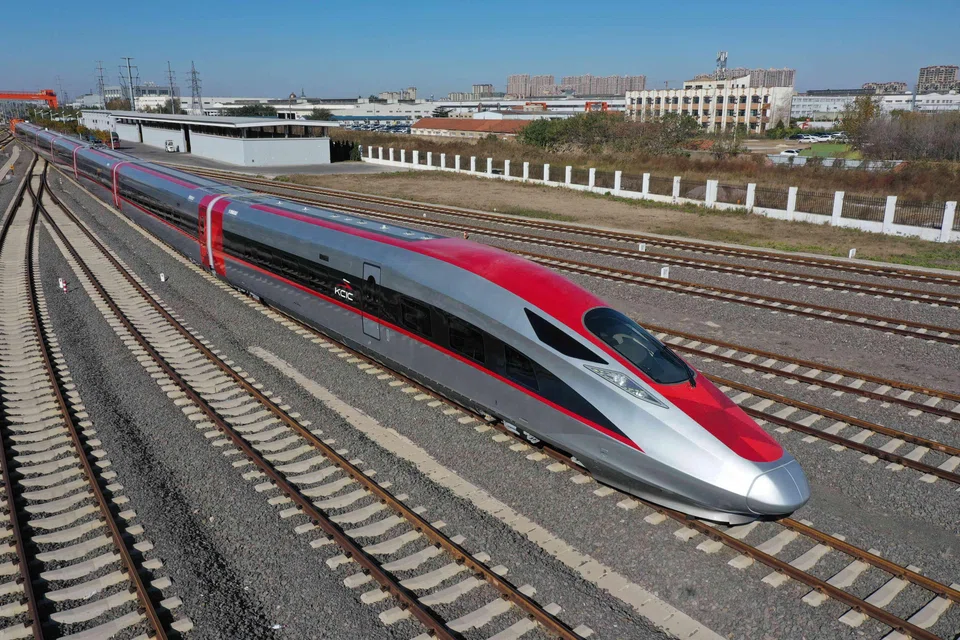
The Jakarta-Bandung HSR, also known as Whoosh, is a 142-km-long rail line connecting Jakarta, the national capital, and Bandung, the capital of West Java.
Capable of a top speed of 350 kmh, the US$7.3 billion Jakarta-Bandung HSR has trimmed travel time between Jakarta and Bandung from three hours to around 40 minutes. This has solved traffic congestion issues, which incur economic costs in the billions of rupiah every year.
With ticket prices ranging from 250,000 rupiah (S$21.19) to 400,000 rupiah, the HSR has transported over 1.5 million passengers since it was rolled out in October 2023.
The service is operated by Kereta Api Cepat Indonesia-China, a joint venture between Indonesian and Chinese state-owned enterprises, including state-owned railway firm Kereta Api Indonesia, construction company Wijaya Karya and China Railway Engineering Corporation.
This project is seen as the flagship endeavour for China-Indonesia cooperation under the Belt and Road Initiative. It stands as a testament to outgoing president Joko Widodo’s legacy of prioritising infrastructure development in Indonesia as he prepares to leave office in October this year.
During Prabowo’s recent visit to Beijing, Chinese President Xi Jinping lauded the Jakarta-Bandung HSR project as a prime illustration of “high-quality cooperation” between Indonesia and China.
The Indonesian government last year proposed an extension of the same project, recommending a 760 km expansion eastward from Jakarta, which would reduce travel time from 10 hours to just 3.5 hours. Local media reported that the construction will require an investment of around US$5.1 billion.
The government expects the project to benefit the domestic economy, as it will develop multiple new stations and transit-oriented development areas in various cities along the route.
In January, Coordinating Minister of Maritime and Investment Luhut Pandjaitan said Indonesia is interested in continuing the project with China.
This is primarily due to the more favourable loan conditions offered by Beijing, as well as China’s proven experience and advanced technology in developing the Jakarta-Bandung route.
However, Djoko flagged that the extension project will require huge funding and that it would be risky for the government to allow state-owned enterprises to draw more loans for the project, given that Whoosh has hampered companies financially.
He also highlighted potential challenges for the Jakarta-Surabaya HSR project, noting that land acquisition issues may arise since the project has been removed from the government’s priority project list.
A route through the northern part of Java, he said, is more feasible due to the flat terrain, while the south corridor is mountainous, which could cost more to build the railway.
“The land prices around the proposed route have been skyrocketing since the announcement. It will become the biggest financial burden for the project,” Djoko said.
The Jakarta-Bandung HSR project, for which construction began in 2016 with an initial estimated cost of around US$6.07 billion, ended up exceeding the budget. Much of this was owing to pandemic-related delays and the rising costs of materials. For that reason, too, the project’s rollout was delayed several times from its targeted commencement date of 2019.
The project secured financing through a loan from the China Development Bank, covering 75 per cent of the expenses, while the remainder was funded by Indonesian and Chinese shareholders.