



Indonesia’s Q1 FDI up 16% at 204.4 trillion rupiah despite political uncertainty
Singapore retains position as country’s largest foreign investor, with about 31% of total FDI

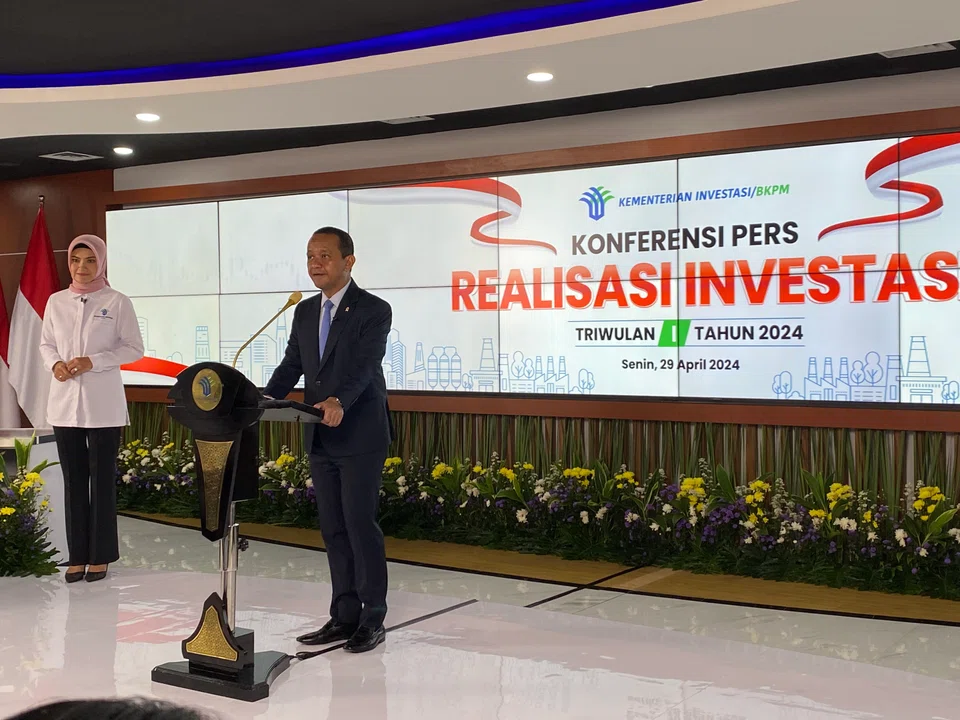
[JAKARTA] Indonesia’s business appeal has held up despite the uncertain political climate. Foreign direct investors committed 204.4 trillion rupiah (S$17.1 billion) of approved projects in the first quarter of this year – up nearly 16 per cent from a year ago, latest data from the Ministry of Investment on Monday (Apr 29) disclosed.
South-east Asia’s largest economy enjoyed a 15.5 per cent growth in foreign direct investment (FDI) on an annual basis, driven by strong investment flows into manufacturing, infrastructure, and mineral downstreaming following the government’s ban on nickel exports.
Overall, Indonesia has received a total investment realisation of 401.5 trillion rupiah from both foreign and local sources, constituting about 24.3 per cent of the government’s annual target of 1.65 quadrillion rupiah. The total investment realisation grew 22 per cent compared with the same period last year.
The ministry’s data excludes investments in the financial as well as oil and gas sectors.
Minister of Investment Bahlil Lahadalia stated that foreign investors continued to demonstrate their confidence in the Indonesian economy despite the ongoing general election and the dispute at the Constitutional Court.
“With the final decision from the Constitutional Court on the election results, I believe investors will begin to actualise a significant portion of their investments in the second quarter, and we anticipate that growth could exceed 15 per cent,” he said at a press briefing.
Last week, the Indonesian Constitutional Court delivered its verdict on two challenges to the outcome of February’s presidential election, ultimately paving the way for Defence Minister Prabowo Subianto to become the country’s eighth president.
The base metal industry saw the largest influx of FDI in January to March, amounting to US$2.7 million, marking a 20.2 per cent increase compared with the previous year.
Meanwhile, the mining sector secured the second position with US$1.4 million, reflecting a 10.3 per cent rise compared with the corresponding period last year.
Following a recent global decline in prices, investments in nickel, a crucial material for electric vehicles, reached 33.4 trillion rupiah, down from 136.6 trillion rupiah in Q1 2023.
Lahadalia disclosed that the significant influx of foreign capital into Indonesia’s downstream sector stemmed from the absence of funding initiatives by domestic banks.
He further urged domestic banks to take a more active role in extending credit to the domestic mineral downstream industry, aiming to reduce Indonesia’s reliance on foreign entities within its industrial landscape.
Additional sectors that experienced benefits from FDI encompassed warehousing, telecommunications, pharmaceuticals, as well as pulp and paper industries.
Singapore retained its position as Indonesia’s largest foreign investor, with 12,112 projects valued at US$4.24 billion, representing approximately 31 per cent of the total FDI.
Hong Kong and China were the second and third largest sources of FDI, with values of US$1.89 billion and US$1.87 billion, respectively.
Meanwhile, the Indonesian government aims to attract numerous foreign investors to enter the future capital city of Nusantara in the fourth quarter of this year, following the realisation of many investments from domestic investors.
The Ministry of Investment reported that the total investment inflow into East Kalimantan, the province where Nusantara is situated, amounted to US$11.9 billion in the first quarter of this year, comprising a total of 5,066 projects.
Lahadalia added: “We will actively encourage foreign companies possessing the requisite technology, capabilities, and experience.”
TRENDING NOW

South-east Asia has lost Nvidia’s best salesman

Higher rates, weaker spending: Is the Philippines entering stagflation?
Who is Leo KoGuan, the Singapore-based billionaire backing Nvidia’s Jensen Huang?

Demand, tech capabilities position Apac and AI as Skyscanner’s next growth frontiers: CEO Bryan Batista

