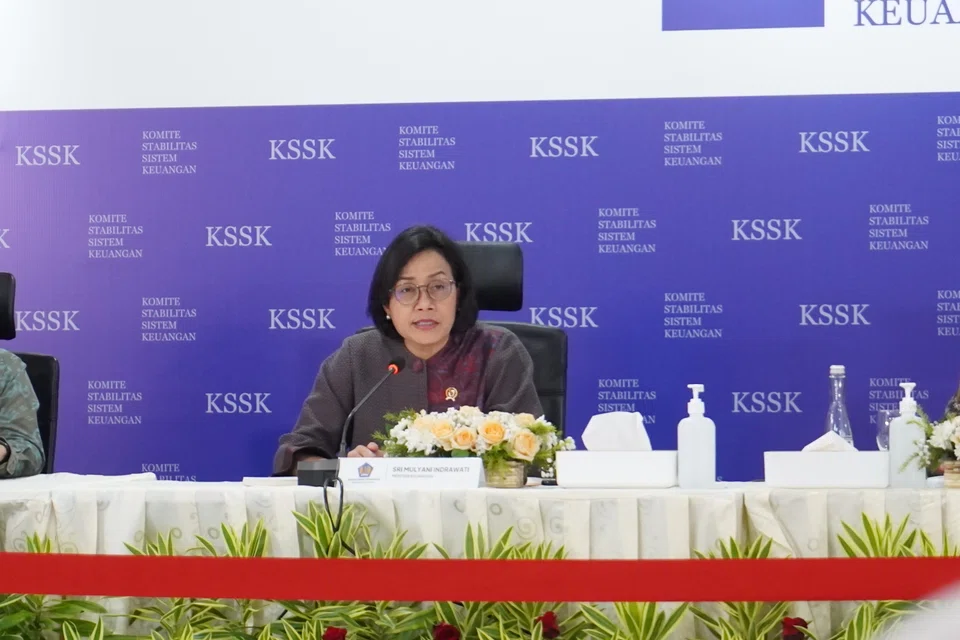
Indonesia shocks markets with removal of prominent finance minister Sri Mulyani
In a surprise Cabinet reshuffle by President Prabowo, she will be replaced by Purbaya Yudhi Sadewa, chairman of the Indonesia Deposit Insurance Corporation

[JAKARTA] In a surprise move, Indonesian President Prabowo Subianto has replaced Dr Sri Mulyani Indrawati with Dr Purbaya Yudhi Sadewa, the head of the Indonesia Deposit Insurance Corporation, as finance minister in a Cabinet reshuffle on Monday (Sep 8).
Jakarta’s benchmark index closed down 1.28 per cent following the announcement, while the rupiah weakened 0.75 per cent to 16,309 per US dollar.
Oktavianus Audi, vice-president at Kiwoom Sekuritas, said the reshuffle underscores the immediate risks stemming from Indonesia’s recent political turmoil and protest-driven demands for changes in tax and fiscal policies.
“That said, if the government quickly lays out a road map for new policies that maintain fiscal discipline, the current pressure on the stock market is likely temporary and (the market) could recover more swiftly,” he added.
Dr Sri Mulyani, 63, served as finance minister from 2005 to 2010 under former president Susilo Bambang Yudhoyono. The former World Bank managing director returned to the role in 2016 under president Joko Widodo and had served in that capacity since then. She was regarded as a strong advocate of fiscal discipline and reform.
Her replacement signals a major shift in Prabowo’s economic team as he moves to advance his policy agenda following deadly protests in Indonesia. The mass protests in Jakarta and other key cities have turned violent, with widespread vandalism and looting last month.
Dr Sri Mulyani’s home in Bintaro was also targeted. In an Instagram post, she condemned the looting as inhumane and urged the public to pursue legal channels rather than resort to violence.
Smaller protests continued in early September, with thousands demanding that Prabowo reform several policies, including measures to halt the wave of mass layoffs affecting South-east Asia’s largest economy.
Rumours of Dr Sri Mulyani’s resignation have surfaced several times, including in March during Prabowo’s first Cabinet reshuffle, though they were denied by the Presidential Communication Office.
The speculation rattled the stock market, with the benchmark index posting its largest drop since 2011 that month. The communication office dismissed the rumours at the time, reaffirming that Dr Sri Mulyani would remain in her role.
Fiscal continuity
Dr Purbaya’s appointment as finance minister comes at a time of economic pressure in Indonesia, with observers noting that his key challenge will be balancing the need to secure substantial funding for Prabowo’s ambitious 8 per cent growth target while maintaining fiscal stability.
OCBC economists Lavanya Venkateswaran and Ahmad Enver said that fiscal policy will be crucial in reshaping perceptions of the government’s economic agenda, placing Dr Purbaya firmly in the spotlight.
“Purbaya’s first task as finance minister will be to reassure both domestic and foreign investors that the transition of power will be smooth. This will not be without its challenges,” they added.
They noted that while his approach remains uncertain, there is growing pressure to steer fiscal policy in a more populist direction.
After his inauguration, Dr Purbaya told reporters that he would safeguard fiscal health while promoting economic growth through accelerated government spending, and emphasised that the 8 per cent growth target is achievable.
“We will ensure that fiscal policy provides optimal support for the economy. The fiscal position is healthy, but we will make sure (the policy) does not disrupt the financial system and that spending remains optimal,” the 61-year-old said.
Before serving as head of the Indonesia Deposit Insurance Corporation, he was an economist who worked at the Danareksa Research Institute and later became president director of Danareksa Securities. He also served as an economic adviser to Yudhoyono and Joko.
He earned a degree in electrical engineering from the Bandung Institute of Technology, followed by a master’s and a doctorate in economics from Purdue University in Indiana in the US.
Brian Lee, economist at Maybank, said that markets will be watching for any new revenue-raising measures from Dr Purbaya and his team.
“The administration’s priorities are unlikely to change with a different finance minister. More funds are being allocated to the second-half stimulus, as the government seeks to support households’ purchasing power and the economy.”
However, he noted that near-term revenue pressures and expenditure needs are unlikely to change significantly. The fiscal deficit is projected at 2.9 per cent of gross domestic product for 2025 to 2026, wider than the government’s estimates.
Lee added that short-term pressure on the rupiah and financial markets may occur, but expects it to ease as markets adjust, supported by Dr Purbaya’s economic experience and a potential 25 basis point rate cut by the US Federal Reserve later this month.
TRENDING NOW
He built the Vingroup empire. Now South-east Asia’s richest man is handing some key roles to his sons
Grab CEO’s wife Chloe Tong on life with Anthony Tan and finding her purpose
What role can Japan play in Asean’s future?
From folding clothes to factory work: Why China is sending humanoid robots to school