Asean Business logo
SPONSORED BYUOB logo

Indonesian consumer firms brace for more earnings pressure as rupiah weakens

Challenges likely to persist amid weak demand, currency swings and volatile commodity prices

Summarise
Elisa Valenta
Published Fri, Aug 7, 2026 · 12:40 PM
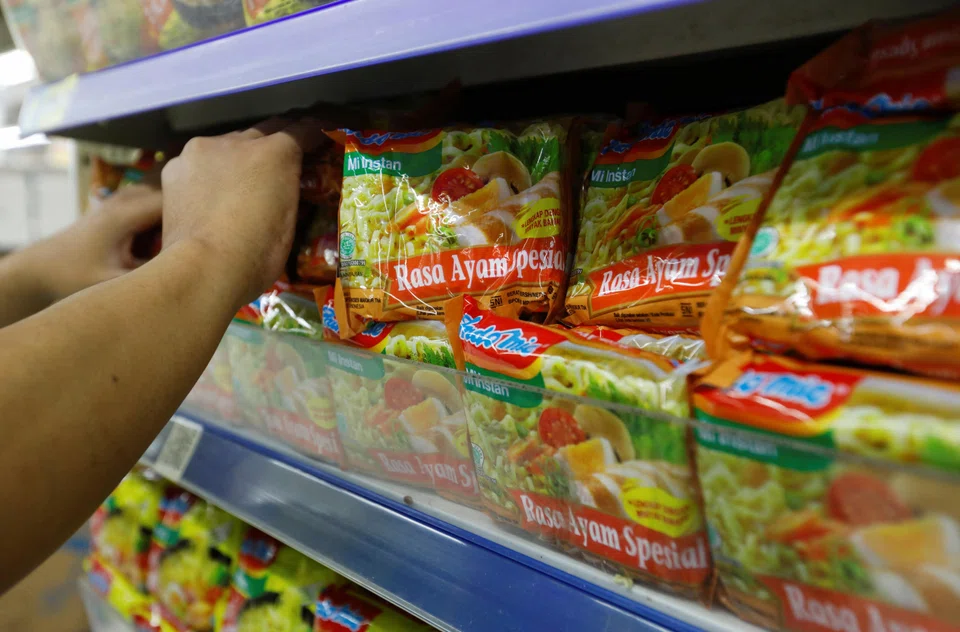
    • Indofood Sukses Makmur, which owns Indomie maker Indofood CBP Sukses Makmur, has been hit by the weaker rupiah.
    • Indofood Sukses Makmur, which owns Indomie maker Indofood CBP Sukses Makmur, has been hit by the weaker rupiah. PHOTO: REUTERS

    [JAKARTA] A weakening rupiah emerged as one of the biggest drags on Indonesian consumer companies’ first-half earnings, eroding profits through higher financing and import costs even as sales held up.

    Analysts expect the pressure to persist in the second half, citing fragile consumer spending, volatile commodity prices and the sector’s heavy reliance on imported raw materials and US dollar funding.

    Ng Yijing, corporate ratings director at S&P Global Ratings, said Indonesian importers are likely to face even greater margin pressure in the second half after the rupiah accelerated its decline in Q2 and slid to record lows in July.

    Beyond earnings, she said the weaker currency could also increase companies’ working-capital requirements as import costs rise and longer shipping times keep inventories elevated, potentially resulting in higher leverage for companies reliant on imported inputs.

    “We believe cautious consumer sentiment could lead to weakness in certain pockets of Indonesia’s consumer sector in 2026,” Ng said.

    The rupiah has fallen about 7.5 per cent against the US dollar this year, sliding to a record low of around 18,000 per US dollar in late July amid a stronger greenback and broader global uncertainties that prompted capital outflows.

    The surprise departure of Bank Indonesia’s governor last week piled further pressure on the currency.

    Indofood Sukses Makmur has been hit by the weaker rupiah on both its balance sheet and operations. The food conglomerate, which owns Indomie maker Indofood CBP Sukses Makmur, relies heavily on imported wheat and carries sizeable US dollar-denominated debt.

    Despite reporting a 9 per cent increase in first-half sales to 65.53 trillion rupiah (US$3.6 billion) and a 14 per cent rise in operating profit to 13.29 trillion rupiah, Indofood’s net profit fell 19 per cent to 4.72 trillion rupiah. This is after the weaker rupiah inflated unrealised foreign-exchange losses on financing activities.

    The company’s finance costs climbed 143 per cent to 5.38 trillion rupiah as the weaker currency drove higher foreign-exchange losses.

    Harry Su, managing director of research at Samuel Sekuritas Indonesia, said consumer companies also face growing difficulty in passing higher costs on to shoppers because softer demand has limited their pricing power.

    “That leaves many manufacturers caught between rising costs and cautious consumers,” Su said.

    Unilever Indonesia cut its average selling prices by 1.7 per cent to keep its products competitive, helping drive an 11.6 per cent increase in second-quarter net sales to 8.5 trillion rupiah as sales volumes rose 12.7 per cent.

    Despite the double-digit sales growth, gross profit margin contracted 316 basis points from a year earlier to 45 per cent. The decline was driven by an increase in imported fuel oil prices – a key production input – at a time when the company was lowering selling prices.

    Nafan Aji Gusta, senior technical analyst and economist at Mirae Asset Sekuritas Indonesia, expects margin expansion across the fast-moving consumer goods sector to remain limited as currency pressure coincides with subdued consumer demand.

    “While seasonal factors could support sales volumes, companies have limited scope to pass on higher costs because of intense competition and increasingly cautious consumers.

    “As a result, earnings growth through the end of 2026 will depend more on each company’s ability to improve operational efficiency than simply on growing revenue,” Nafan said.

    He noted larger consumer companies such as Indofood are better positioned to cushion the impact through their scale, diversified operations, procurement strategies and hedging programmes.

    Meanwhile, companies with sizeable export businesses are better positioned to weather currency volatility because foreign-currency revenue provides a natural hedge against a weaker rupiah, helping offset higher import costs and reducing the impact on profitability.

    Mayora Indah is one such example. While domestic sales were broadly flat, export sales continued to grow, with revenue from Asian markets rising 1.5 per cent and sales outside Asia increasing 7.9 per cent, providing a partial buffer against the rupiah’s weakness.

    The F&B maker reported a 46.5 per cent increase in first-half net profit to 1.7 trillion rupiah, despite revenue edging up just 0.7 per cent. The company, best known for its Kopiko coffee candy, generates more than 45 per cent of its revenue from overseas markets.

    Moderating economic growth

    The pressure from a weaker rupiah comes against a backdrop of moderating economic growth and uneven consumer demand. With the boost from first-quarter festive spending fading, Indonesia’s economy expanded 5.29 per cent year on year in the second quarter, easing from 5.61 per cent in the January-March period.

    Indonesia’s real retail sales index contracted in April and May compared with a year earlier, with Bank Indonesia’s survey indicating another contraction in June, suggesting households remain cautious about spending.

    S&P’s Ng said while producers of staple goods are expected to remain relatively resilient because consumers continue to prioritise essential purchases, companies selling discretionary products could face a more difficult environment as higher interest rates encourage households to postpone big-ticket spending.