



Indonesian equities plunge after MSCI flags ownership, free float concerns
Global index provider cites persistent ‘fundamental investability issues’ and concerns over coordinated efforts to distort prices

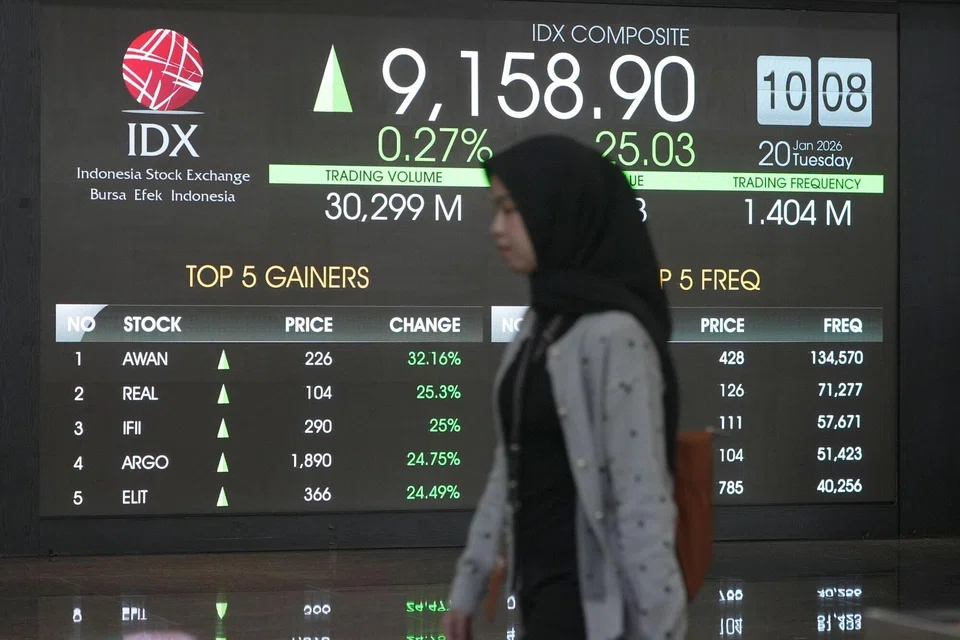
[JAKARTA] Jakarta stocks tumbled on Wednesday (Jan 28) after global index provider MSCI said that it would pause certain index adjustments for Indonesian companies, citing unresolved concerns over tightly held ownership structures.
The market opened in jitters with the benchmark Jakarta Composite Index plunging nearly 7 per cent, with heavyweight stocks from state-owned banks and companies linked to major conglomerates, under significant selling pressure.
The index extended its losses to as much as 8 per cent, prompting the exchange to impose a 30-minute trading halt at 1.34 pm Jakarta time, shortly after the second trading session opened.
Stocks recovered some ground after trading resumed, but still closed 7.4 per cent lower, their steepest decline in nine months.
The sell-off followed a pointed warning from the global index provider, which raised fresh doubts about the investability of Indonesian equities.
In its latest announcement, MSCI said that it would temporarily freeze index treatment for Indonesian stocks amid persistent concerns over free float levels and overall market accessibility.
The decision added to mounting pressure on South-east Asia’s largest economy, where investor sentiment has already been strained by concerns over the government’s fiscal trajectory and increased currency volatility.
In a statement released on Tuesday, MSCI said that it had concluded its consultation on the assessment of free float for Indonesian shares.
While acknowledging some incremental improvements introduced by the Indonesia Stock Exchange (IDX), MSCI noted that the measures fell short of addressing the core concerns of global investors.

MSCI cautioned that inadequate progress on transparency by May could prompt a review of Indonesia’s market accessibility, potentially slashing its weight in the MSCI Emerging Markets Index and paving the way for a downgrade to frontier-market status.
Gary Tan, a portfolio manager at Allspring Global Investments, pointed out that MSCI’s announcement could trigger near-term selling pressure in Indonesian equities.
“How Indonesia responds will be a key test of its broader capital-market reform agenda, and an opportunity to reaffirm its commitment to transparency, stronger corporate governance and attracting stable, long-term foreign investment flows,” he said.
Nafan Gusta, senior market analyst at Mirae Asset Sekuritas, cautioned that a potential MSCI downgrade of Indonesia to frontier-market status could trigger capital outflows of as much as 40 trillion rupiah (S$3 billion). “What remains a key concern is whether Indonesia can address the transparency issues flagged by MSCI,” he said.
The decision follows MSCI’s proposal to tighten its definition of free float for Indonesian stocks, a key factor in benchmark weightings.
MSCI said that it may use alternative data to assess true free float, warning that lower-than-reported levels could force passive funds to cut holdings.
Free float has become a concern in Indonesia, where investors say many large companies are thinly traded and tightly controlled by a small group of wealthy shareholders, exacerbating volatility and increasing manipulation risks.
An IDX spokesperson said that, following MSCI’s announcement, regulators and market institutions would continue to engage with the index provider.
“Previously, we enhanced disclosure by publishing free float data on the IDX website,” the spokesperson said. “However, if MSCI considers this insufficient, we will continue discussions on data transparency in line with MSCI’s proposals, with the aim of reaching a mutual understanding.”
Andrey Wijaya, head of research of RHB Indonesia, said that without clearer visibility on ultimate beneficial ownership and concentration, valuation re-rating is likely to stay constrained despite improving corporate fundamentals. “The May 2026 review represents a critical milestone.”
Decoding Asia newsletter: your guide to navigating Asia in a new global order. Sign up here to get Decoding Asia newsletter. Delivered to your inbox. Free.
Copyright SPH Media. All rights reserved.
TRENDING NOW

DBS, OCBC, UOB rout lops billions off STI as inflation, rate concerns spook investors

Grab CEO’s wife Chloe Tong on life with Anthony Tan and finding her purpose

OCBC sheds S$8 billion in value as shares close nearly 6% down; analysts cautious on banks

Deal between tycoon friends sparks scrutiny of Philippine power sector

