



Indonesia’s central bank holds rates steady, focuses on foreign-exchange stability
The rupiah’s weakening after the US elections has prompted Bank Indonesia to take a more cautious approach to interest-rate cuts

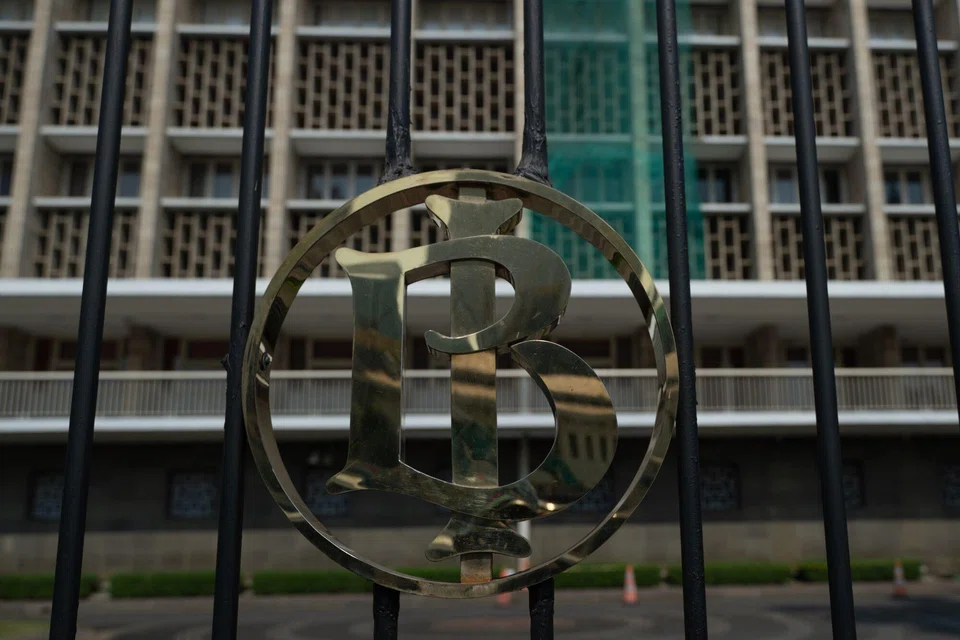
[JAKARTA] Bank Indonesia (BI) kept its key interest rate unchanged at 6 per cent at its meeting on Wednesday (Nov 20), with the aim to stabilise the rupiah amid the currency’s post-US election slump.
Analysts, however, warn that the central bank’s room for further rate cuts is becoming increasingly limited.
BI’s decision, in line with the expectations of economists surveyed by Bloomberg, marks the central bank’s second consecutive month of keeping its benchmark interest rate steady. This was after a 25-basis-point cut in September, a move aimed at stimulating economic growth.
The central bank also left the overnight deposit facility and lending facility rates at 5.25 per cent and 6.75 per cent, respectively.
Once dovish on the prospect of rate cuts this year, BI has adopted a more cautious stance in response to the rupiah’s fluctuations over the past month amid evolving global dynamics.
BI governor Perry Warjiyo emphasised the central bank’s commitment to safeguarding the rupiah, as global economic volatility intensifies in the wake of Donald Trump’s re-election as US president.
He highlighted concerns over Trump’s inward-focused and protectionist stance, warning that it could deepen trade fragmentation and stall the decline in US inflation.
This scenario, he added, could significantly limit the Federal Reserve’s ability to lower interest rates further.
“The outlook for the (US) dollar, interest rates, and global capital flows has shifted rapidly due to geopolitical dynamics in the US,” Warjiyo said at a press conference.
As a result, he noted, “BI is refocusing its priorities on maintaining stability”.
He also expects the Federal Reserve to reduce its interest rate by 25 basis points this December, with two more cuts of 50 basis points next year – significantly lower than BI’s previous forecast of a 100-basis-point reduction.
As the Federal Reserve’s room to cut interest rates narrows, analysts believe BI will face similar constraints in adjusting its own rates.
Narrowing room
David Sumual, senior economist at Bank Central Asia, predicts that BI’s ability to reduce rates will become increasingly limited. “This is due to the Fed’s rate expectations staying steady following Trump’s re-election,” he told The Business Times.
Satria Sambijantoro, head of equity research at Bahana Sekuritas, observes that with the greenback strengthening and the US economy in a “no-landing” scenario, further rate cuts by the Indonesian central bank this year are unlikely.
“Our forecast for the BI rate is 5.5 per cent for next year, with two 25-basis-point cuts – one in the first half and one in the second half of 2025 – assuming a technical pullback in the dollar index early next year,” he wrote in a note.
Meanwhile, Josua Pardede, chief economist at Bank Permata, suggested that BI still has room to lower the rate by 25 basis points to 5.75 per cent next month, with an additional 25-basis-point cut to 5.5 per cent expected in 2025.
While Indonesia’s inflation held steady within the central bank’s target range at 1.7 per cent last month, BI now grapples with the challenge of stabilising the exchange rate, as Trump’s re-election leaves the future trajectory of the US economy uncertain.
The rupiah, like many other emerging-market currencies, slipped as the US dollar strengthened across the board.
Global investors shifted their portfolios back to the US in the wake of the early November elections, further dampening demand for the rupiah.
By mid-November, the currency had weakened by 0.84 per cent compared to the previous month, trading at 15,870 against the US dollar on Wednesday afternoon after the BI rate decision.
BI hinted at a more proactive use of SRBI, Bank Indonesia’s rupiah securities instrument, to attract foreign capital and bolster rupiah stability.
During the latest auction on Nov 8, the central bank absorbed 30 trillion rupiah (S$2.5 billion) through SRBI – the highest liquidity uptake in four months – offering an average 12-month yield of 7.04 per cent.
Supporting growth
While BI’s primary focus is on exchange-rate stability, Warjiyo said that the central bank will continue to support economic growth through other macroprudential measures, such as offering liquidity incentives to encourage banks to extend credit.
By October, BI had channeled 256 trillion rupiah in liquidity incentives to national banks, aiming to boost credit flow, especially to key sectors such as agriculture and housing.
The central bank projects credit growth to hit 12 per cent this year, fuelled by a surge in investment and working-capital financing.
Overall, the central bank projects that South-east Asia’s largest economy will grow between 4.7 and 5.5 per cent this year, with expectations for a pickup next year.
TRENDING NOW

Government to bring forward raising of retirement age, give employers more financial support to create flexi-load jobs

If Europe goes to war, the fallout will be felt in East Asia

Former minister Maliki Osman, Revolut chairman join Asia Gulf Holdings advisory board

Small nuclear reactors could boost the Asean Power Grid: GE Vernova executive

