



Indonesia’s dual citizenship push to combat brain drain, talent shortage: analysts
While its diaspora rallies behind the idea, dual nationality may not be a cure-all for the country’s talent woes


[JAKARTA] Indonesia’s professional diaspora has cheered the prospects of dual citizenship as South-east Asia’s largest economy mulls the move to lure its citizens back home, although experts caution that this alone will not solve the country’s acute digital talent shortage.
Granting dual citizenship to the skilled workers diaspora could be a much-awaited game changer for the Indonesian economy amid a rapid growth in the digital era, said Sulistyawan Wibisono, president of the Indonesian Diaspora Network (IDN) Global.
The plan to amend the dual citizenship law is set to be discussed between the Indonesian government and parliament, said Wibisono, an Indonesian lawyer based in Melbourne.
“But it’s still unclear when the policy will be legalised as Indonesia will see changes in members of parliament and government in the third quarter of this year,” he told The Business Times.
IDN Global, a platform that connects and engages the Indonesian diaspora community worldwide and contributes to the country’s progress, has been advocating for dual citizenship since 2012.
“The idea initially emerged to advocate for the Indonesian diaspora who were forced to change citizenship due to job demands that need cross-border mobility,” Wibisono said.
In addition, he said the limited visa-free travel options for Indonesian citizens can be a headache, particularly for those travelling for business.
He also noted that foreign nationals of Indonesian descent face a cumbersome permit process due to stringent licensing procedures when trying to open businesses and invest in Indonesia.
“Dual citizenship would simplify this, making it easier for them to invest,” he said.
Bloomberg reported this week that Indonesia’s plan to enable dual citizenship is getting traction with the government hosting a meeting in early May with associations representing Indonesians abroad and families with mixed nationalities to gather input on such a plan.
Indonesia’s law does not recognise dual citizenship for adults. Children of Indonesian and non-Indonesian parents may hold two passports until they turn 18, after which they have three years to register their preferred citizenship.
Rabiatul Adawiyah, a 28-year-old data analyst who’s been based in the Polish capital Warsaw for almost five years, is among some eight million Indonesians living abroad.
“In Poland, I have plenty of opportunities to work for multinational companies in Europe, which offer better salaries and exposure to diverse cultures compared to Indonesia,” she told BT.
She plans to apply for permanent residence next year, which could be a gateway to Polish citizenship down the road.
However, she doesn’t dismiss the possibility of returning to Indonesia one day and contributing to the development of her hometown in Lombok, West Nusa Tenggara. If that happens, a dual citizenship would alleviate the burden of dealing with immigration documents again.
“I’m still young, and I don’t know what the future holds. But this dual citizenship policy will give me more flexibility to pursue my plans,” she said.
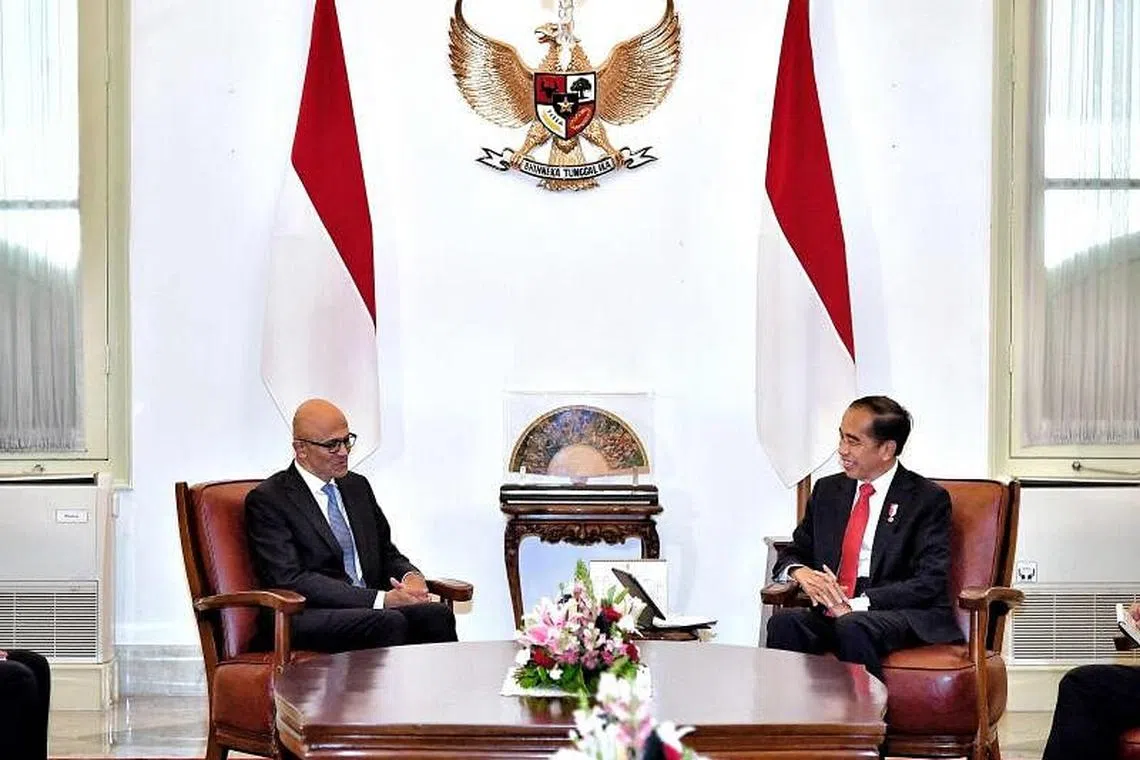
Coordinating Minister for Maritime Affairs and Investment Luhut Pandjaitan proposed the dual citizenship plan ahead of a meeting between President Joko Widodo and Microsoft chief Satya Nadella, whose company has pledged a US$1.7 billion investment in Indonesia.
Attracting talent and investment from the Indonesian diaspora and the international tech community is key to advance the country’s goal of becoming a high-income nation by 2045.
Google, Temasek and Bain & Company predict that Indonesia’s digital economy will reach US$109 billion by 2025 and US$360 billion by 2030.
As substantial foreign investment floods into the digital sector, Indonesia is grappling with scarce skilled information and communications technology workers.
A survey by the East Ventures-Digital Competitiveness Index 2022 predicts the country needs around 600,000 digital talents every year, which alludes to a major gap based on current supply.
Across the Asia-Pacific region, it is predicted that there will be a shortage of 47 million digital talents by 2030.
Even so, experts caution that enabling dual citizenship is not a silver bullet to address Indonesia’s brain drain.
Nailul Huda, director of digital economy at the Center of Economic and Law Studies, called for Indonesia to create a work ecosystem on par with international standards, including offering competitive salaries.
Currently, the average salary for tech workers in Indonesia is relatively low compared to other countries, a major push factor.
According to data from consultancy Michael Page’s latest salary guide, the average salary for tech workers in Indonesia is about US$51,000 per year. This figure is notably lower than that of tech workers in Singapore, which ranges from US$100,000 to US$200,000 per year.
Singapore remains a preferred destination for Indonesian citizens seeking employment according to the Indonesia Immigration Office. Between 2019 and 2022, nearly 3,200 Indonesians acquired Singapore passports, often driven by better career prospects and significantly higher salaries.
In August last year, Indonesia introduced a golden visa policy designed to lure foreign investors and top-tier talent to the country. However, the policy garnered less attention than expected, with the Immigration Office reporting only 270 applications out of the targeted 1,000 applicants.
The concept of dual citizenship has long been debated extensively in Indonesia, with proponents arguing that it would help attract and retain skilled workers, improve economic competitiveness, and enhance national unity.
On the other hand, lawmakers have raised concerns about dual citizens being influenced by foreign powers or accessing sensitive information due to their multiple citizenships.
TRENDING NOW

Ex-Nvidia CEO Jensen Huang carried a secret for more than a year. It led to his downfall

South-east Asia has lost Nvidia’s best salesman

Demand, tech capabilities position Apac and AI as Skyscanner’s next growth frontiers: CEO Bryan Batista

Jensen Huang discusses comeback as Nvidia CEO with allies: report

