



Indonesia’s illiquid stock market churning out 1,000% stock gains
 Add BT as a preferred source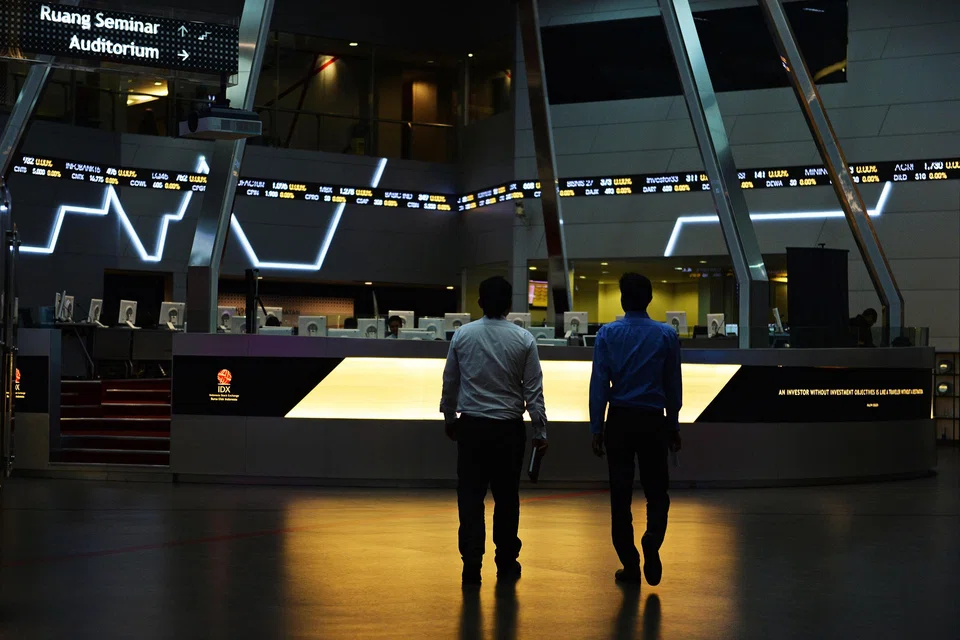
DeeperDive is a beta AI feature. Refer to full articles for the facts.
UNEXPLAINED gains in Indonesian stocks are fuelling calls for tighter regulation in South-east Asia’s biggest equity market.
Known as “deep-fried” shares among local traders, they often have concentrated ownership, low trading volume, scant analyst coverage and elevated valuations relative to peers. In the past three years, at least 83 Indonesian companies have swung by 1,000 per cent or more from peak to trough, according to data compiled by Bloomberg. That is about 10 per cent of total stocks listed, a higher proportion than in neighbouring Thailand, Malaysia, Singapore, Vietnam and the Philippines.
While wild stock swings for illiquid shares are nothing new in emerging markets, the moves have become so extreme in Indonesia that regulators on Monday (Jun 12) introduced a new watchlist board to quickly spot what they perceive as troubled companies, as a way to protect investors.
The list will include firms with no revenue growth, low share prices, thin liquidity and which are undergoing debt restructuring, among other factors. Some traders are pushing for the authorities to do even more, while President Joko Widodo has urged regulators to boost supervision of possible market manipulation.
At stake is investor confidence in a nearly US$640 billion stock market that has become so illiquid that it has forced some companies to resort to higher-cost bank loans as a way to raise capital. The International Monetary Fund said in a report last year that Indonesia’s “shallow” financial markets are a long-standing challenge for growth. The ratio of the nation’s stock market cap to gross domestic product is also the lowest among South-east Asian peers.
“We need the regulators to step in,” said Jerry Goh, an investment manager covering Asian equities at Abrdn Asia.
Navigate Asia in
a new global order
Get the insights delivered to your inbox.
Not all shares that are volatile are considered deep-fried stocks, though traders have expressed confusion over the growing levels of big swings. The results of the gains have minted or propelled the wealth of a handful of ultra-wealthy tycoons. Low Tuck Kwong, a billionaire who controls Bayan Resources, became one of Asia’s richest men after shares shot up more than 220 per cent over six weeks at the end of 2022. A nearly 14,000 per cent surge in shares of DCI Indonesia in the five months after its debut in early 2021 propelled majority owners Otto Toto Sugiri and Marina Budiman into billionaire status.
Representatives at both Bayan and DCI declined to comment. Low and Sugiri did not respond to a request for comment. Budiman told Bloomberg in a text message that she was unaware about the gyrations of DCI’s share price, and that she could not trade in the stock. In 2021, both she and Sugiri and Budiman pledged not to part with their shares, switching their holdings to untradeable stock. Sugiri had told Bloomberg last year that the move was to show people they were not trying to influence the market.
The Indonesian president cited the extreme swings in shares of Indian tycoon Gautam Adani’s companies when he called for more supervision, in a speech to Indonesia’s financial regulator in February. In a case that has drawn global interest, Adani’s flagship company soared by more than 3,300 per cent between March 2020 through the end of last year, and then lost half its value in the wake of a short-seller report alleging market manipulation and accounting fraud. Adani has repeatedly denied the allegations.


The Indonesia Stock Exchange has already imposed intraday trading limits and automatic rejection of certain bids and offers if they veer too far away from the asking price. Meanwhile, the financial services authority uses monitoring tools like trading halts or suspensions to cool any unusual market activity, said capital market supervisor Inarno Djajadi. Still, neither the exchange nor the regulator have indicated how they plan to filter and investigate anomalies among the about 800 stocks in the country.
Some investors have developed a nickname for stocks that make eye-popping gains after a rush of buying and selling that later dies off. The Chinese call it chao gu, or stir-frying stocks – a reference to rapid speculation that keeps such shares “hot”. Indonesians have borrowed the concept, referring to such firms as saham gorengan, or deep-fried stocks. One way to describe this cohort is akin to how food of suspect quality tastes better fried.
The term became synonymous with the spectacular collapse of state insurance giant Asuransi Jiwasraya in 2020. The company needed a government bailout after investment into risky stocks – a violation of management guidelines that resulted in a gaping US$2 billion financial loss.
One of Jiwasraya’s stock investments was in a company called Hanson International, the shares of which surged more than 1,700 per cent during the lows of the financial crisis through 2016, before a series of swift declines.
In late 2020, a court handed a life sentence to Hanson International president Benny Tjokrosaputro, for charges related to corruption and money laundering. Indonesia’s Supreme Audit agency called the company a “deep-fried stock”, validating investors’ fears of such rapid-rise shares, reported the magazine Tempo. The agency did not respond to multiple requests for comment. Hanson is no longer in operation.
The Indonesian bourse in 2021 investigated DCI on possible transaction manipulation, but did not disclose results of its investigation. The firm’s corporate secretary told Bloomberg at the time that there was no indication of violations by the company. DCI is trading at more than 200 times price-to-earnings, with a price-to-book ratio based on latest quarterly results at over 50 times, down from a high of 153 during 2021.
When shares of coal miner Bayan Resources surged to a record high at the end of December, shareholder Low Tuck Kwong purchased more of the stock, according to an exchange filing. Prior to the surge, Low’s net worth was US$5 billion, about one-fifth of his total today. Bayan is trading at 16 times price-to-earnings, higher than all of its regional peers. Its free float sits at 2.5 per cent, lower than the exchange’s threshold of 7.5 per cent.
The puzzling share price moves are weighing on analysts trying to avoid covering companies that could gain notoriety for being out of sync with reality. “We cannot cover stocks if there’s not enough information and fundamentals to support our research,” said Andrey Wijaya, head of research at RHB Sekuritas Indonesia, in relation to a number of wild price swings.
Petrindo Jaya Kreasi, which is involved in coal and gold mining, gained nearly 370 per cent within seven weeks of its debut in early March. That was a windfall for its main shareholder and business magnate Prajogo Pangestu.
A week after the company debuted, the stock exchange flagged unusual activity in the trading of its shares. The company has no analyst coverage, noted Bloomberg data, and its price-to-book ratio based on the latest quarterly results was at 6.6 times. A company representative did not respond to a request for comment, and Pangestu declined to comment.
Indonesia’s bourse has worked to increase transparency of its markets, including creating special lists to monitor unusual activity. It also actively talks to companies about significant swings and tries to investigate anomalies. Still, progress appears to be slow, and the results, minimal, said John Rachmat, senior advisor at Singapore-based Pinnacle Investment. “After so many decades, it’s still a dead end,” he said of regulators’ efforts to curb volatility.
Wild market swings gained notoriety in the US last year, after a number of micro-cap stock debuts gave way into dizzying rallies. Those include Chinese garment manufacturer Addentax Group, which soared 13,000 per cent on its trading debut last year; Hong Kong financial group AMTD Digital surged some 32,000 per cent. Representatives at both firms did not respond to a request for comment.
China and Hong Kong have at times been known for dramatic price volatilities too. Over the past three years, some 14 per cent of Hong Kong shares have swung more than 1,000 per cent.
But there is potentially more at stake for Indonesia, a market that is still a fraction of China and the US’, and is trying to attract more investors to help boost its economy. “Low liquidity can be both a boon and a bane, and investors don’t want to be caught holding a low-liquid, low-quality stock,” Abrdn’s Goh added. BLOOMBERG
Decoding Asia newsletter: your guide to navigating Asia in a new global order. Sign up here to get Decoding Asia newsletter. Delivered to your inbox. Free.
Share with us your feedback on BT's products and services
TRENDING NOW
‘Boring’ is the new black: The stars are aligning for a Singapore stock market revival

Near sell-out launches in March boost developer sales to 1,300 units after four slow months

China pips the US if Asean is forced to choose, but analysts warn against reading it like a sports result

Genting Singapore’s Lim Kok Thay receives S$7.5 million pay package for FY2025

